Masters Dissertation – Milestone 7

Milestone 7
Die bangste bobbejaan spring die verste…
(Studio Fairy,2011)

*
The end draws near… With only a few weeks left to go we have handed in our documents, as they are, to our external examiners and are all now in damage control mode; fixing everything we can as much as we can with the time we have left. The term ‘Architectural Triage’ comes to mind as the best way to describe how the work ethic is currently being done.
The Final Crit
How are final presentation works is as follows, our final marks are broken into two subjects:
DIT – Technical Design and  DPD – Design (Theory, Process, Concept e.t.c )
The marks are awarded by a panel made up of 12 or so internal and external jury members chosen by the school. Each mark is made up of 25% from your study leader, 25% from your individual external, 25% from the external panel and 25% from your internal panel as whole. Our actual document, which occupies 50% of your year time, actually counts for nothing, but is used by your study leader and external examiner to understand your project.
The judging takes place over 3 days in Boukunde, and each person is given a 10 minute shared slot to present their framework with their group, a 30 minute slots to present DPD (Design) and a 30 minute slot to present DIT (Technical): 5-8 minutes to explain your project, 10 minutes to answer questions from your external, and the rest of the time to answer questions from the panel.
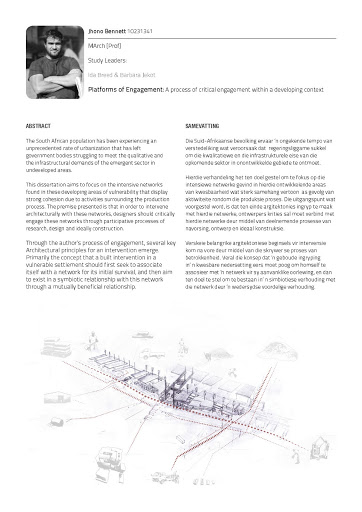
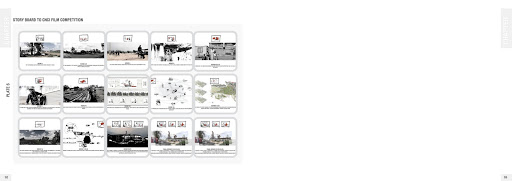
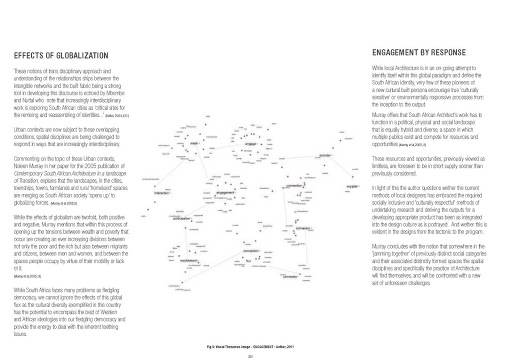
The entire panel receives a small booklet made of single pages such as the one below:
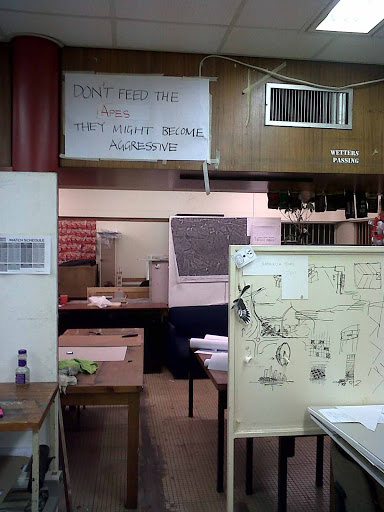
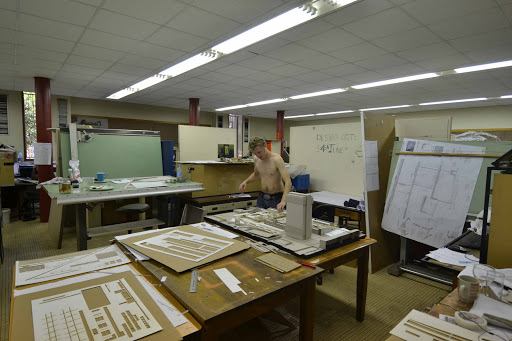
This is an extremely stressful time of the year, as times slots are tightly followed and the entire building, specifically the masters studio, is a fury of nerves and stress induced energy – waiting to snap.
My Half of the studio – my desk by the window
We had two stress related incidents this year, one heart attack mimicking panic attack and another a bit more serious, both taking place in the studio. Its quite an amazingly powerful how the mixture of sleepless nights, unhealthy mental and physical living conditions and one all consuming in one small environment can manifest.
Our symbol of the Studio Stress, those involved will understand
Friends will be at each other throats over music volume issues, laughter that once were not even registered will tear at your mind like nails on chalkboard, self preservation takes hold as you find yourself holding back, out of fear, information or resources that you know would benefit others, but you might need at some stage – people’s personalities will reveal their true form.
Conversely stress will also reveal the weirder side to the studio as we experienced:
Our conversion into animalism…
Our lack of clothing boundaries…
The source of my wisdomous quotes
Self explanatory
Read closely…
No explanation required

The Great Koffee Off; it may sound lame – ok it is – but we kept track of how much coffee we drank and made bets as to how much could drink in the year, it got a bit excessive…

The pièce de résistance, our own Darth Laubscher
My Work Space
 
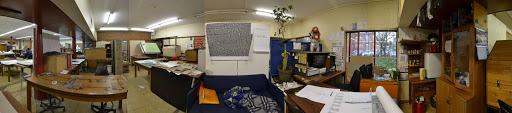
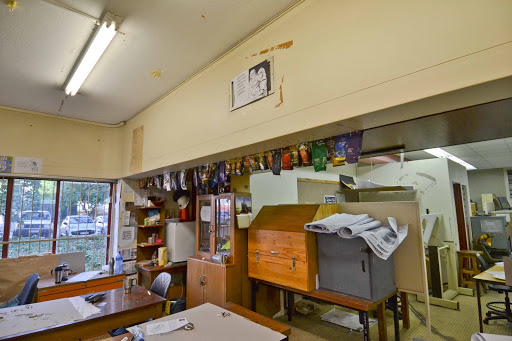
If anyone has been wondering what the conditions in a masters studio are like, below is the spatial atmosphere that has enveloped me all year.
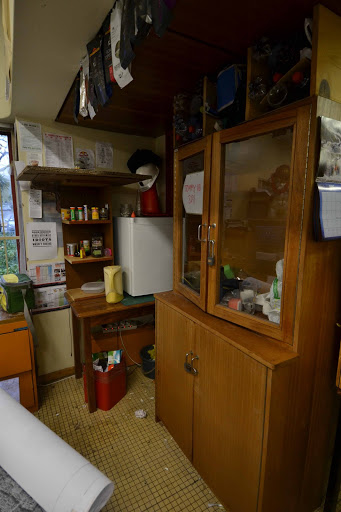
Please note: the couch/bed, touch of greeness in the dying Ficus, Shim standing watch, the supply of foods and other basic living resources by the kettle, the only view of the real world – a small window that nearly caused me hypothermia in winter.

Standard issue studio supplies: energy medicine, coffee, sugar, kettle, fridge stacked with unmentionables, emergency escape room signified by dinosaur emblem. The usual.

Its almost sad to leave this mess of a space, but it must be handed over to the next generation of near suicidal, ego-maniacal, sadistic students we have so wonderfully become.
*
end

Masters Dissertation – Milestone J.1 (Draft 1 Submission of Chapters)

Milestone J.1 (Draft 1 Submission of Chapters) 
                                                            Masters student 1: How’d the presentation go?
                                                            Masters student 2: The only way to describe that, was as a g**g r**e of a crit.
                                                            Masters student 1: I see…
(Studio moment, 2011) 


Final Chapters 
The year’s marks are decidedin your final presentation, You are assigned two external who reads your book before and are present at your final presentation.
Although the book counts for less than the final presentation, it has been an exremely useful tool in organising and explaining the process and my thoughts to myself and my study leaders.
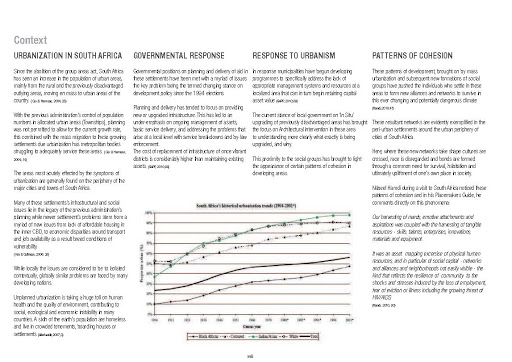
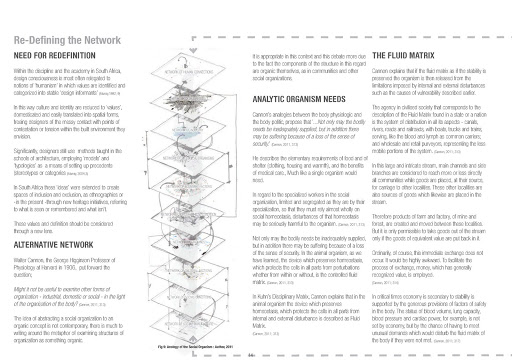
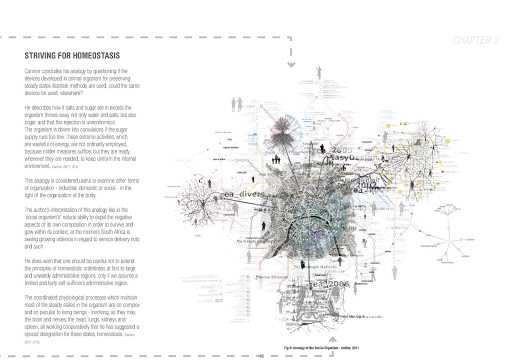
My first complete draft for my dissertation submission. Still havn’t finished chapter 8 or fully rendered the design drawings in chapter 7, but here it is in flash format (give it a few mins if it doesn’t show straight away):
Less than 40 days until the final presentation.
*
End

SWFObject 2 dynamic publishing example page http://scripts/swfobject.jsvar flashvars = {}; flashvars.name=”Dr.Solve” var params = {}; params.quality = “high”; params.menu = “false”; params.scale = “noscale”; params.wmode = “transparent”; var expressInstallSwfurl=”flash/expressInstall.swf”; var attributes = {}; swfobject.embedSWF(“flash/testFlash.swf”, “testFlash”, “250”, “300”, “9.0.0”,expressInstallSwfurl, flashvars, params, attributes);

Masters Dissertation – Milestone 6

Masters Dissertation – Milestone 6 
All Architecture projects in existence are made up of green urban networks of community based structurally adaptive reuse – with a planted roof.
(Studio Banter, 2011)
*

Re Rationalisation

The focus of this milestone was the finalised technical resolution of the design. After, the dismal success of the previous technical crit, a re-evaluation of my concept was required.

The first step was to rationalise the lifting mechanism, and why and how a building should grow.

I looked at the crane, and compared old systems of lifting vs new. Notably, the Shadoof, the Pentapastos and the Capstan stood out as the best systems for non mechanical lifting while the climbing truss used in stage productions.

The next diagram was an exploration of an industrial building vs an organic built warehouse using the Stewart Brand’s breakdown of building to re-order typical industry components.

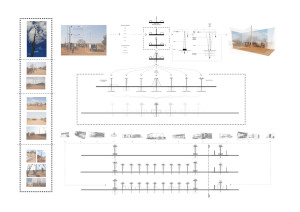
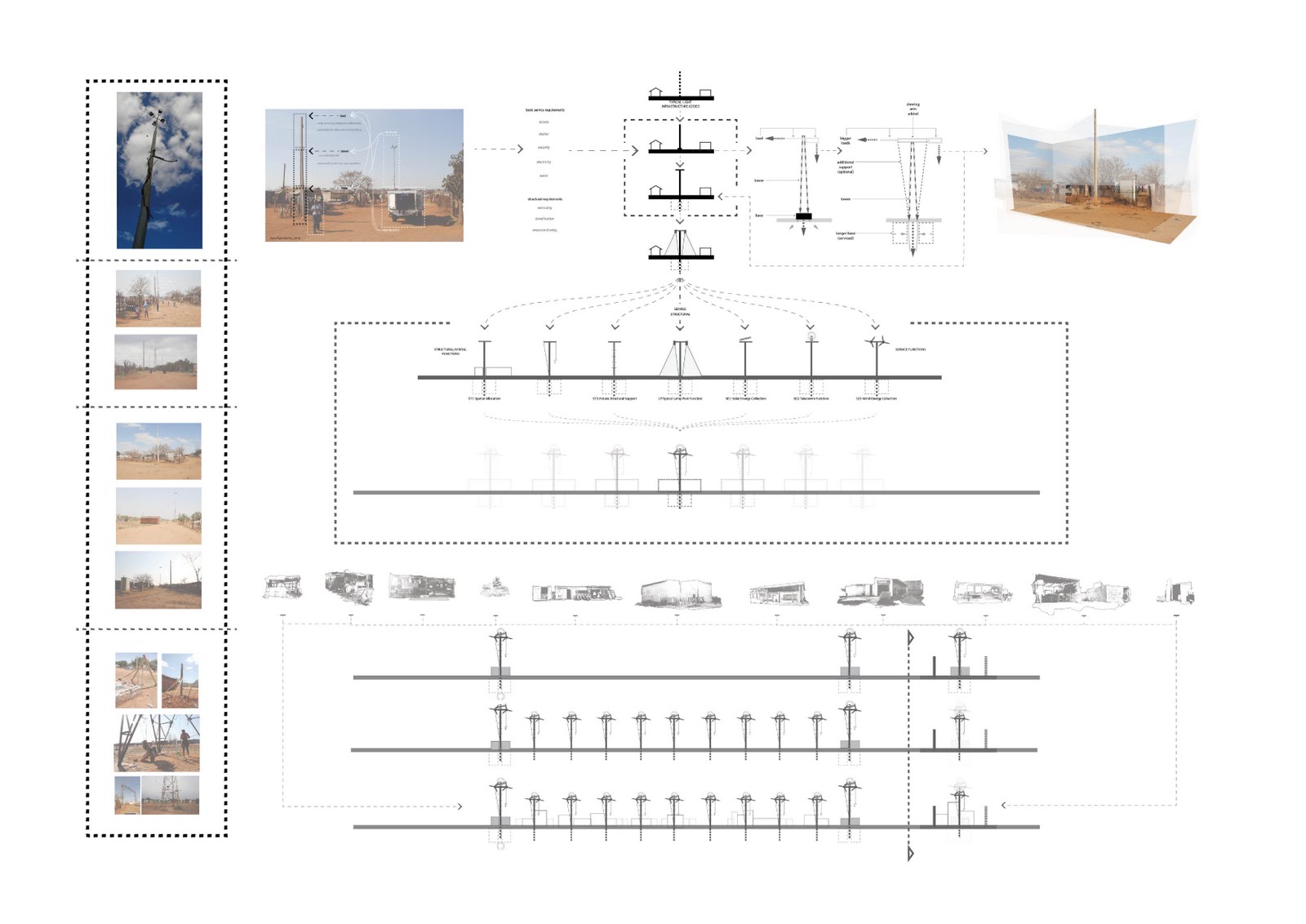
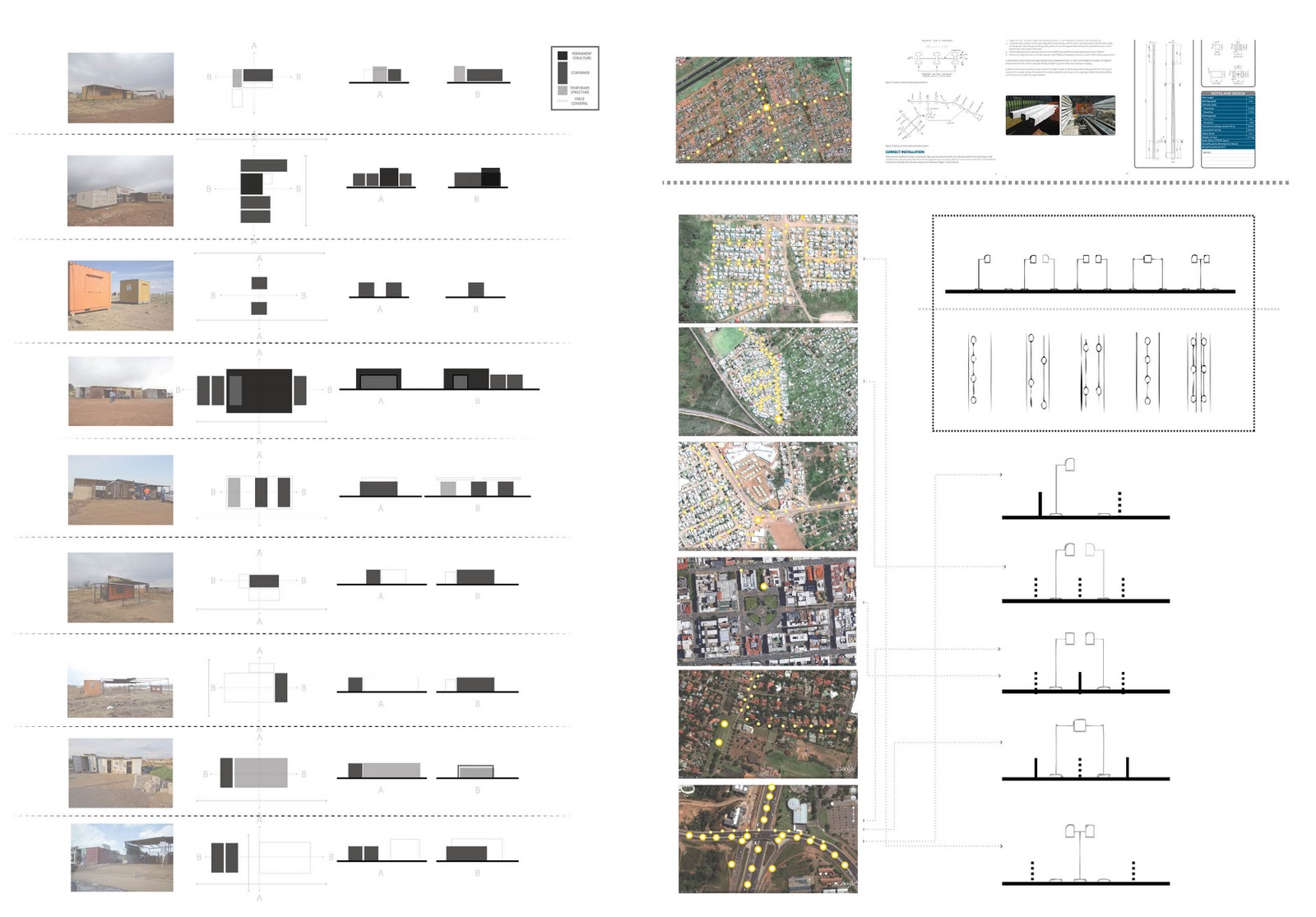
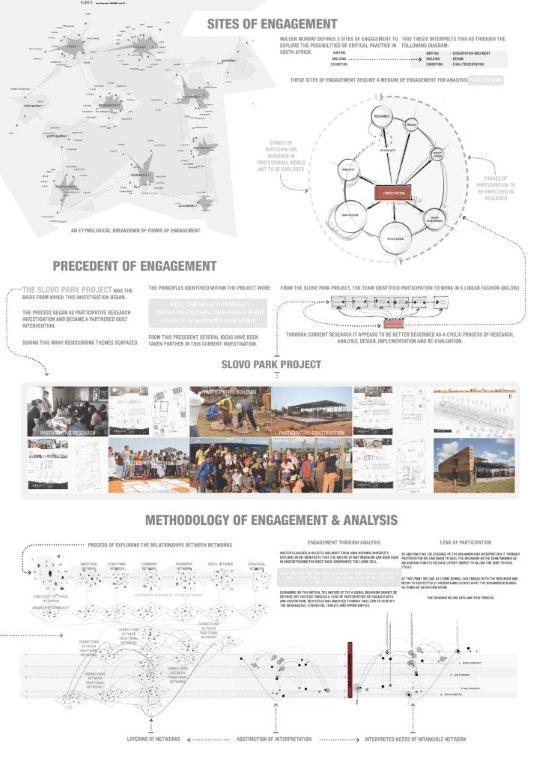
I went back into my research, and looked further into the Slovo Park Project. What came out strongest was the relationship of urban infrastructure in the developing context of townships. Most importantly lamp posts, and the allocation of light for security.
New Scheme
The re-vised premise, seeks to re-interpret the role of the vertical infrastructural member, i.e the lamp post, into a piece of shared urban infrastructure that foster the development of street retail in developing areas.
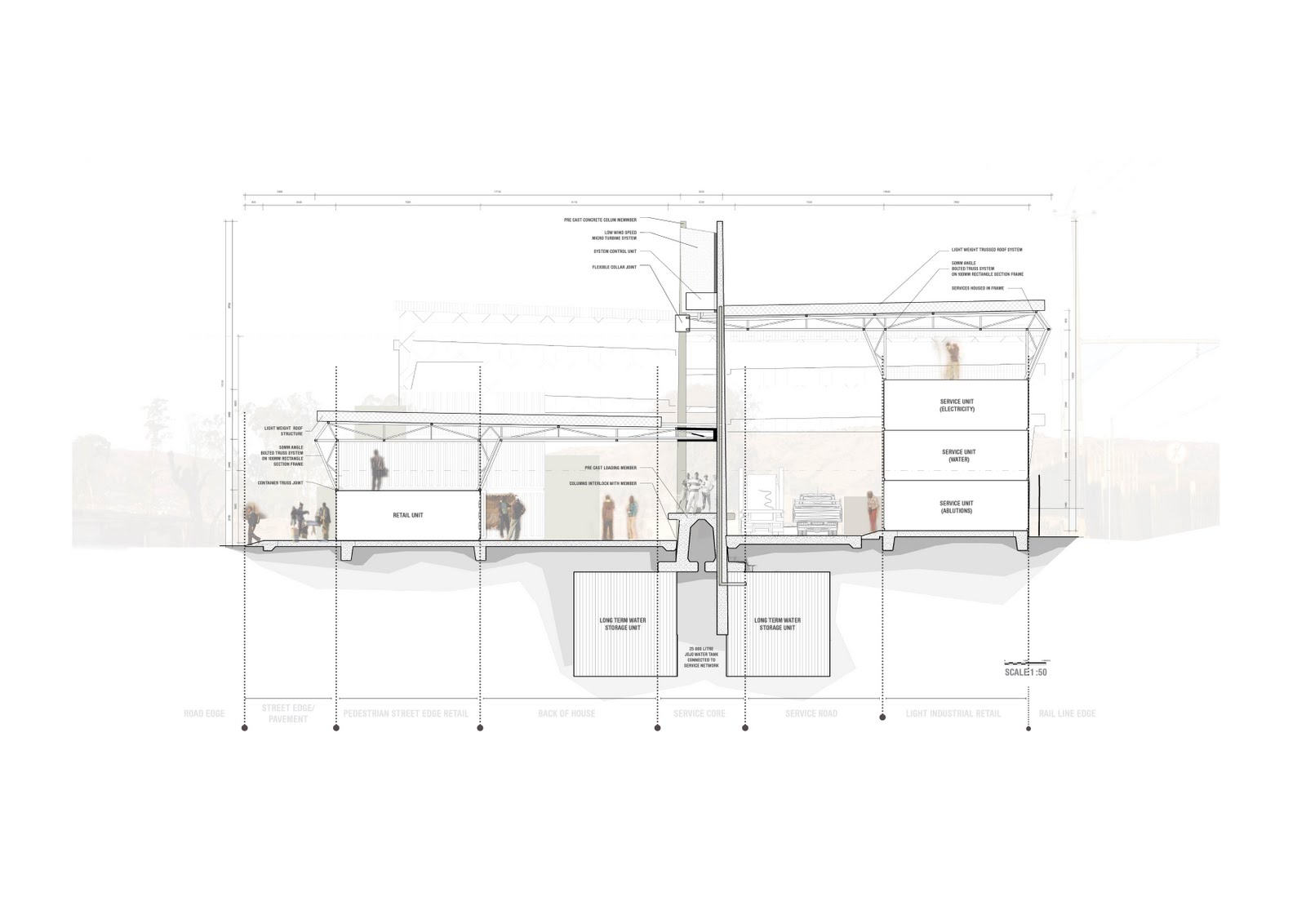
Using pre-cast lamp post design, that inherently responds to edge condition, a multi structural/service lamp post member is introduced and used to ‘grow’ a development.
The process of growth is planned to take place around the lamp post, by placing two major service piece and filling in them in with smaller units to facilitate growth.

Lamp posts were the more appropriate choice as they inherently respond to edge.

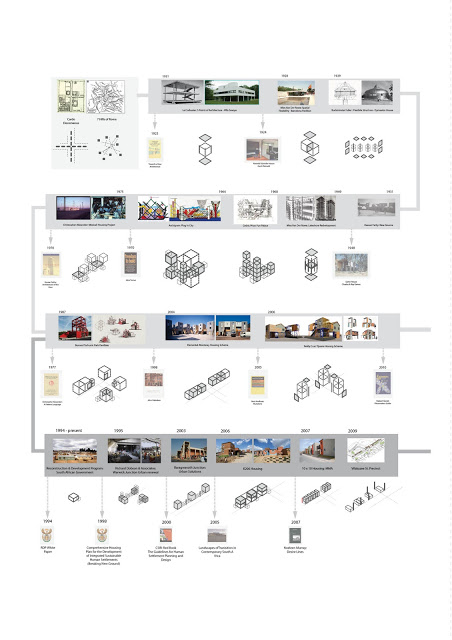
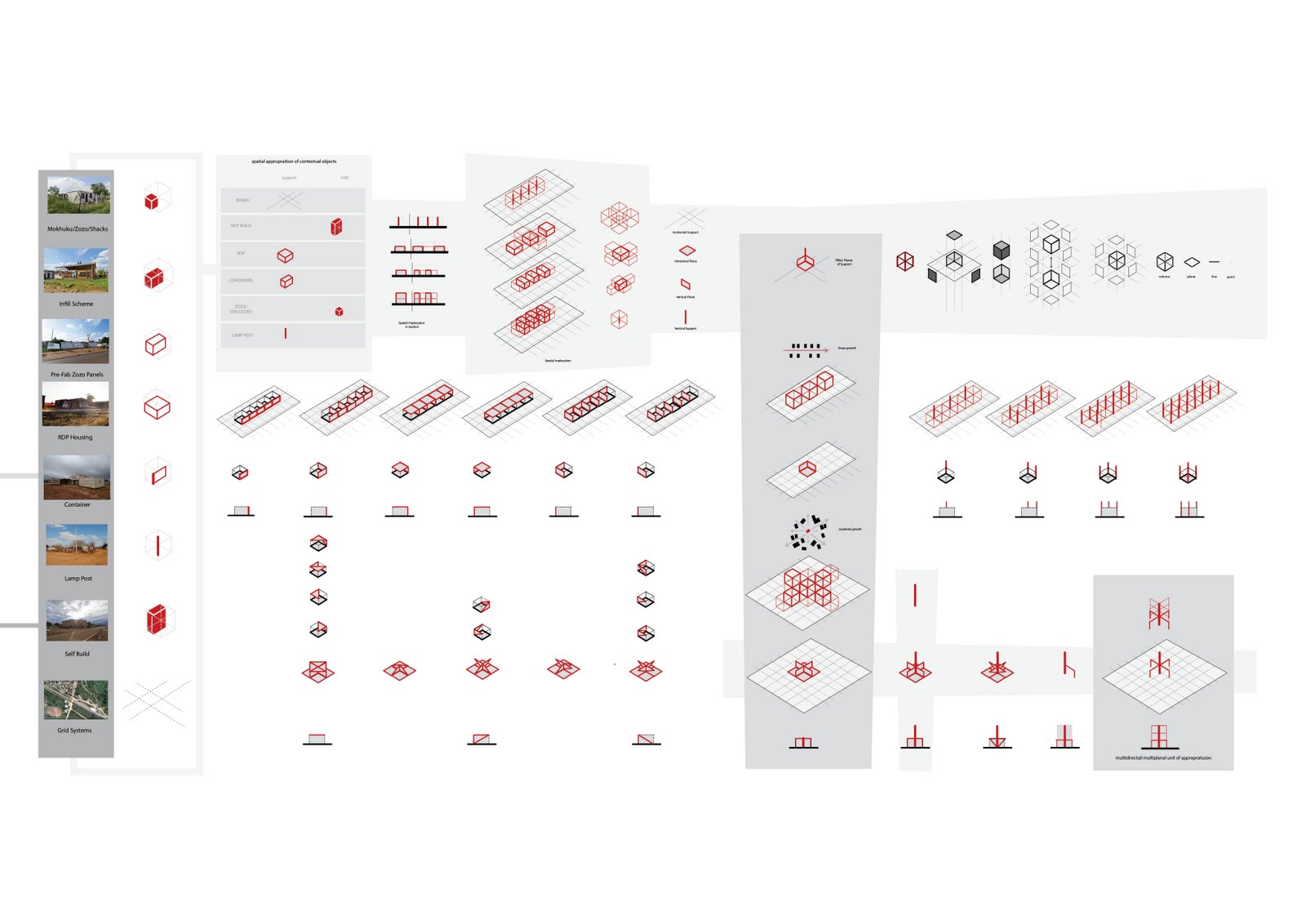
While exploring an appropriate spatial appropriation scheme, I looked back into the history of space, through line, volume and plane. Comparing international examples with local.

 
Applying those principles to Mamelodi, I illustrated the process of arriving at the form for the unit of growth.

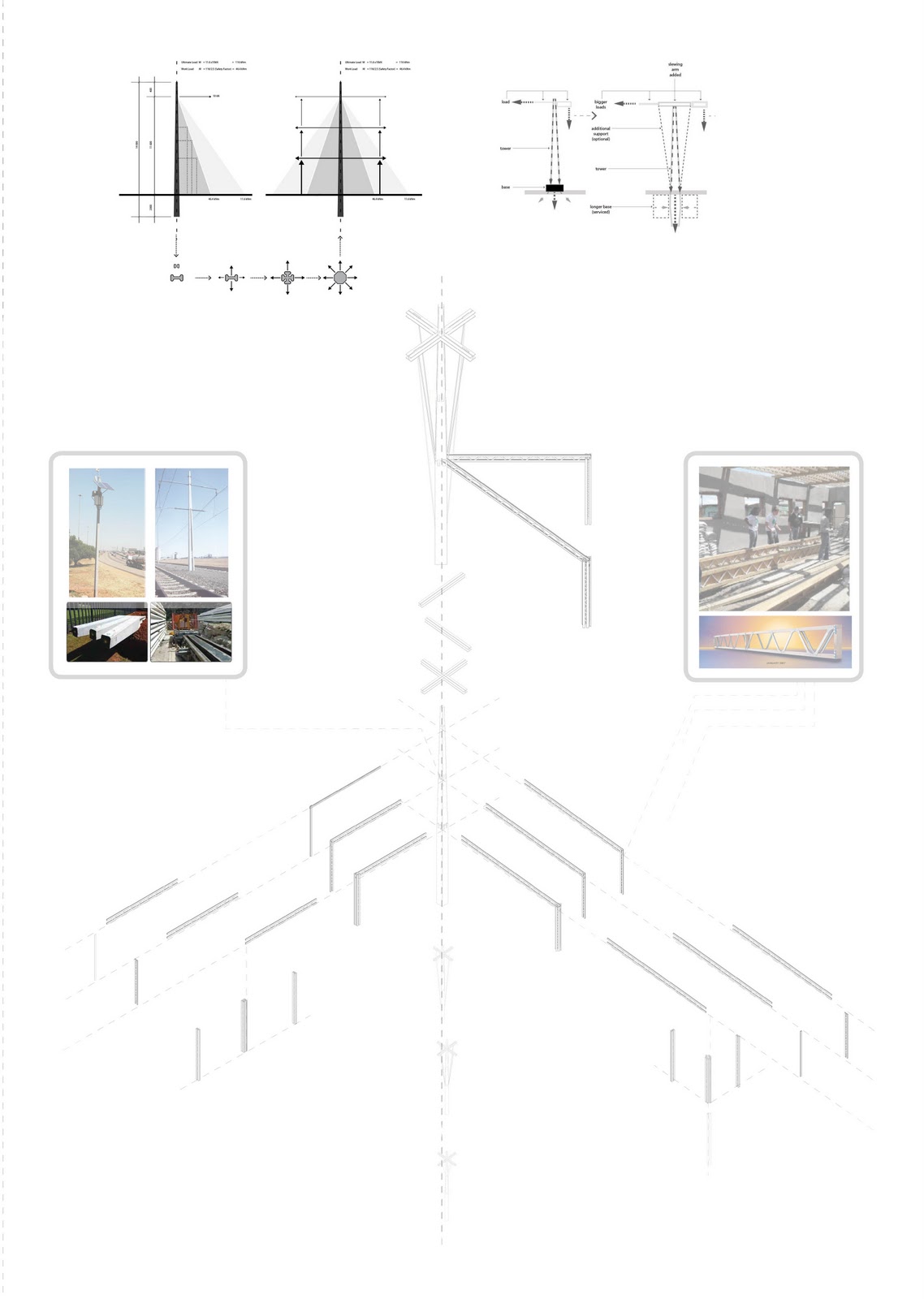
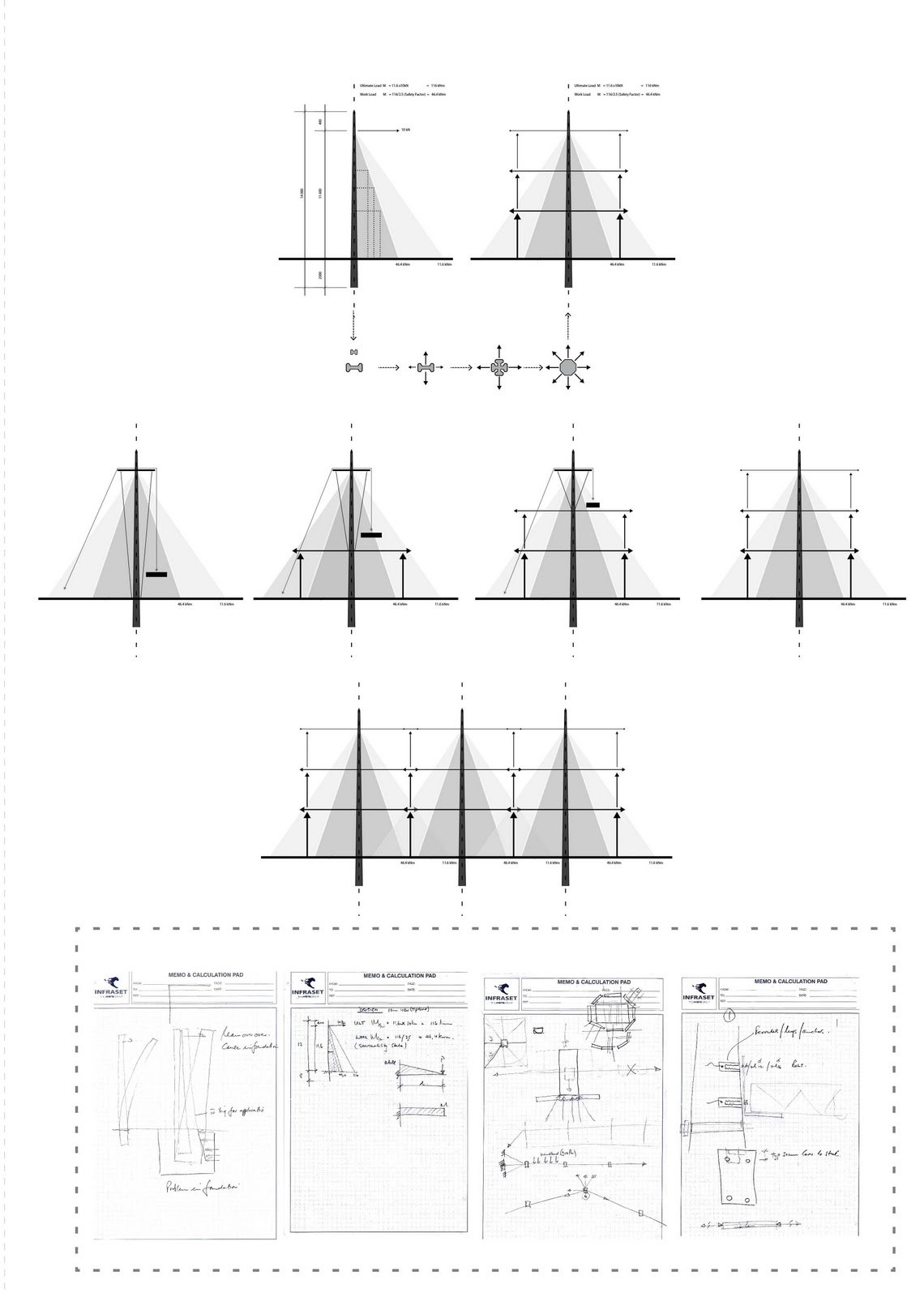
Structurally the form needed changes, and after a discussion with various engineers, I arrived at the form. The idea, being that a typical pre-cast concrete lamp post could be slightly modified to become a structural member by providing lifting opportunity with an additional member.

The typical pattern of growth, allowing for incremental and appropriate growth.

The Technical Resolution
Summary

The final presentation did not go as well as planned, firstly the roof (the only typical architectural element in the project) was not completed in time, and a simple structure was used in the time left.

But the external panel said that the building system was successfully designed, but they couldn’t see what was designed and which was allowed for.

Again, I received another question mark for work, not to worried, its now just a task of finishing up in time for the final presentation.

November 8, here we come.

Masters Dissertation – Milestone 5

 Masters Dissertation – Milestone 5
 
Architectural Emesis 
(Archi Vomiting)

The act of expelling a conceptual idea from the bowels of ones’ mind through the gullet of design 
by the projectile expression of pen to paper. 

Generally occurs prior to major hand ins and other times of design stress.
 
Much like any unpleasant bodily function, the process is not comfortable while happening, but necessary, 
as the contents of one’s mind bowels at times requires outer body inspection in order to achieve conceptual relief.
 
*
Pre – Technical Crit
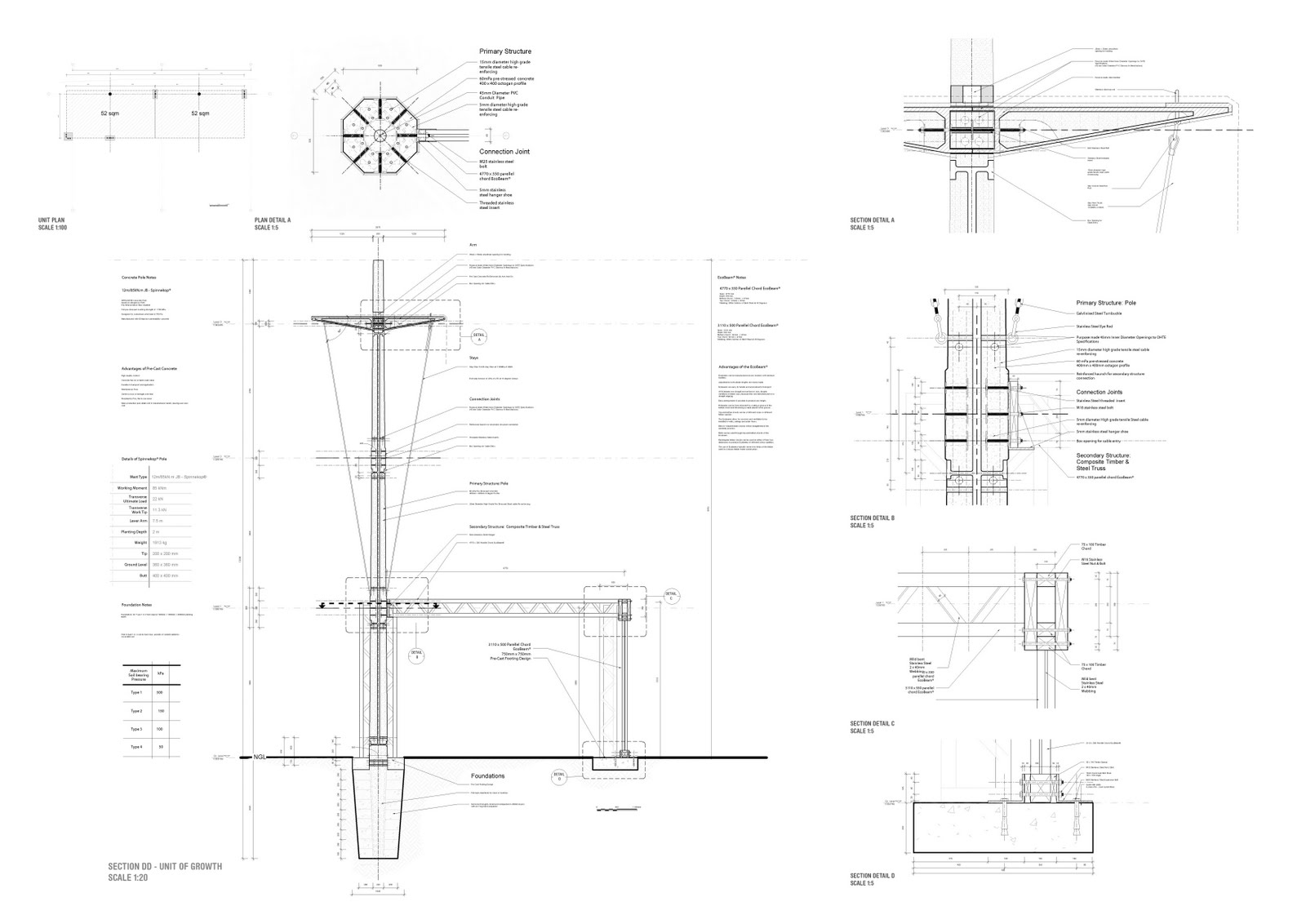
This milestone was shortly placed after Milestone 4 to kick the class into technical gear, the requirements were to begin expressing the design’s technical aspects through a 1:20 section, a 1:100 plan and any accompanying technical diagrams.

My ‘Technical’ Section

I have realised that my design hinges around the Unit of Growth, and how that needs to express the poetry of a Mamelodi Techtonic working with a larger more structural techntonic in order to grow beyond its current limitations.

The roof element is intended to move up, holding the services, while the columns (the containers) support it through its growth.

I was hoping to express the duality of the street edge versus the rail edge, and how this techtonic allows for a dual expression of either.
Ultimately I failed this crit, due to unresolved nature of my detailing. My first fail this year, but warranted as I still have a lot of work ahead of me…
*

Masters Dissertation – Milestone 4

Milestone 4

Student:      The idea of the dissertation is to explore the concept of – 
Lecturer:    – FALCON PUNCH!!!

Student:      …mild post punch groan….

(Die Grobbels, 2011)

*

July offered the brief reprieve of a 2 week break from the Masters Year. I spent the holiday in the Cape, attending the national arts festival and getting some down time with the family in Cape Town.
The break was absolute necessity. After 20 weeks of constant dissertation thought and talks, some ‘human’ time is required.

The first day back we hit the ground running, as Milestone 4 loomed ominously overhead.

This was the last pure design milestone, and was labelled as the decider: if we did not have enough work to the lecture re’s satisfaction, then we would be told to extend to the following year.

No pressure…

The Submission

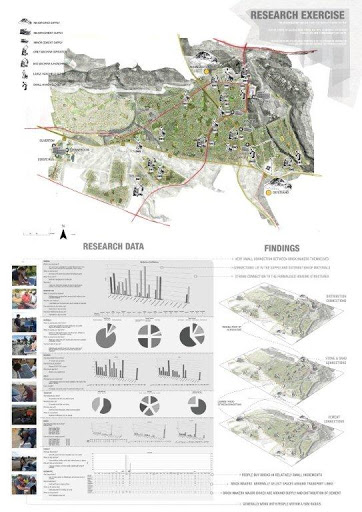
I kept the presentation the same for the analysis work, and spent my time resolving the design. Pages and pages of sketch plans, sections and details later I quickly through together a presentation.

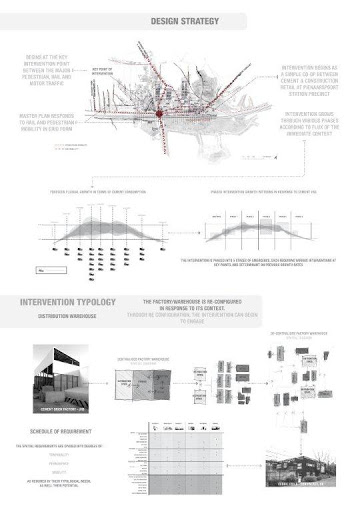
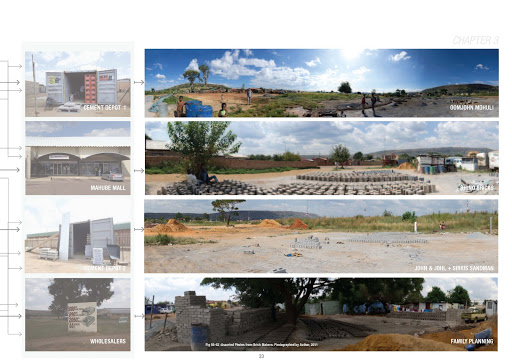
The program is now a distribution depot for cement, and later other goods, made up of support infrastructure that provides the necessary elements to allow for a growth of appropriation.

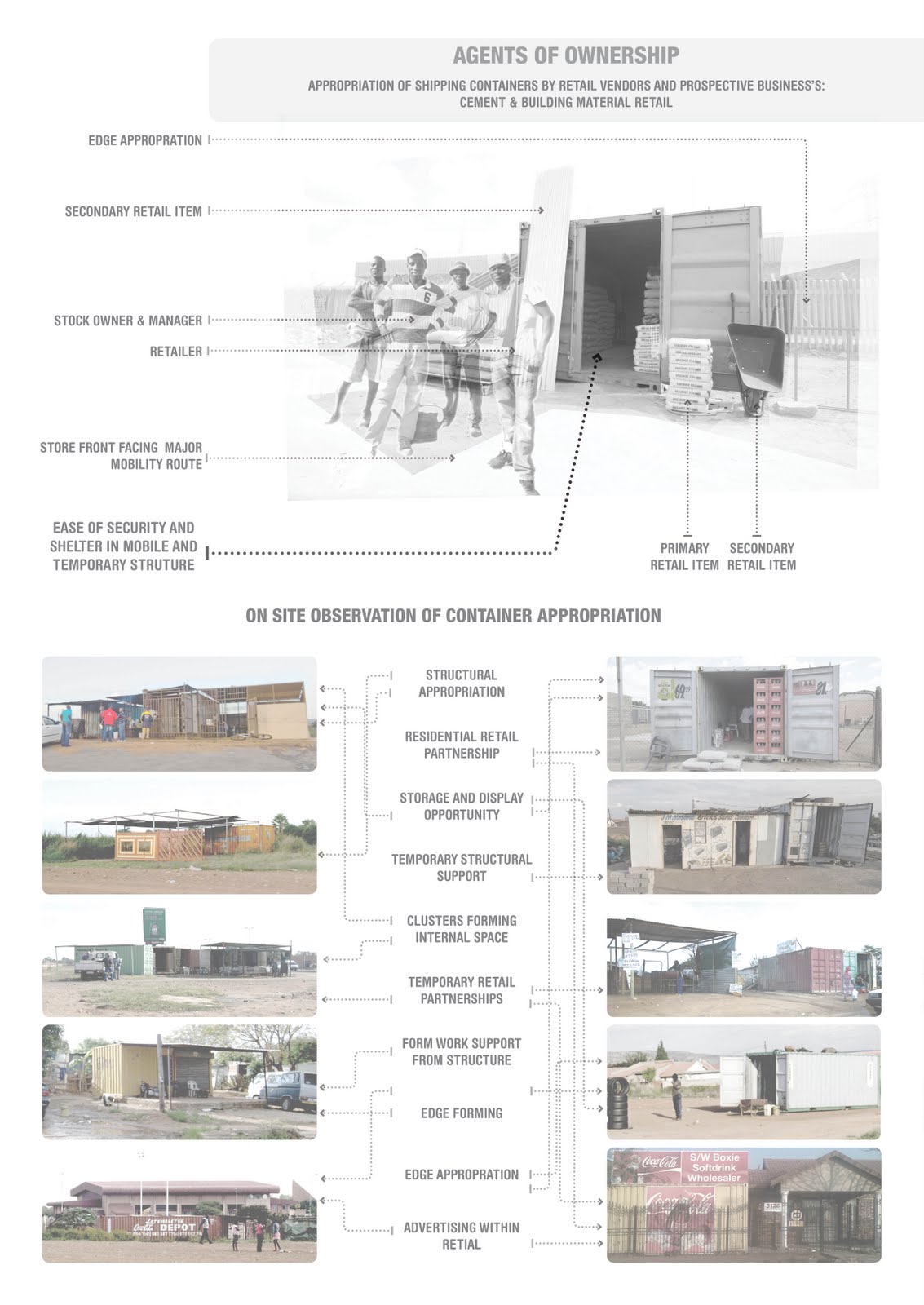
Integral to the organic growth is the identification of agents of Ownership (Users) and Agents of Control (Client). In this case the container retail agents existing in Mamelodi have been chosen based on the previous research.

The methods of structural and spatial appropriation have been documented here as design generators.

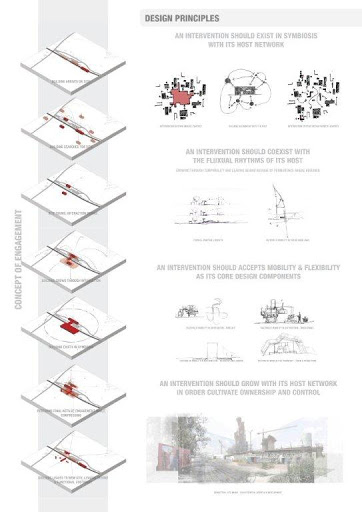
The module for growth is the container, the idea that the container is a temporary element of growth (a form work) that allows larger structural and spatial elements to grow from it.

The orange elements represent the structural and spatial appropriation around the container and the support.

A diagram explaining the growth based on a series of negotiated responses between the agents of control (Afrisam Consortium) and the agents of ownership (Retail Elements).

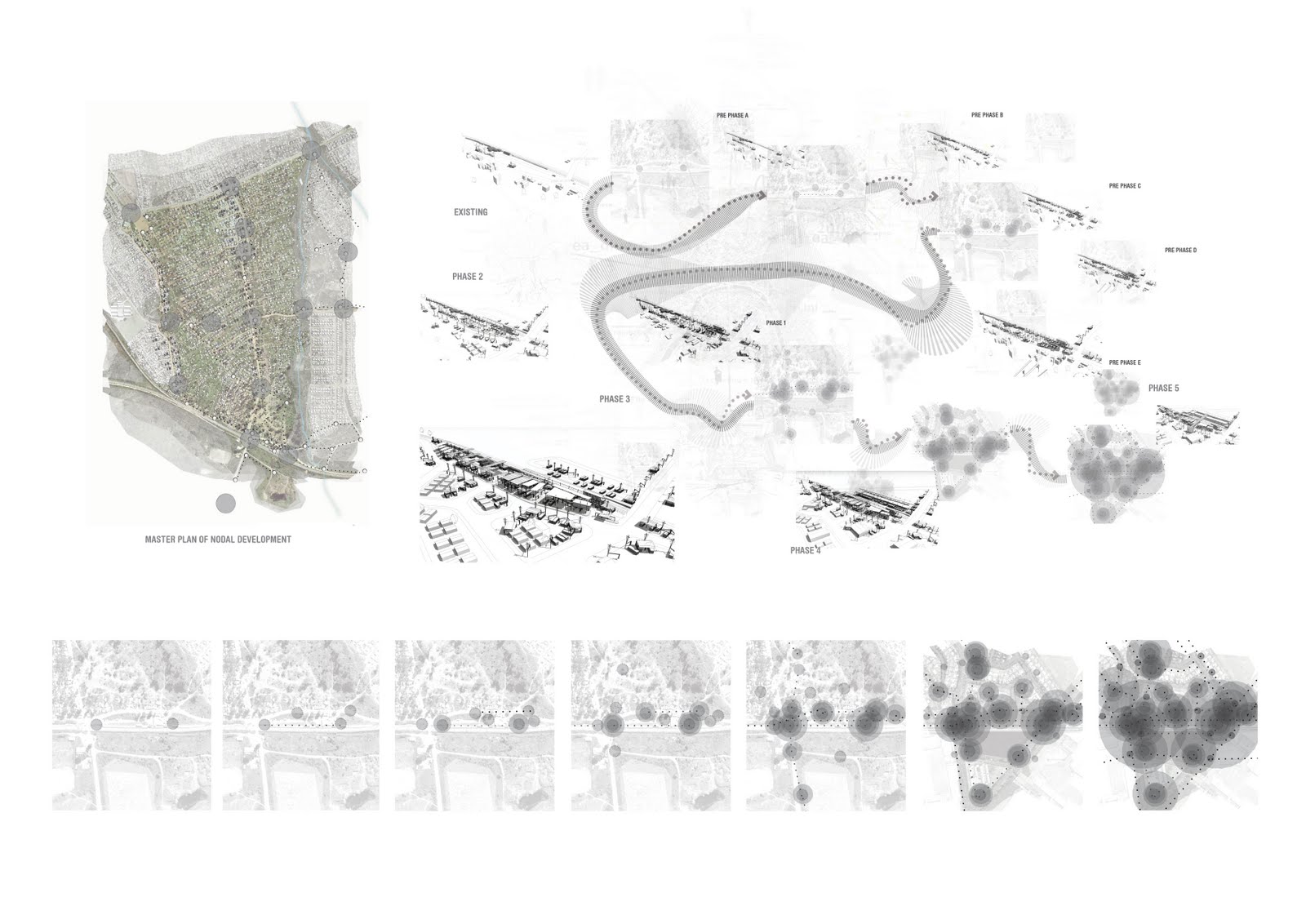
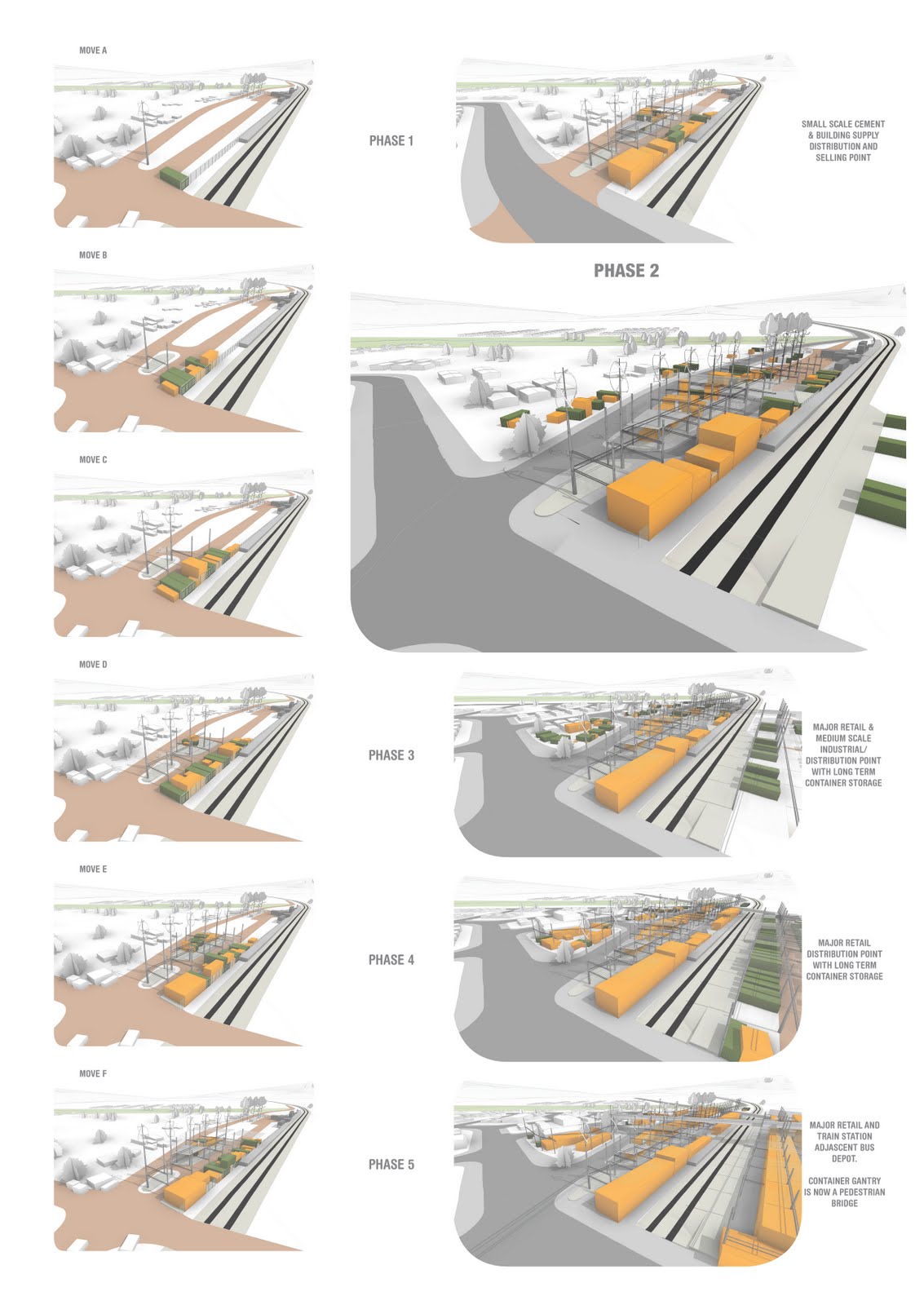
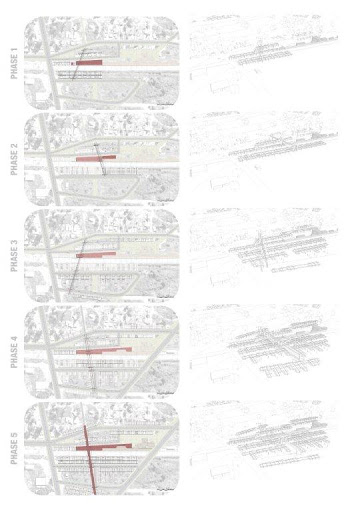
The scheme is broken into 5 main phases preceded by 6 sensitive pre-phases. These are explained here, focusing on phase 2 as the ‘main design’ for the presentation.

To re-iterate the concept, that the building begins as something small and through a series of negotiated responses ‘grows’ into something much larger that leaves behind a residue that is appropriatable by future generations.

The process explained:

Phase A

A small intervention, a structural support element that provides a loading support to a cement retailer at a key junction between pedestrian, rail and road crossing.

Phase B

The intervention grows as the space is appropriated, while the agents of control add to the infrastructure through discussion of needs.

Phase C-F

As energy increases around intervention more infrastructure is supplied as cement retail increases, the orange blocks represent the sub infill, where the retailers let out the space in between to smaller more temporary retail based on need and accommodation.

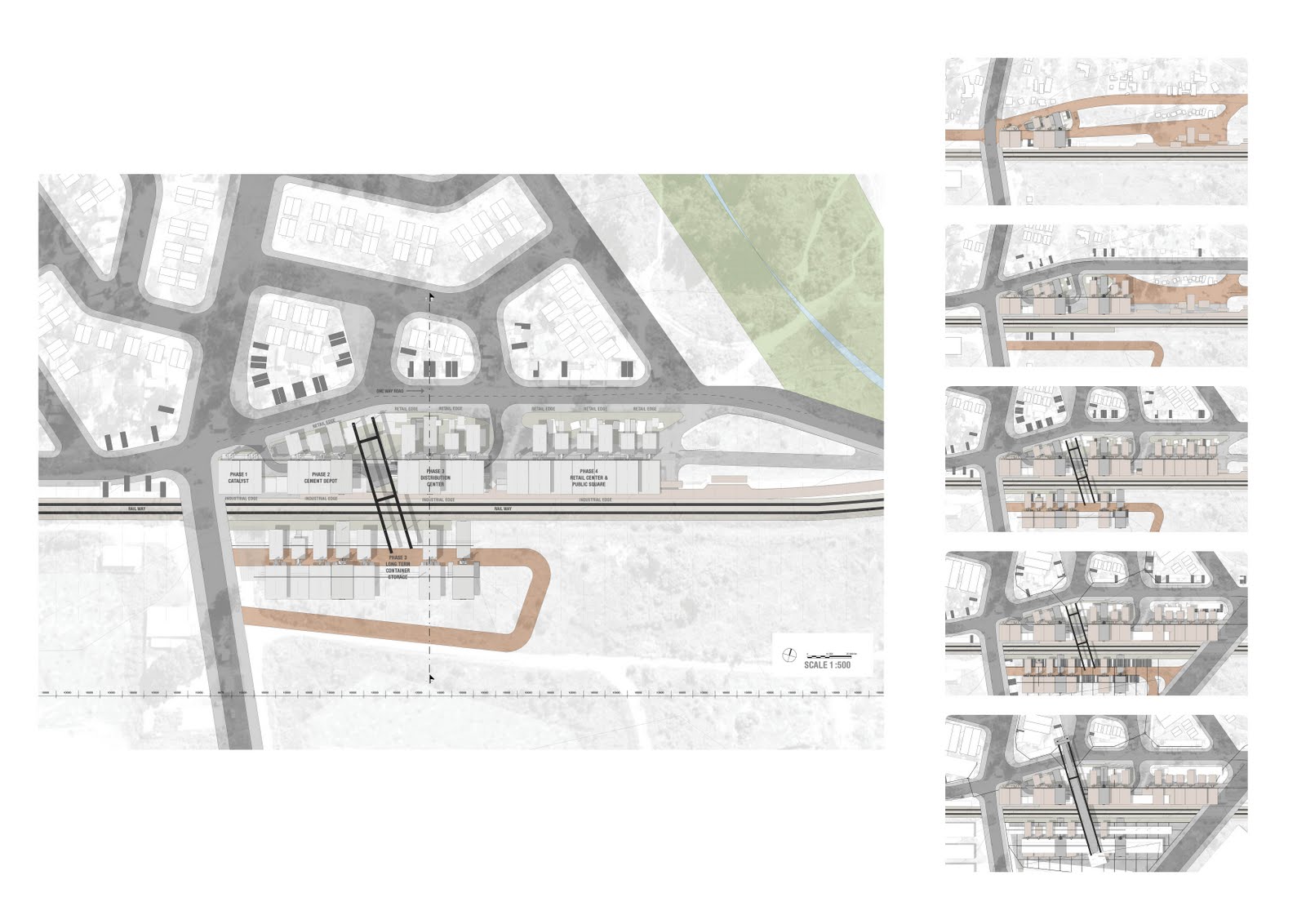
Phase1

At this point the development is fully functioning cement and building supply depot, with smaller retail filling in between. The framework development begins with introduction of a serviced tar road linking the site tot he rest of Mamelodi.

The depot itself is made of de-centralised storage (Agents of Ownership) and infrastructural support including loading facilities, training spaces, and office area for Afrisam Consortium (Agent of Control).

Phase 2

Many of the original container have provided the support necessary for the agents of ownership to build there own temporary/permanent structures according to their requirements.

The framework has now developed the intersection and provided a small service road to retail elements against the rail edge, while this develops the front of house (street edge)

Phase3

The zenith of development, the intervention has grown and merged with the existing train station. The storage facility now stretches over the rail, and provides longer term storage for goods in containers across the rail.

The framework development is now almost complete.

Phase 4

The cement depot program has almost faded now, with the residue of this development allowing medium scale industry (carpenters, welders, pre-fab zozo and brick making) to appropriate the spaces against the rail edge with the street edge now a bustling front of house, extending across the road.

Phase 5

The industrial nature f the program is now gone, with the major framework development being completed, the site is now a major high street and retail center with the container gantry that serviced the storage facility becoming a pedestrian bridge over the busy intersections.

The container storage laid the way for the train station that is now serviced y the adjacent transport interchange and industrial yard across the busier road.

Summary

Our presentations were marked by an external local Architect who, during my crit, discussed the ideas of support and infill and the dualities that exist between doing to much and too little.

I was told that there is not enough building on my behalf, and that I should design more.

I don’t feel its an exercise of designing more, as what is presented is the 5th version of on going process that encompasses 11 phases within it.
The process of ‘non-design’ requires more investigation and design and a simple design does. The challenge lies in how to represent and present the work that goes into it correctly without overwhelming the viewer.

The rest of the class was given an indication mark: i.e P=Pass, F=Fail, MP=Medium Pass e.t.c.

I was given a question Mark: ?

*

Masters Dissertation – Milestone 3

Milestone 3
 
Beware of Paprophila – the fear of commiting design to paper.
(Studio Banter, 2011)
*

Milestone 3 marks the half way point in this year’s dissertation ‘race’.
Being forced to produce a design and put it on paper although painful, has the benefit of exposing the hidden pitfalls and potentialls to the light of peer review, but more crucial – to one’s own ‘objective’ self criticism.
Although right now, I’m not happy with the design, I know that this tooth pulling process of committing something to paper will lead to a more appropriate solution.
 
       
Milestone H: Chapters 1-5

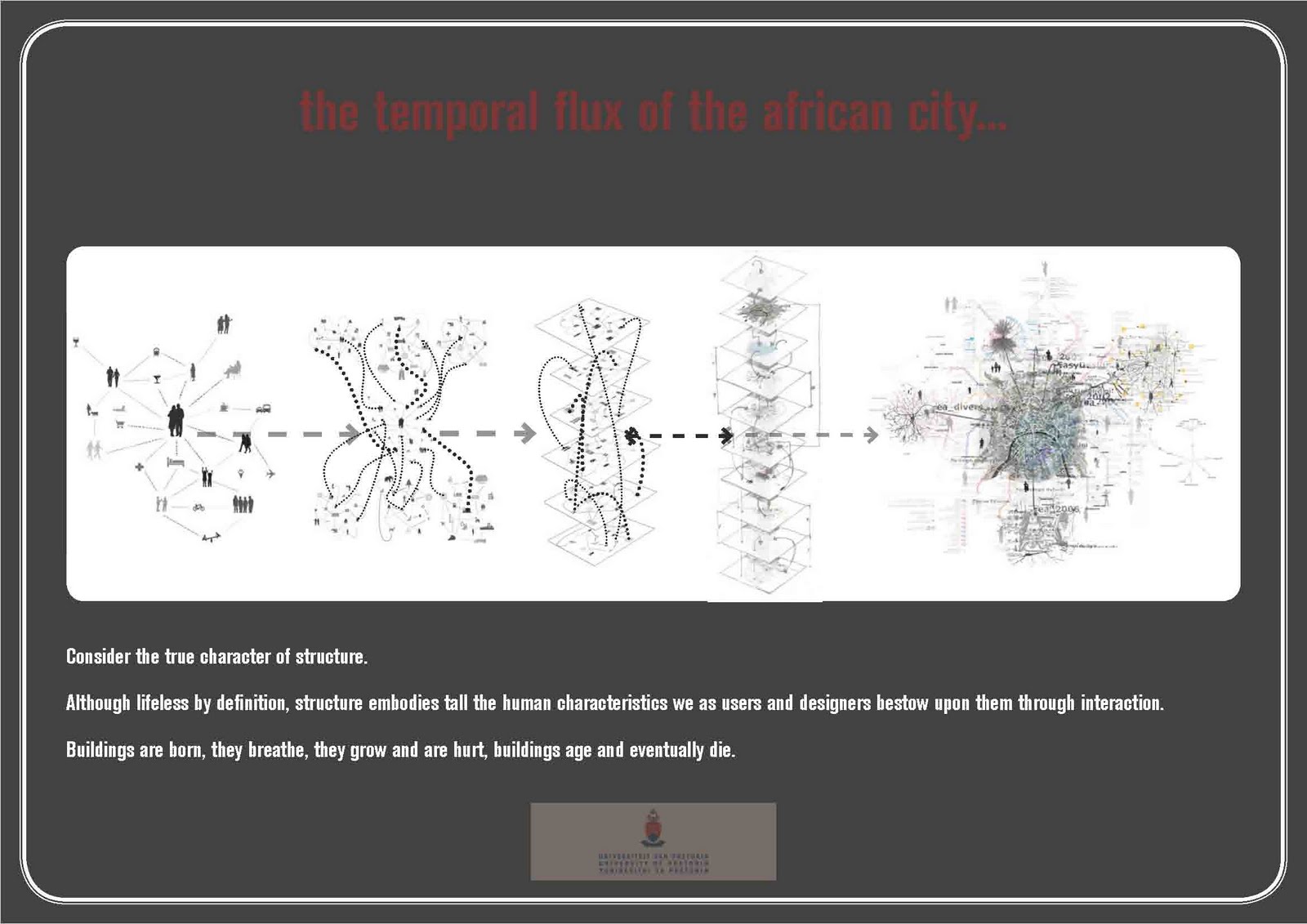
Moving Spaces 2011 – Temporal Flux of the African City

This years Cement and Concrete Institute’s Film Competition was themed Science Friction and called for ideas on what the Future of the African Citiy will be.

The film competition gives students the oppurtunity to pitch their ideas to the organisers, who then select the top 4  entries and give them R25 000 to make a short film.

Previous winner include ‘Litshe le Golide ‘ / “Stone From Gold” –won Best Documentary Film (International Category)in Turkey at the International Istanbul Architecture and Urbanism Film Festival.

The film was produced by Guy Adam Ailion, Andrew Ross Bell, Tamara Lynnand Craig Michael Maarschalk all students from Wits University.

‘Litshe Le Golide “Stone From Gold” is a Short Film About Johannesburg City as a Mining Town Turn
Metropolis. The film narrates the memories of a mine worker swimming through water while he contemplates his infatuation for this contrasted city and questions, WHAT HAPPENS WHEN THE GOLD RUNS OUT ?


Original Pitch

Having spent the last few years working in the peri urban settlements of South Africa, the choice to do a film about the conditions around these areas was quite easy.

The work done around my Dissertation Research was used to support the story line, which was developed by myself and Tommy Van Deventer, a studio colleague who shares the corner nook of anti-social life in the bowels of Boukunde.

The Story

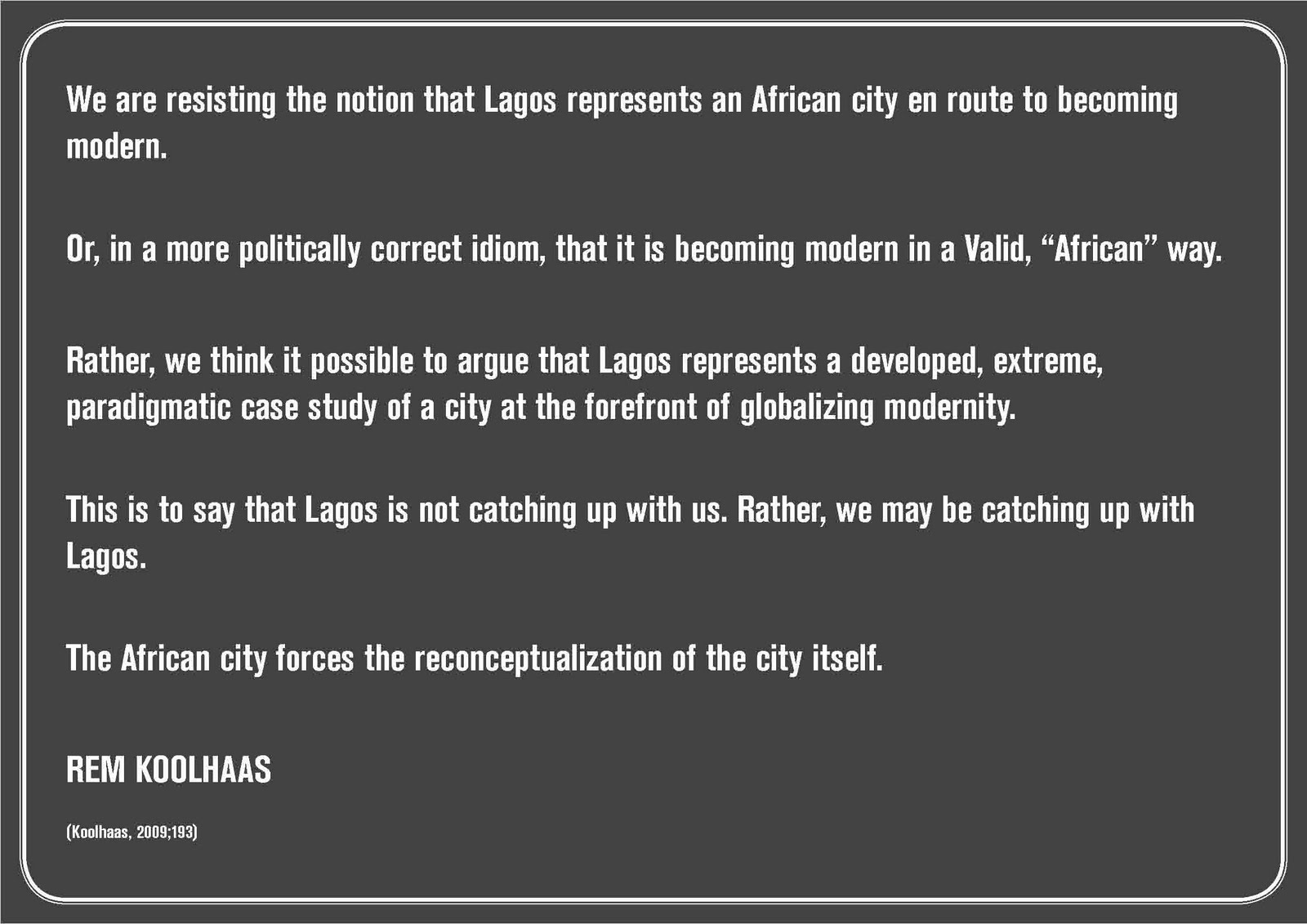
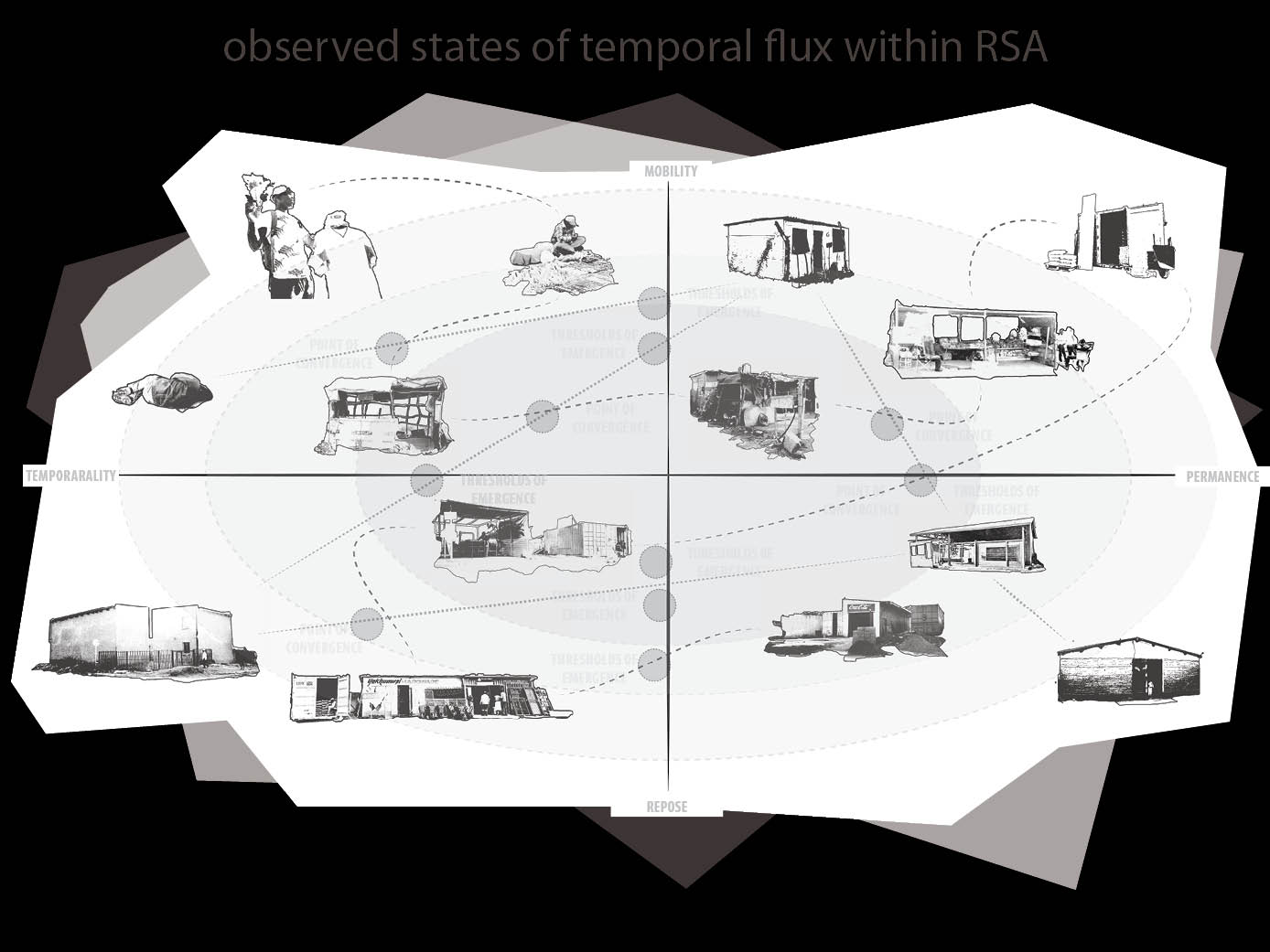
The basic outline of the story hinged on Rem Koolhaas’s study of Lagos, he put forward that possibly the future patterns of First World Cities lies in the sporadic and fluxual growth pattern of African Cities.

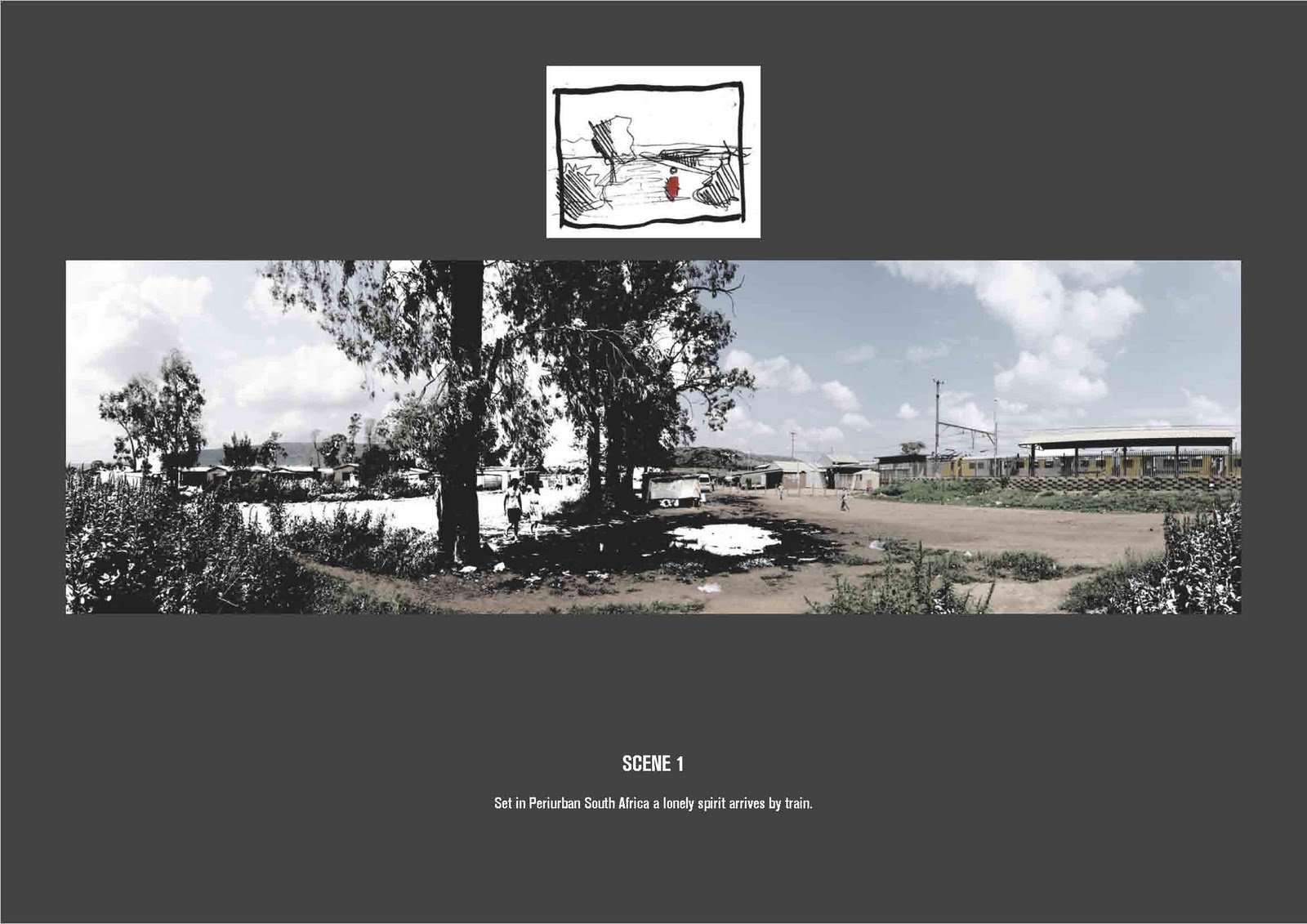
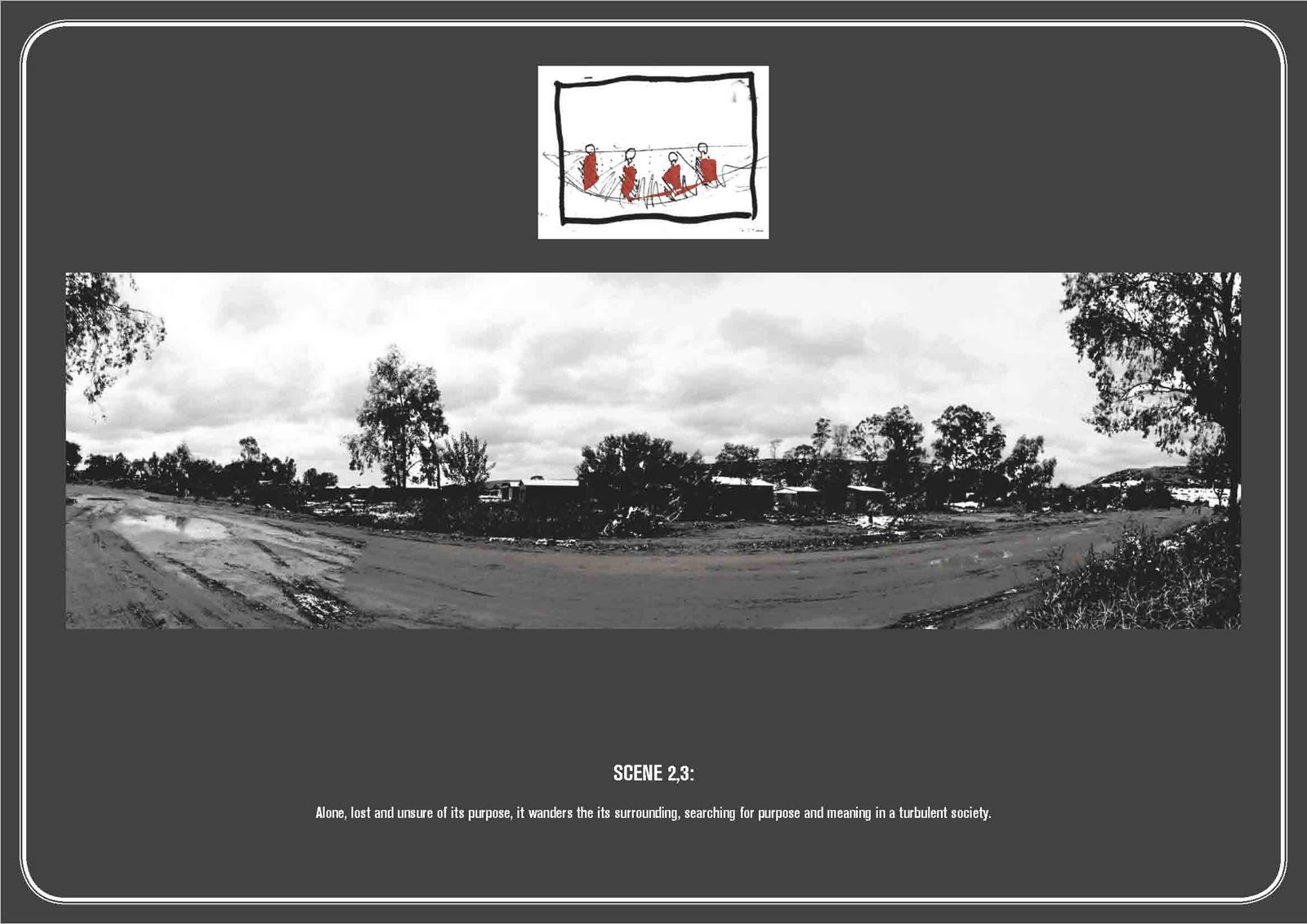
The Story begins when a lonely and lost spirit arrives in a foreign environment ( A Township).

The spirit then begins to wander his new environment, searching for purpose and place in this new world.

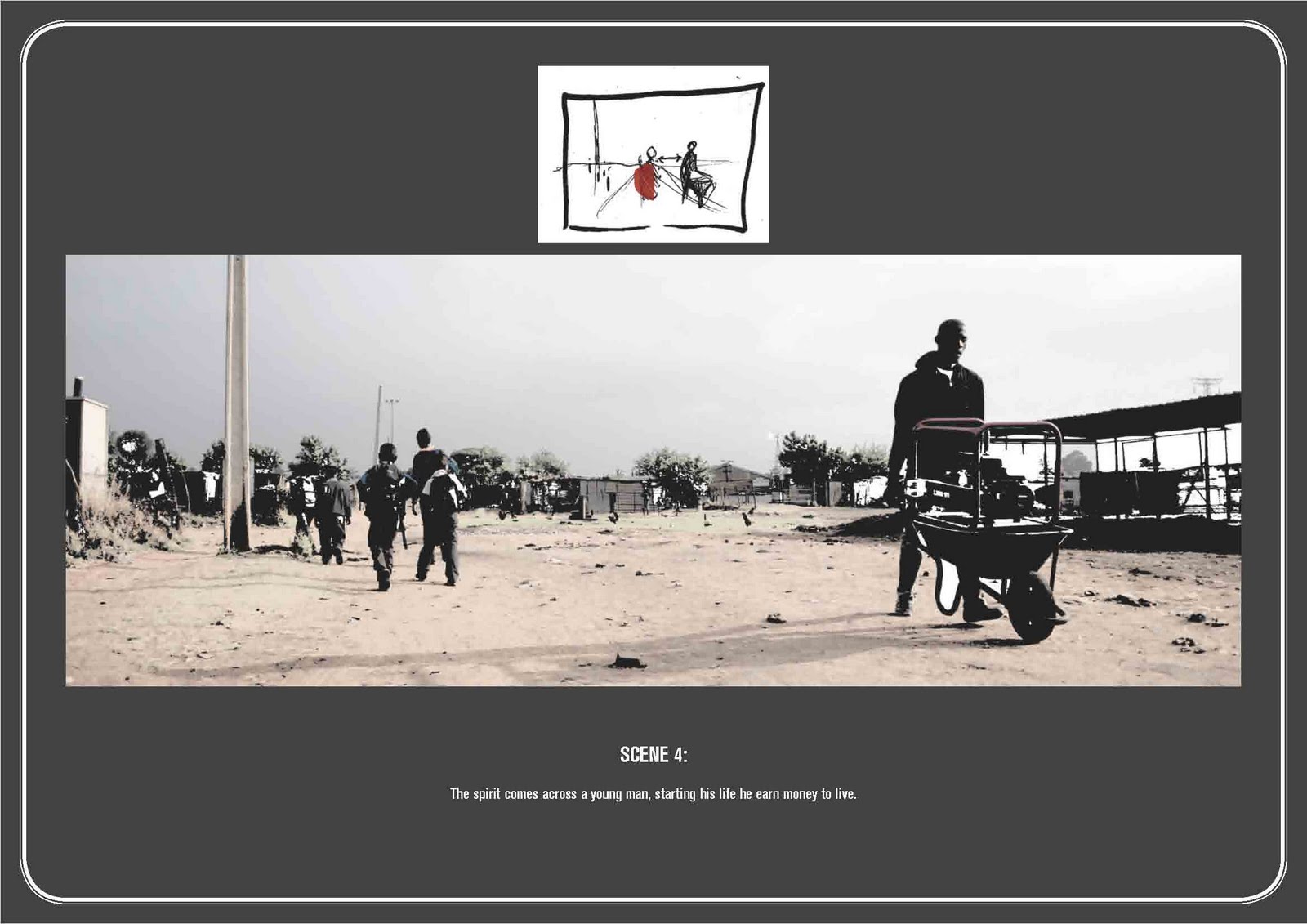
The spirit then makes contact with a young man who, striving for his own place in this world of the peri-urban, sells goods from a small mobile stand on the road.

The spirit then takes the form of his stand, providing him with support, shelter and place to work from.

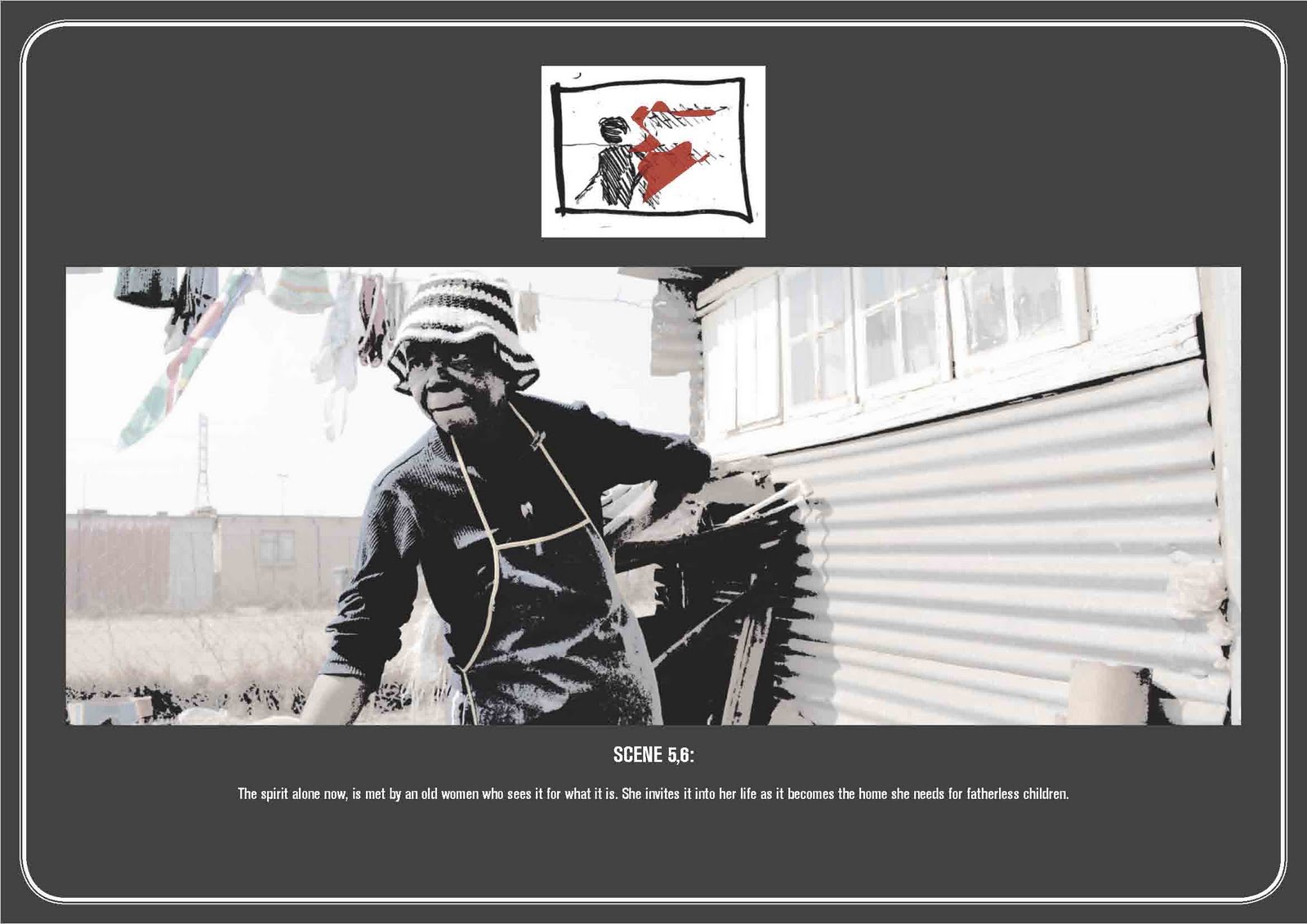
The young man eventually rises above his circumstance and moves on, leaving the spirit abandoned to wander this world again. He meets and old woman, who is supporting herself and her children.

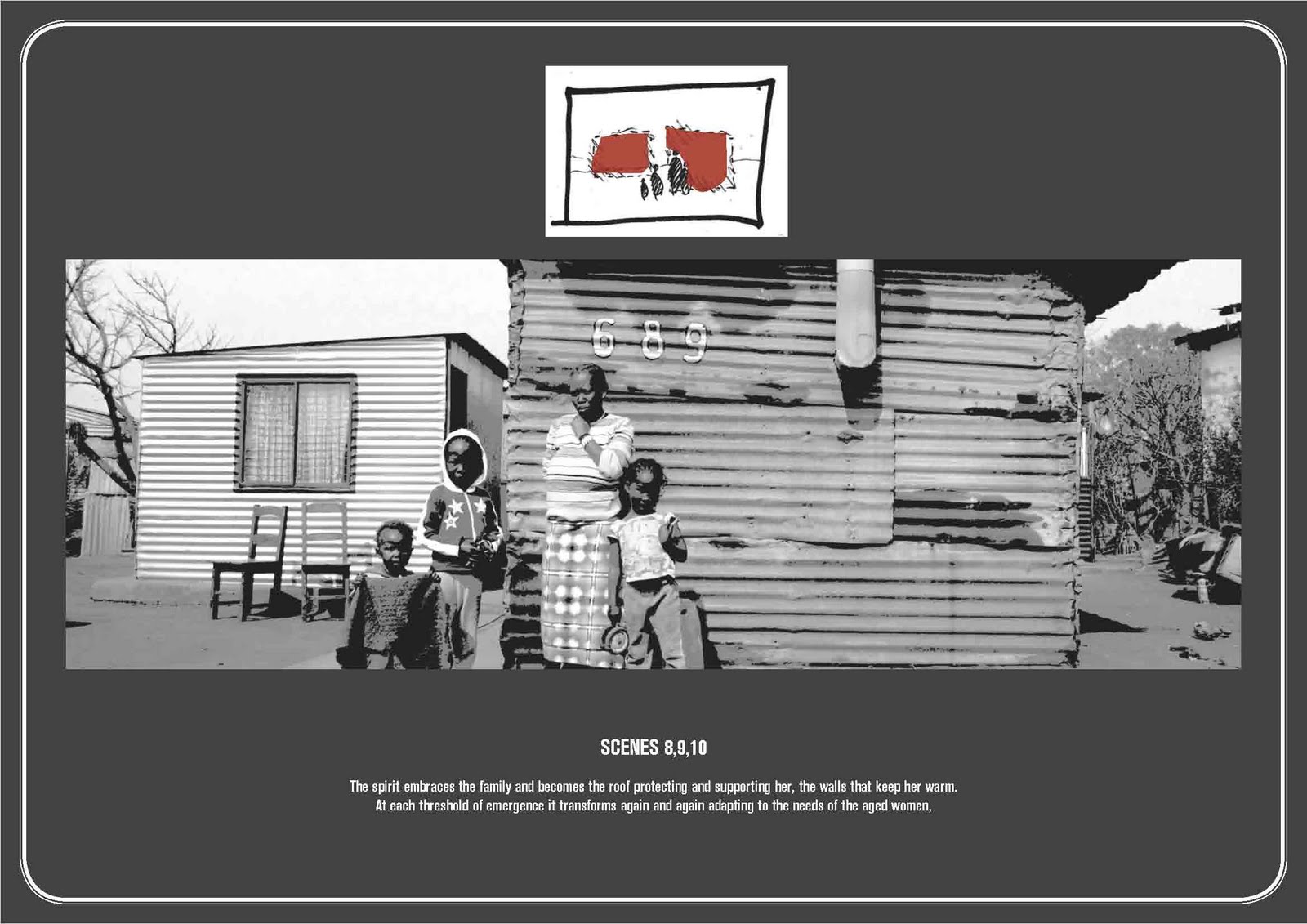
The spirit then takes the form of the woman’s house, providing shelter for her and her children, growing and changing over the years to adapt and meet their ever flexing needs.

The woman passes on and her children move away, again, leaving the spirit alone. Yet again it wanders coming across this time a group of men producing bricks from their backyards.

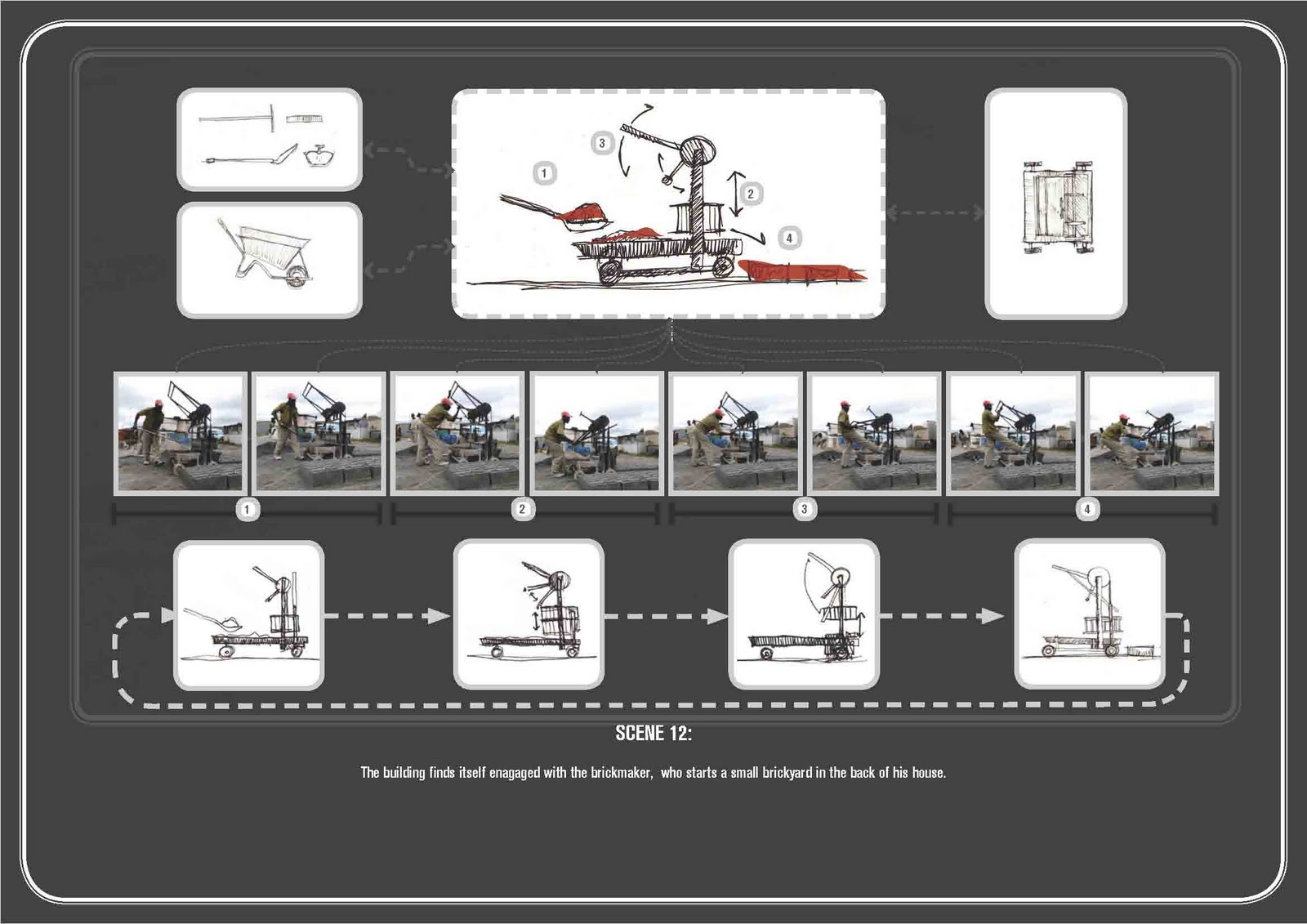
The spirit then takes the form of the bricks themselves.

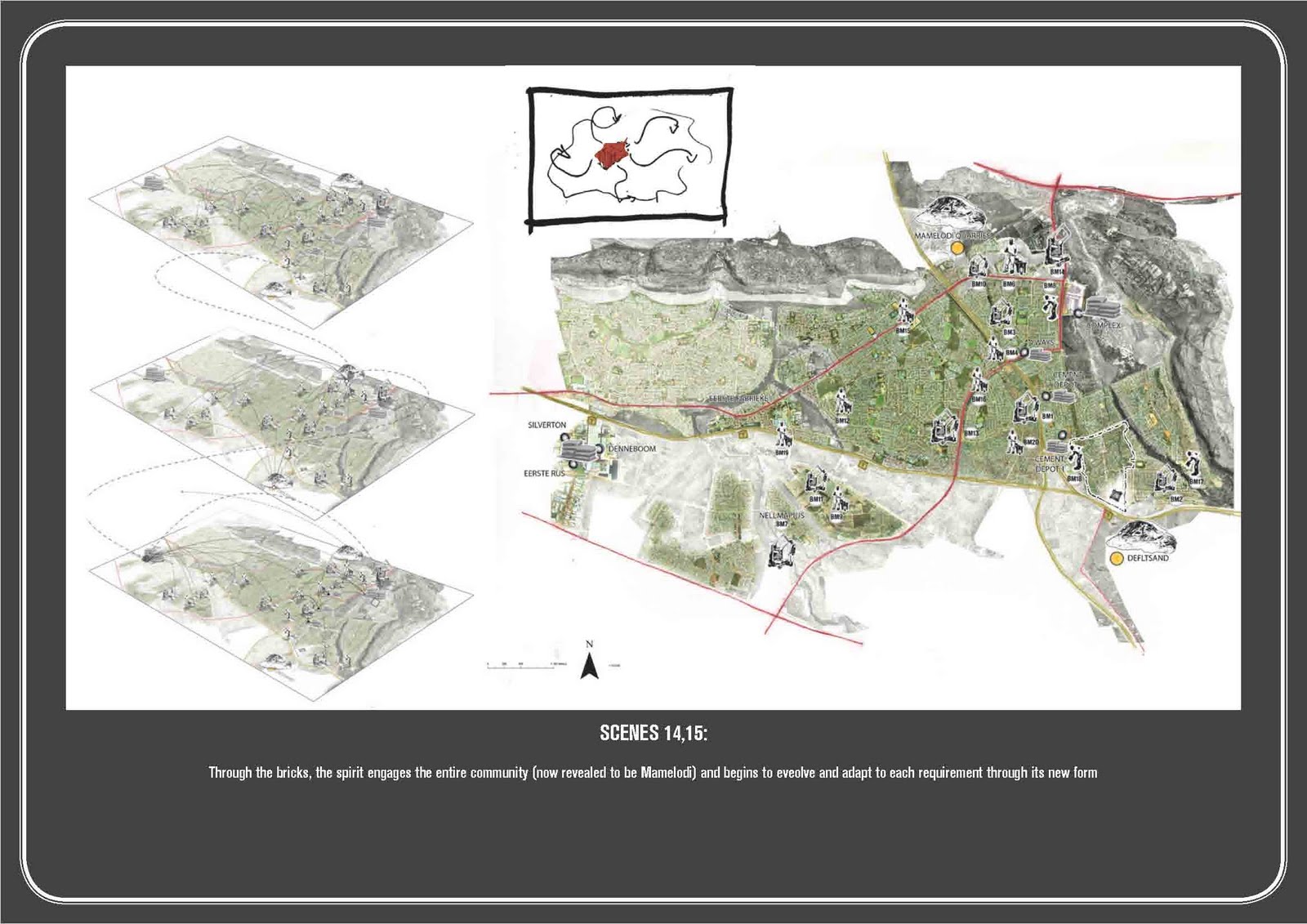
Embodying the building block, the spirit then engages all facets of his now familiar world. Meeting the needs of as many people as it can through its now flexible form.

The spirit carries on for years as the brick, each year doing more to help, to find its purpose and place through engagement and response.

Finally, over saturated and overspent, the spirit relents its form as the brick, and by choice, wanders alone again.

The spirit then returns to where it first arrived, and begins to think. It starts to consider what it saw, what it did, how it helped and how it couldn’t, who it is and where it is, what it is?

As it sits thinking, it begins to change, it changes as it reflects on what it has seen. While the forms it takes begin to speed up, the people in the area begin to gather around it. The more it changes, the more the people gather.

The spirits own flux in form begins to speed up, more and more, people begin to engage with the spirit, taking shelter under its overarching form, resting on its changing surfaces.

The fluxual growth of the spirit, the multifaceted  flexible forms express the fluidity and adaptiveness of the South African condition. The spirit becomes one with the people thus exemplifying the true South African condition.

Pitch to the Producers

From this original pitch, we were shortlisted to a final 8, of which 4 were to be chosen after a pitch to the judging panel. 

Tommy Van Deventer, Merike Swanepoel, Alexander Melck and myself, then began preparing a more developed presentation. 

We decided as a group to take the original story and expand it to include the urban condition of South Africa as well. And take a step back and look at the theory behind the story.


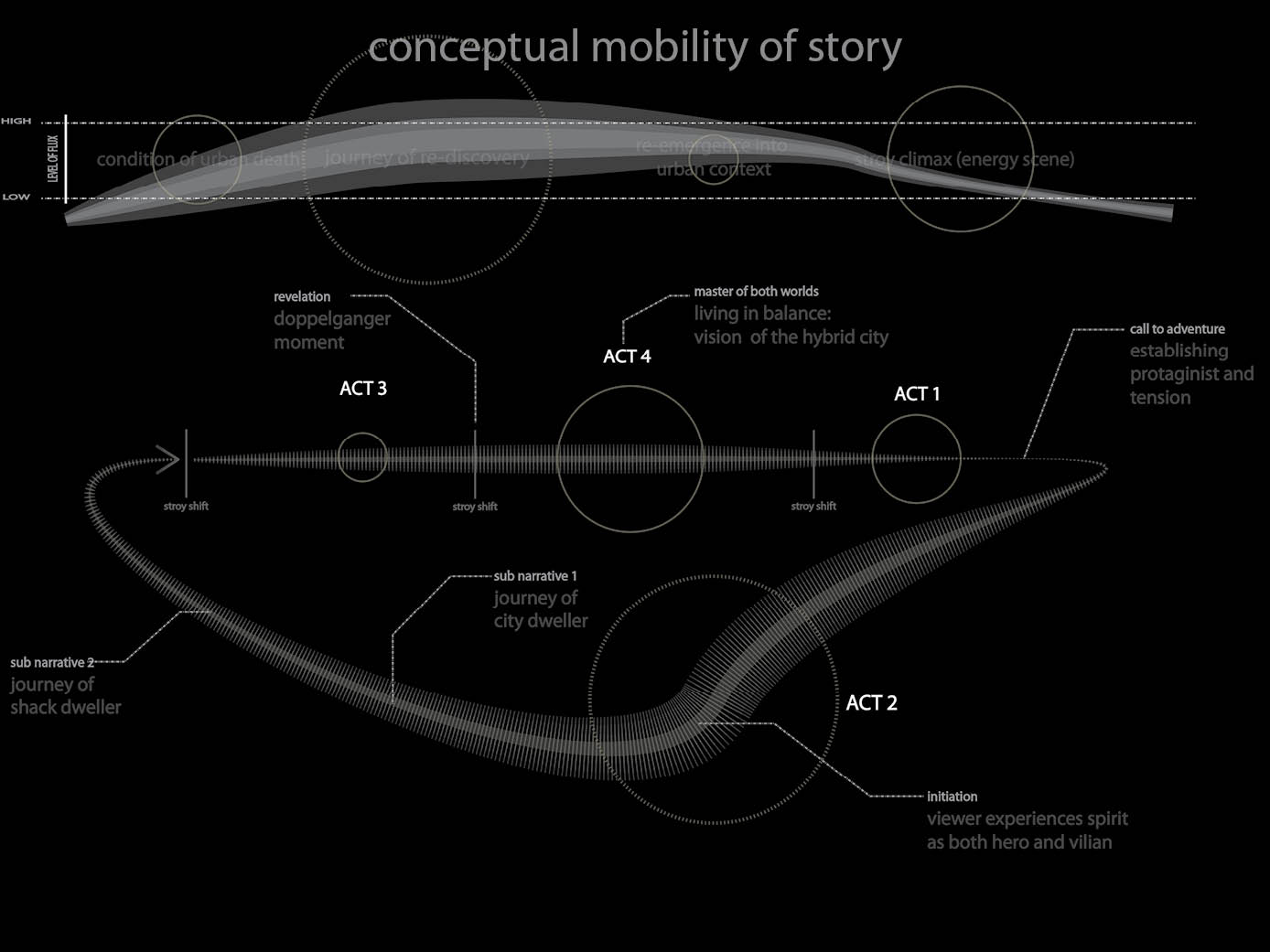
The narrative would remain similar, but would tell the story of two spirits, an Urban and a Peri-Urban character,  describe each character, explain their micro stories, depict an event that brings them together and through a process of re-emergence, discover they are the same, and ultimately merge to be a truer, stronger spirit that embodies the nature of African City.

Merike put together a short introductory video to create the atmosphere necessary to begin the process.

Introduction of story Themes and Theory

Introduction of the true nature of the spirit, the indomitable human spirit to select one’s own path in life, regardless of choices offered.

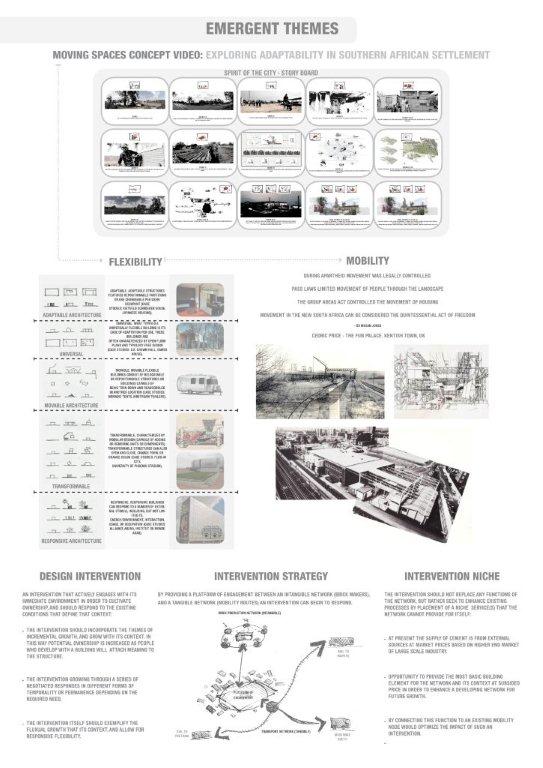
Introducing themes of mobility:

Urban Character
Peri Urban Character

Themes of cohesion:

Urban Character
Peri Urban Character

Themes of Adaptability:

Urban Character
Peri Urban Character

Themes of Appropriation:

Urban Character
Peri Urban Character

Investigation into the history of mobility:

Where it began
Where it extended
Current Condition
Investigation of Mobility through Urbanisation in South Africa
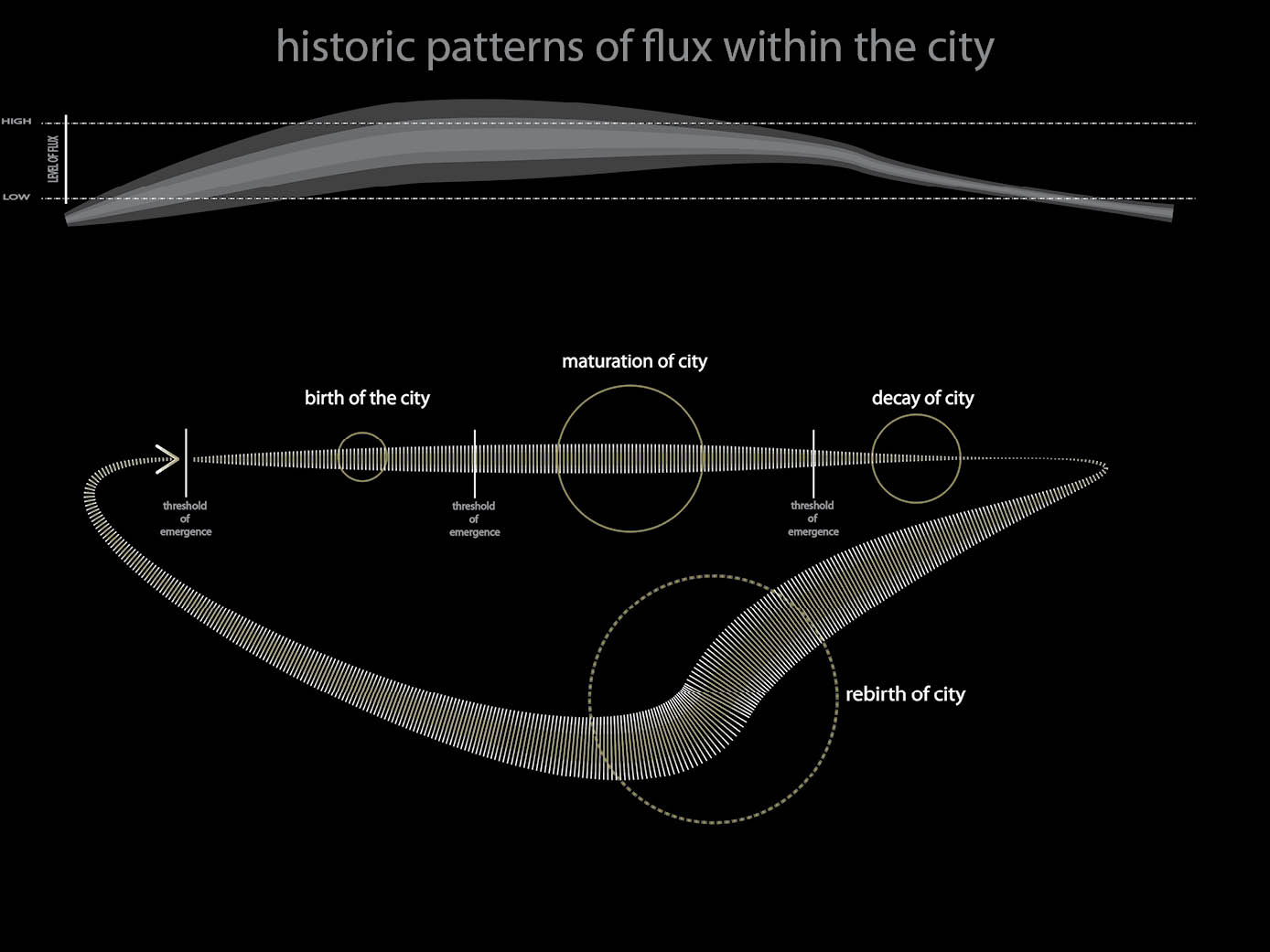
Investigation of fluxual growth through Mobility
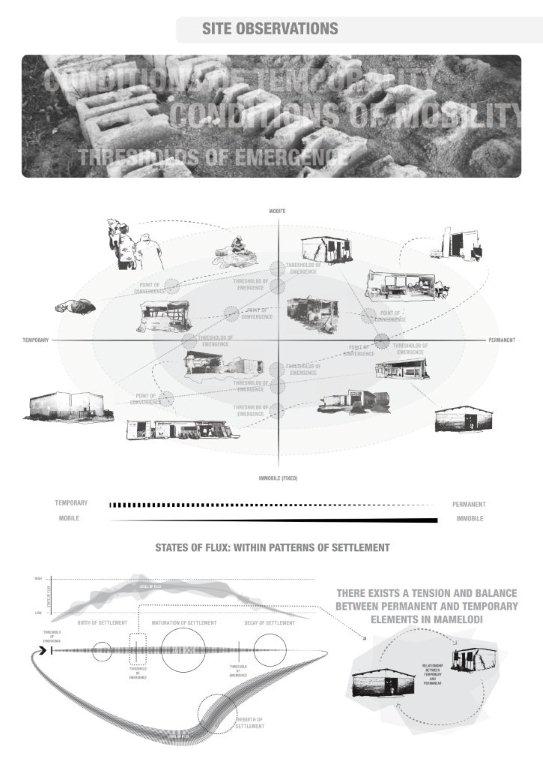
Fluxual diagram of permanence
Fluxual diagram of temporality
Tension and balance within overlap of conditions

Future of the temporal flux of the African City according to Rem Koolhaas.

Summary of Temporal growth within Settlement
Adaptation of theory into storyboard
The Story

ACT 1

Introduction of Peri Urban Context
Introduction of Urban Context

ACT 2

Introduction of Urban Character
Introduction of Peri Urban Character
ACT 3
Doppelganger Moment – When the two spirits, previous enemies, realise they are twins.

ACT 4

Realisation of unity, and merger to ultimate master of two worlds.

We then closed with short test samples using footage from Site Visits and animation to explain our visual intent.

32
END
 *

Unfortunately, we did not make it through to the final 5. We were told our themes were too theoretical and our presentation did not convey our ability to produce a film.

Perhaps we should have stuck closer to the original story and presented a better narrative the second time around.

In hindsight, it would have been difficult to produce this video for the September deadline and complete the Dissertation year’s requirement. But the themes, and ideas discussed did much in the way of supporting the dissertation.

But, as we were re-assurred by the producers – there’s always next year….

Masters Dissertation – Milestone 2

MILESTONE 2

When thing go bad, BOOM! …Disney…

(Studio Colleugue Henner,2011)
*

With 5 weeks until the half way mark, the dissertation is beginning to fall into place.

Working in studio has been the single most valuable decision I have made since I began post grad.  The atmosphere, the knowledge exchange and communal idea forming that takes place in the seemingly lost and ‘wasted’ hours of coffee break chats and procastinatory pranks have pushed the entire dissertation to a new level of enjoyment and academic calibre.

Strange to say, but I’m actually looking forward to 25 more weeks of studio-madness; 2:30am ephiphany’s and the strange feeling of warped reality that only the bowels of boukunde’s ‘night life’ can bring.

*

Masters Dissertation – Draft Chapters 1-3

MILESTONE G.2 – DRAFT CHAPTER 1-3 
You cannot create life in 9 months…  
Dissertation Year Co-ordinator (Koning Laubscher, 2011)
The year continues on, stealing from me my the small degree of socialness that I once had, as well as my grip on what I once thought was ‘normal’ behaviour… I digress.
*
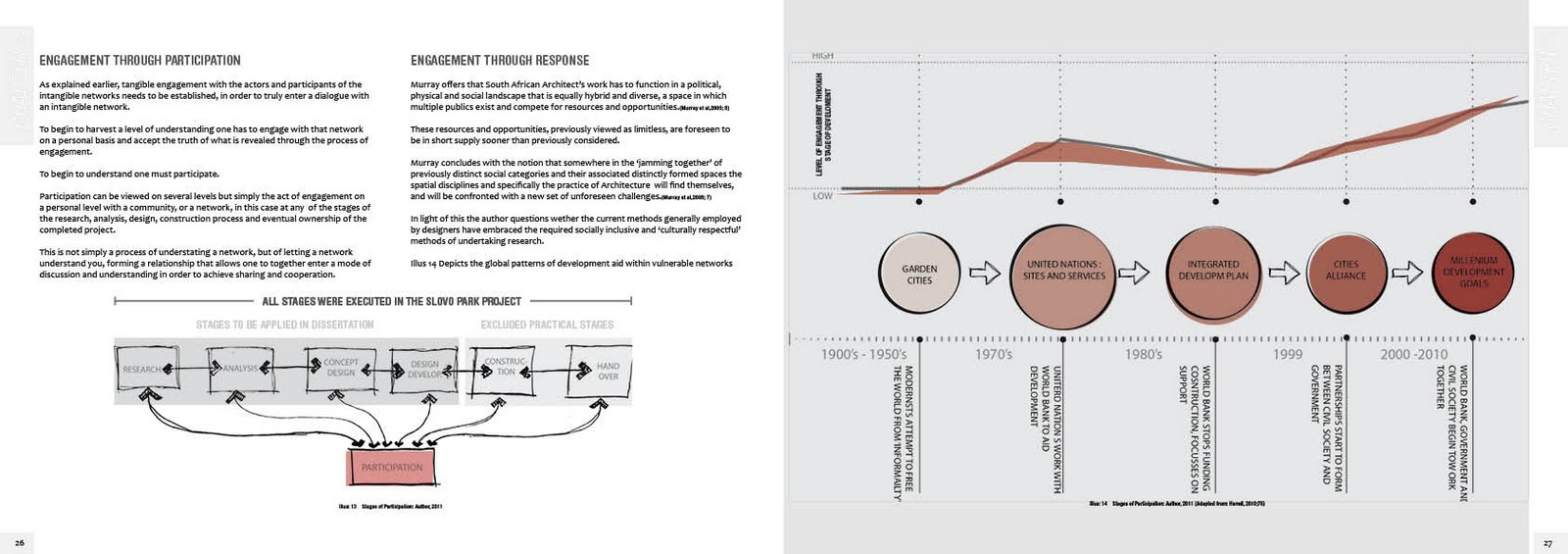
Chapters 1-3; Encompassing my revised thought process on what I plan to do this year.
No building yet, but some informative site visits, data and great interviews and an idea for an idea.

Masters Dissertation – Milestone 1

MILESTONE 1  (A- G.1)

“Design, like many things,  is not a linear process…”
(Koning Darth Laubscher,2011)

Only now, in the 13th week of my final year, am I finally feeling like I’m getting into the issue of what I’m really dealing with in my Master’s Dissertation.
Its amazing how much of the time has been spent thinking, writing, discussing and throwing out the multitude of ideas and themes that present themselves in one moment as the salvation of your deadlines worries then quickly become the core of your design thinking struggle.
What has been greatly rewarding is seeing how an idea is formed from the initial spark of interest and through the repetitive process of  moulding, critiquing, reforming it slowly takes shape into something that is worth putting on paper.
*
 

The Year Breakdown

The year has been divided, by our fearless leader – one Koning Darth Laubscher, into several Milestone Deadlines. These deadlines are supported by smaller hand in milestones and have had the class on their toes since we started in February.
Although it feels like the order and requirements for each of these submissions is counter to what one feels like doing at the time, it has been remarkable how this ‘un-linear’ process has worked to push the progress of the work to where it needs to be, the words of our critical co-ordinator sound constantly in my mind:
“Design, like many things,  is not a linear process…”

Milestone A –  Critical Review: Precedent Theses

We began the year with a critical evaluation of previous theses submitted by Pretoria Students and compared them to International Theses that we could find.

The University of Pretoria has an amazing database of theses, that are extremely well organised and freely available to anyone.
This resource has been invaluable so far:

Milestone B – Mapping Exercise – Mamelodi vs Menlyn

This was followed by an exercise in mapping, where we examined and discussed the various academic methods of mapping and presented a small experimental mapping exercise.

The experiment my group choose was to attempt to map perceptions of place between Menlyn and Mamelodi.

We set up the narrative of two different people breaking down in their cars and depicted what they saw and felt from two similar vantage points in BP petrol stations in either point and documented the going ons of the station over a 12 hour period.

This was presented in a short video and followed by a series of questions to the class. These answers were then mapped quickly mapped and discussed.


Milestone C – Theory Overview

We were asked to depict and summarise the theories that we had been taught and explored since first year, again, at first we thought was a mundane exercise, but after completion we realised how much we had actually been exposed to over the course of our careers so far, as well as the theories we were going to explore this year.

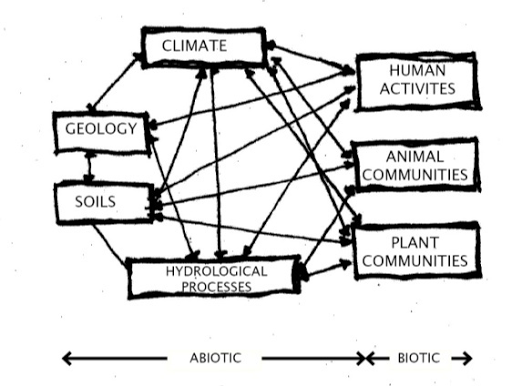
I presented Ken Yeang’s theories of biological integration of buildings into the environment and cited Simon Van Der Ryn’s writings of Ecological design around buildings, both theorists covering the topics of Deep Ecology.


Diagrams adapted from Ken Yeang’s Eco Masterplanning, 2005 

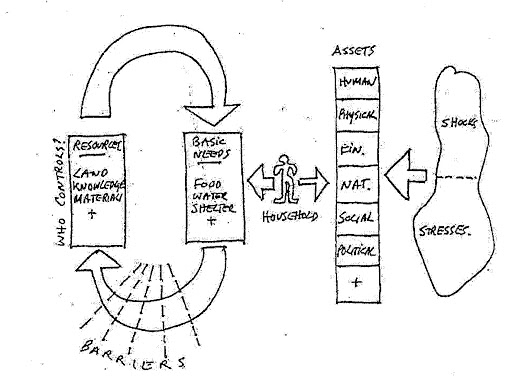
I also was looking to explore the themes and principles around Open Building and spoke of the work of Nabeel Hamdi and John Habraken.

 Diagrams adapted from Nabeel Hamdi’s Placemakers Guide, 2010
Hamdi Poem from Small Change

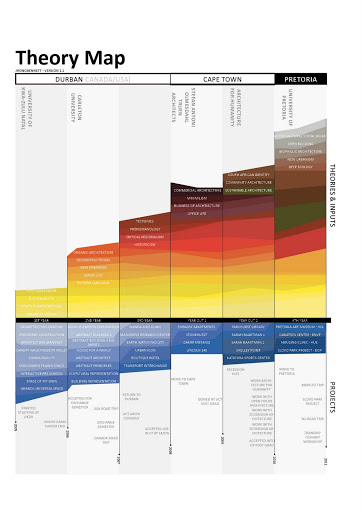
This became somewhat of a confidence building exercise, I borrowed the graphic concept from an image I found online, I could not find the original author to reference, but adapted it so display my career thus far.

Mapping of my Career thus Far

We were also required to represent a parti-diagram, which I realise now is more a functional process diagram of how I intended to approach the design

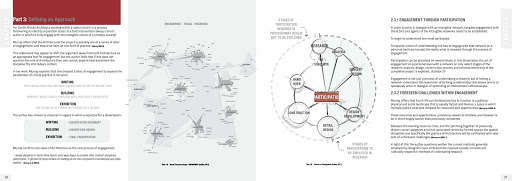
Functional Process Diagram of  my intended approach


Milestone D – Chapter 1: Broad Strokes

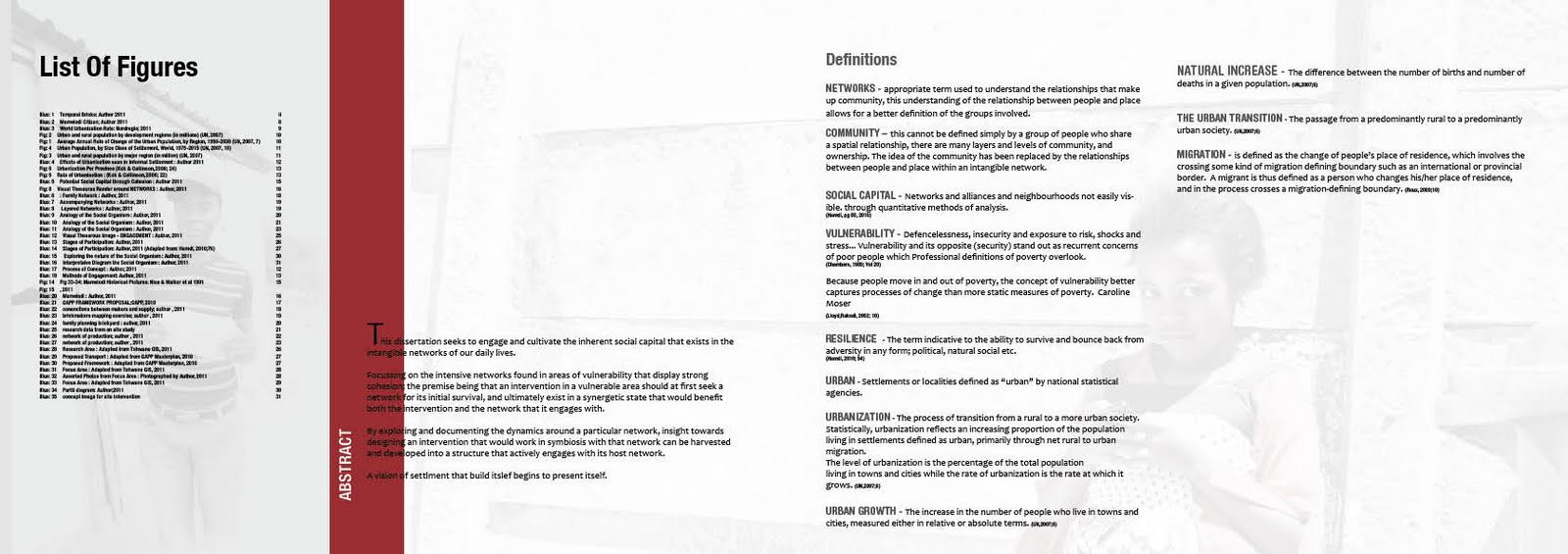
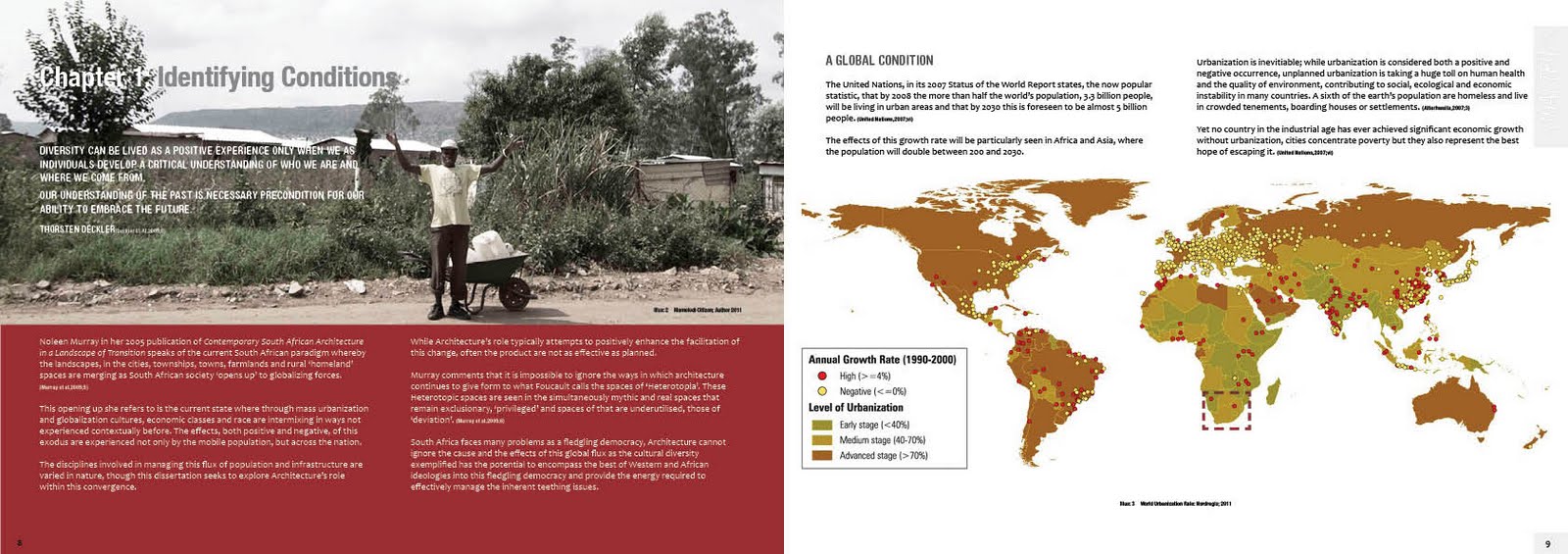
The submission had us write out our first chapter, which in a thesis document is intended to explain and set up your entire book – a sort of abstract chapter.

Book Cover : Draft x

By this stage I had decided on working in Mamelodi, and I had a vague impression of how I wanted to explain my ideas.

I knew I wanted my project to deal with some of the issues around developing the previously disadvantaged areas in this country and I felt that I wanted to be involved closely with the chosen client.

I had visited an NGO earlier in the year and while I knew that I wouldn’t work with them, I felt the interview I had with them had started some ideas in my mind.


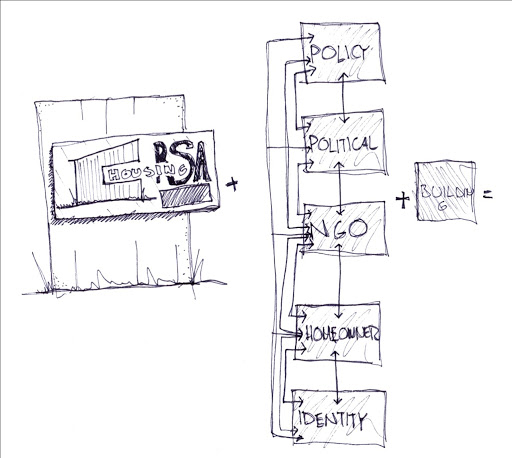
 Diagram Explaining my idea’s around developmental Aid in South Africa

Still unsure of my focus at this point, I found myself writing a very general description of what I intended to do, although the process of writing opened up my thinking and forced me to start thinking more towards a design problem and a building.


Milestone E – Critical Building Review and Group Site Discussions

Critical Review – As part of our pre-scribed work we were required to write a short article in the same style and format as the Architecture South Africa. It was easy for the class to design a template for this, but the difficulty lay in that we could not write about an already published building.

Site Selection Summary – Closing in on where, what and how I wanted to work, I drew up a good old fashioned SWOT list.

At this stage I was still battling with my site choice and had visited a few sites in the area:

Viva Village is an NGO run by Melonie and Leon Kriel in Mamelodi East. They are very active in aiding the people of this area in developmental aid and several initiatives running at the moment from day care to trade skills training.

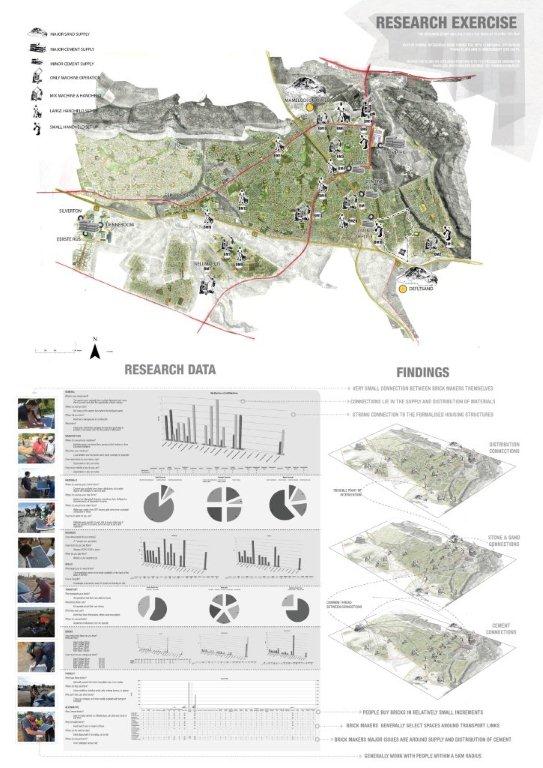
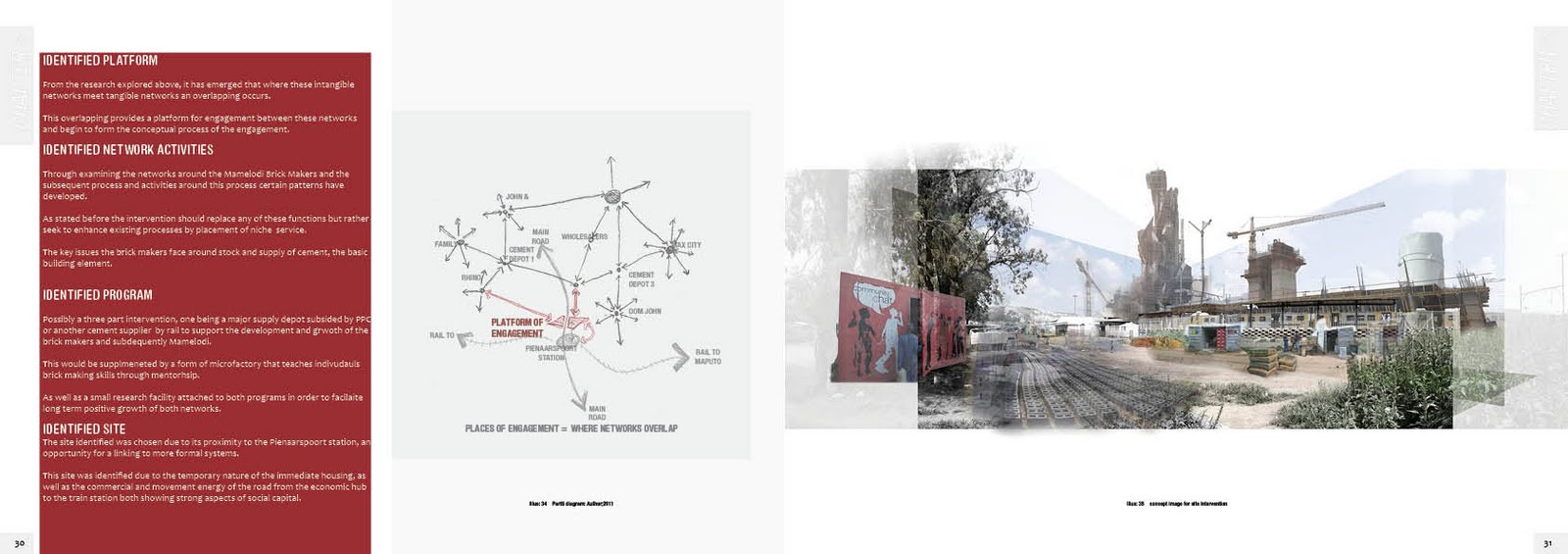
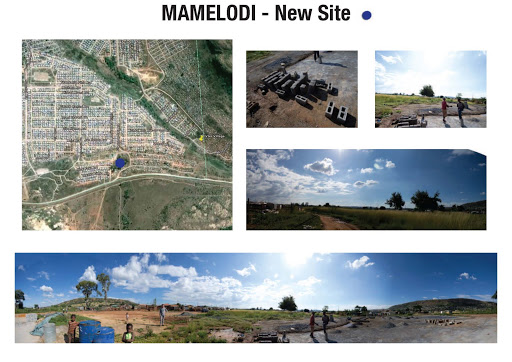
Ext 12 was where I discovered a group of guys making bricks with some low cost materials and production methods. This seemed a very interesting place to work and I was quite interested in the idea of brick making and the energies around the production of these bricks.

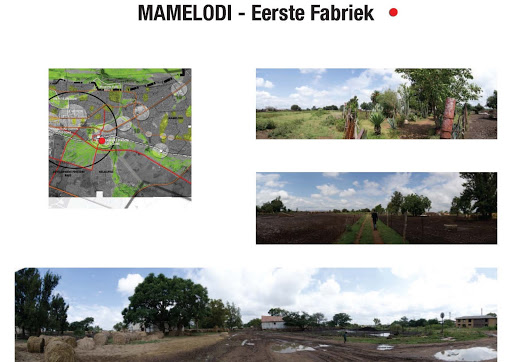
Eerste Fabriek was a site that another of my group member had chosen, as was well situated in the GAPP framework in terms of future development and contained some very sensitive and beautiful heritage elements.

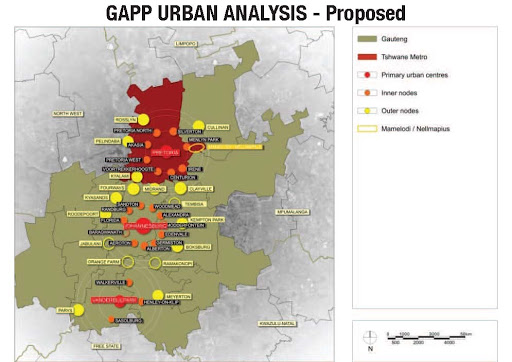
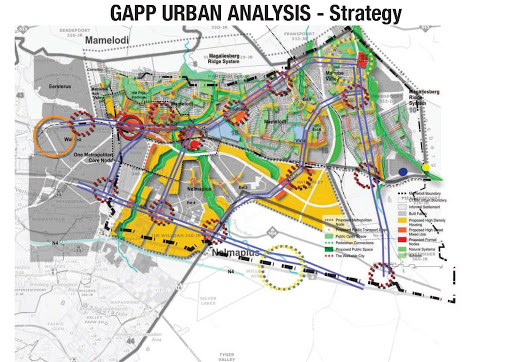
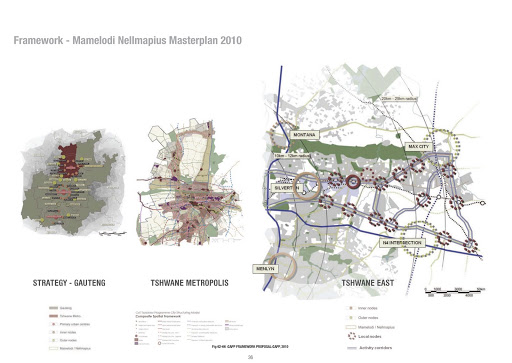
By now I had been joined by two colleagues in the Mamelodi Labarotory of research and we had been luckily enough to come across GAPP Architecture’s proposed framework for the Mamelodi/Nellmapius area and used that as our basis for the proposal.


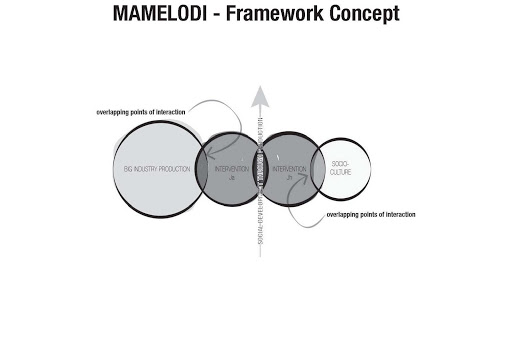
We had also decided on some ideas around a group framework, and the themes around the process of manufacture and production emerged as the dominant idea at the time.

Group Concept Diagram


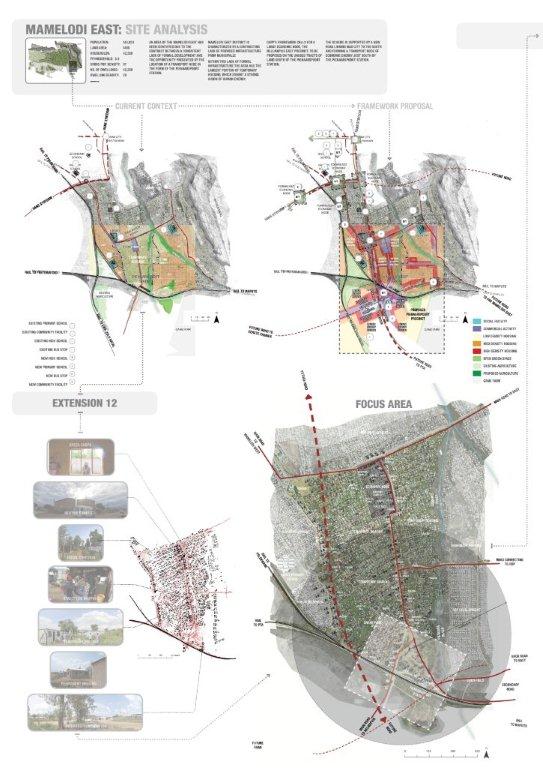
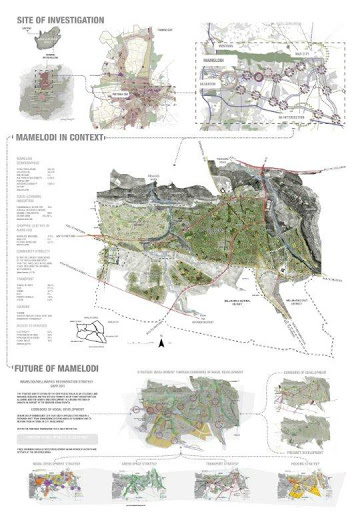
In the end I chose a site adjacent the Pienaarspoort Station, in Mameldoi East after some good advice in regard to working with existing energies and infrastructure, also due to its energy levels around the station, the nature of the housing in the area, and basically a gut feel.

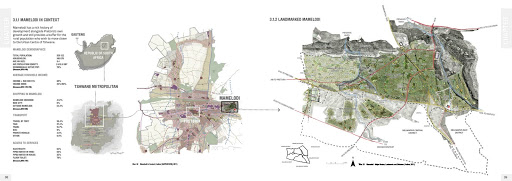
Mamelodi East


Milestone 1 – Concept Presentation

Probably the hardest presentation of my career so far, we had to present our concepts to a jury of externals.

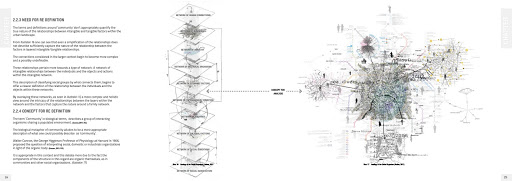
At this stage I’d begun to understand that I was really dealing with aspects of community and how they are more defined through the ideas of a network rather than the current notions of ‘community’.

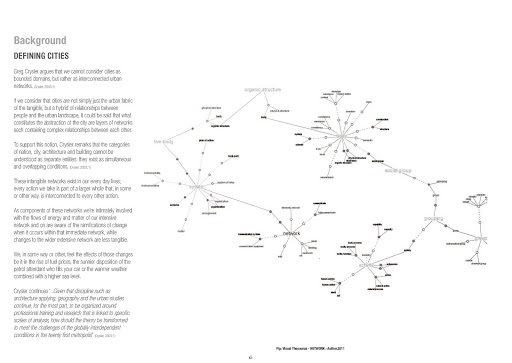
Visual Thesaurus Diagram of Terms around Community

This process of drawing out exactly what we were going to do and present it was extremely difficult, but through this I reached an amazing level of clarity in my own thinking.

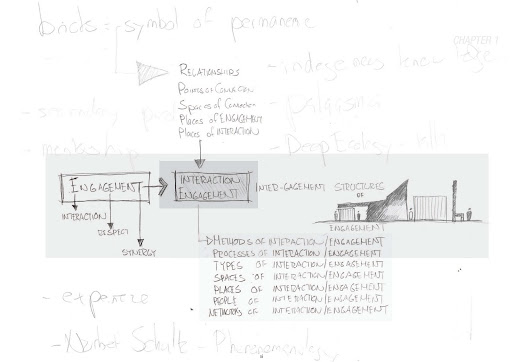
Mind Map of thoughts around Community and Vulnerability at the time

Even though what I presented was not exactly what I was going to do, the act of putting my current thinking on paper and defending it allowed me the freedom to start thinking about how I’m going to intervene on site.

I decided after that presentation to focus on the networks around the brick makers I had met earlier in the year.

Milestone F – Framework Presentations


We had to present our ideas for our framework presentation and summarise how we were going to intervene at an urban level. Because the 3 of us working in Mamelodi were so far apart, we agreed on the points of GAPP’s framework we liked and then each responded individually to our own sites.

Milestone G.1 – Chapters 1-3: Broadstrokes

The last submission of the term was the broad strokes submission of chapters 1-3. Again this process of forcing ideas onto paper has brought me to a clearer stage of thinking.


Moving Forward

Post hand in I’ve begun to start considering the notions of ‘temporal architcture’ for this site.

My gut is telling me that the intervention needs to be designed into many phases with each phase being functionally holistic towards the next:

i.e While working in Slovo Park we designed benches for the mobile clinic, but those benches were designed to support walls later to house the actual clinic e.t.c

So the quick easy phases (required for interventions in economically  vulnerable areas) can be implemented to meet the basic needs while the function remains intricately linked with the space for the next more complex
phase.

Within this idea is that of a temporal architecture; the beauty of aesthetic  beautiful lies in its ‘non completness’ the same way that buildings under construction are more interesting and expressive than the complete product.

And that in an area like Mamelodi, this is crucial in order to allow the building to grow with the people’s development and cultivate ownership and meaning towards the structure.

I feel the programme’s around the brick makers and linked construction activities will serve to enforce this idea as well.

*
End

Corobrik Student of the Year Awards- 2010

The Corobrick Student of the Year -2010 finalists were exhibited at the Wanderes Club, Illovo in Johannesburg in April this year.

Several of us ‘bou-kinders’ and other students were fortunate enough to attend the exhibition and the accompanied lecture by Paragon Architecture’s Henning Erasmus.

The choices we all face
Architecture Karate

Being heavily involved in my dissertation at the moment, this was a great opportunity to see what the country’s finest architecture students of 2010 had to offer.

*
THE FINALISTS
INTERPRETATION CENTER

PJ Klippie De Toit
Tshwane University of Technology

    \    

The opportunity that this unique site of natural and cultural heritage presents, for establishing a new ecological paradigm of connectivity and interdependence, is utilised by this design through spherical geometry and a cyclical narrative. The crater, if properly understood, reminds us of our common origin and place in the universe as well as the essential unity of all existence. 
The thesis maintains that the building will be a heuristic or didactic device that reinforces this connection. The narrative, an elliptical walkway referencing the cycle of eternal return and metaphor for the timeline of the universe and earth, explains the evolution of the universe through various interpretation venues, each creating an experience analogous as well as symbolic of the event that occurred at that point in the history of creation.
excerpt taken from http://www.keepitgreen.co.za 

  
INNER CITY INTERCHANGE
Cazir Naroth
The University of Kwa-Zulu Natal


The projects aims to bring the possibility of a fully integrated modal interchange facility to the South African city. The site, which is already zoned for public transport, is situated in the Durban CBD at the intersection of existing major road and rail infrastructure, with the interchange forming the backbone of a greater urban scheme.
Global environmental and economic issues, along with local cultural and social history provide a solid justification for the promotion of public transport and the scheme seeks to create a thriving hub at a key point in a city that is thirsty for an injection of activity. The proposed complex allows for the seamless integration of busses, taxis and trains whilst attempting to use transport as a tool to create civic spaces wherein socioeconomic integration can naturally occur. The potential of such a facility calls for a solution on a greater urban level, and my scheme seeks to promote both the rejuvenation and development of the surrounding areas by proposing a precinct master plan that suggests new development whilst reinforcing the existing infrastructure.
In essence the design provides a spine of pedestrian life and a spectrum of positive development, which radiate from a contemporary urban transport landmark. 
excerpt taken from http://www.keepitgreen.co.za  

ECHOES IN ARCHITECTURE
Pierre De Lange
University of the Free State

Echoes in Architecture was an investigation into a how the intervention of a new building can reconciliate a neglected historical structure. Specifically, the old Rissik Street Post Office in the Johannesburg City Centre which was devastated by a fire in November 2009. The project aimed to marry contemporary and historic architecture to achieve an equilibrium between preserving cultural heritage and providing a memorable urban space. The result was a subtle geometric insertion so that the new appears to be hugged by the existing ruin. This created a building with two fronts; the face of memory (old) and hope (new).
excerpt taken from http://www.keepitgreen.co.za 

SECURING OUR FUTURE
Nikhil Tricam
Nelson Mandela Metropolitan University

Close Ups…


My project focuses on introducing urban spatial and formal hierarchy into the township through the introduction of an Urban Health Precinct with emphasis on the detailed design of a Mother & Child Centre, in the township of KwaZakhele, Port Elizabeth. The choice of building type stems from the addressing of current social concerns, namely the lack of adequate healthcare facilities in our township areas as well as alarmingly low infant care standards. The treatise focuses on the investigation of the constituents of nurturing & healing space, as well as the introduction of identity and a sense of place within a historically segregationalist, architectural identity-devoid context. The components of the building include a pre- and post- natal facility, delivery and recovery as well as an educational component focused on, but not limited to, the empowerment of women form the community, drawing on their experience as mothers and caregivers to educate younger and first time mothers.
Nikhil also won the best use of clay brick for his entry. He says, “I chose to make extensive use of brick masonry in my design due primarily to the sense of permanence conveyed through it’s tectonic, which was integral to the conceptual direction my design has taken. The spatial and formal possibilities afforded by bricks are well documented and it was my intention to exploit these. The environmental imperative, affordability and relative ease of construction were all factors in the selection of brick masonry as a building material. Personal preference and a predilection for the works of Louis Kahn and Rogelio Salmona was influential in the manner in which the brickwork was employed in my design.  
excerpt taken from http://www.keepitgreen.co.za 
  

PROXIMITY
Calayde Davies
University of Pretoria 

Close Ups…

The thesis generates an architectural model for vertical hydroponic agriculture for the city of Pretoria on the existing industrial heritage site of the Old Pretoria West Power Station. The project aims to aid in the development of a new productive urban building, productive urban landscape and ultimately a productive urban society for South Africa in the 21st century. The design also caters for an urban market and agriculture park as part of the food factory concept. The project is sustainable and resource-efficient and aims to become a model for urban reform through urban agriculture across the city of Pretoria. The design is a seven-storey indoor food-growing building, constructed entirely from contemporary and experimental building materials in the forms of structural bamboo, structural steel and bamboo-reinforced concrete. 
excerpt taken from http://www.keepitgreen.co.za 
 

QUARANTINE
Catherine De Souza
University of Witwaterstrand 

I believe that may be Catherine De Souza peeping up from behind the model…


Close Ups…

My project explores the conditions of quarantine of patients infected with drug-resistant TB at Sizwe Infectious Diseases Hospital on the east of Johannesburg. 
It does not seek to liberate them, to do away with the institution, or to integrate the hospital with its surrounding suburban context, but rather recognises the irrefutable need for such institutions in the face of the very serious public health threat posed by drug-resistant TB. 
The project thus has two interrelated aims.

I To change the nature and quality of quarantine
II To capitalise on the natural resources of the site  This involves improving the quality of life of patients, creating a sense of connectedness to the world outside, and providing possibilities for income-generating work.  


However, it contends that equally important is the need to pay attention to the human rights and dignity of the people who find themselves, through no fault of their own, held in these institutions in conditions not unlike prison.
The second aim is to rehabilitate, conserve and make accessible to the public the grasslands and watercourses of the site by incorporating them into a nature reserve.
The architectural design works with the idea of territorialising the boundary, layering thresholds and creating new possibilities for passage; it exploits non-mechanised means to create infection-safe living environments; and it explores possibilities of landscape integration which are uncharacteristic of modern institutions.

excerpt taken from http://www.keepitgreen.co.za

KL-METAMATIC (Winner)
Stefan Van Biljon
University of Cape Town

Close Ups…
 The Structure
Supporting Models

The tension between an industrial site and natural forces inspired the project at Cape Town’s Duncan Dock.
A seawall manifold reintroduces water to the reclaimed site. The tide is choreographed to create a changing landscape that registers the passage of time as the sea gradually consumes the site. The effects of the flood are used to amplify the atmosphere of the site.
The flood machine communicates in gesture, compelling guests to interpret its response to the elements. Atmospheric restlessness is used to create a place of contemplation.
Facing systematic destruction, the building haunts KL-Berth. This haunting is a function of patience and risk. The site becomes a barometer for wider environmental issues.

excerpt taken from http://www.keepitgreen.co.za

*
As a mid-masters student the exhibition was incredibly inspirational while simultaneously very daunting…
There was much debate amongst the boukinders after the exhibition, especially around the winning entry.
Many felt the project wasn’t a true architectural project for an Masters in Achitecture (Prof) degree, while others were simply too impressed to see anything wrong with the project.
There is unconfirmed talk that the student was awarded 100% by his final jury panel during is masters presentation, and was told by one of his own faculty that if he, the faculty member, had it his way – he would have failed him.
I guess that is the nature of these designs of architectural poetry, some people will love every expressive piece of the work while others will fail to see the point; you’ll never know until the last minute whether the project is what you hoped, or if it was worth putting in all your chips for the win.
 *

Pre Masters Building Study

Every December my family’s evacuation from Durban to the relatively drier and calmer Western Cape takes us through the Transkei, Eastern Cape and Western Cape at break neck speed to lessen the hassle of the trip, a 1660km journey through the N2.
*Note 1

Having been involved in this pilgrimage for most of my life, and hardly experiencing more than a 5 minute fast food breakfast en route, I was determined to see what the N2 had to offer me as a student, a South African and Durbanite living in Pretoria with attachment issues from his time in Cape Town. 
The Blue Book
After a brief online look into what information was available on line for an Architectural Tourist, a flip through through Ora Jouberts Blue Book and a Friday bunny chow session with my former undergraduate lecturer Derek Van Heerdan I had mapped out a rough assortment of stops along the N2.

The focus of the trip began as a quite broad look into contemporary Architecture in developing settlements of South Africa – I had no specific question to answer, I felt the journey was more a search for a question rather than a search for an answer.

*
*NOTE: All images from Author unless indicated. *Note 1 IMAGE: adapted from http://www.gallerytours.net/images/1time-Map.gif
SOUTHERN KWA-ZULU NATAL/EASTERN CAPE

Shayamoya

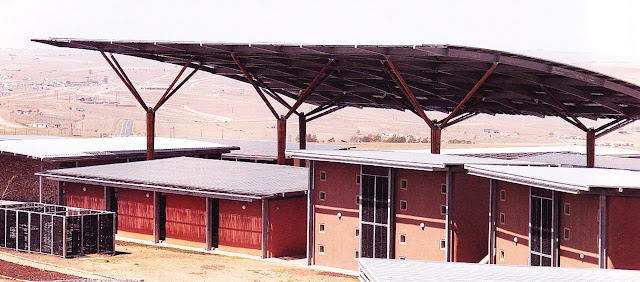
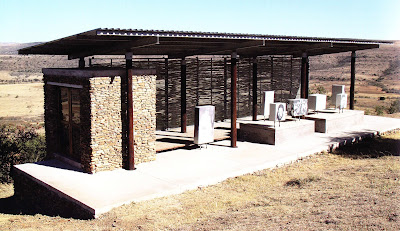
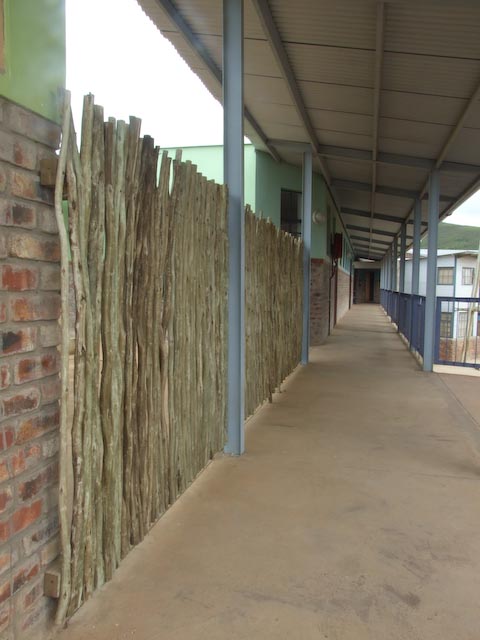
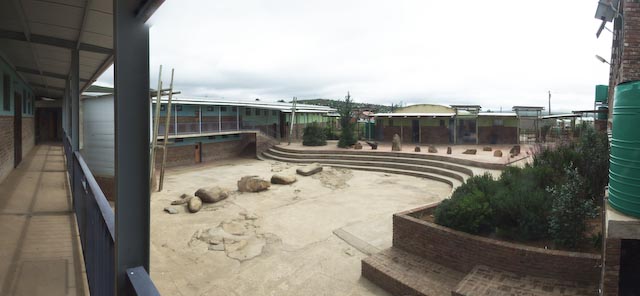
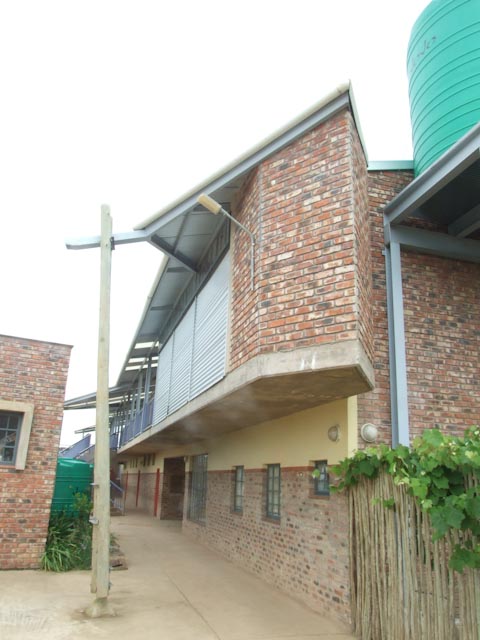
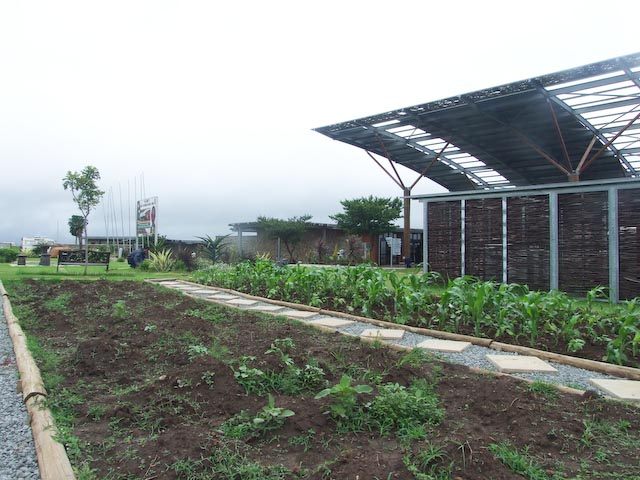
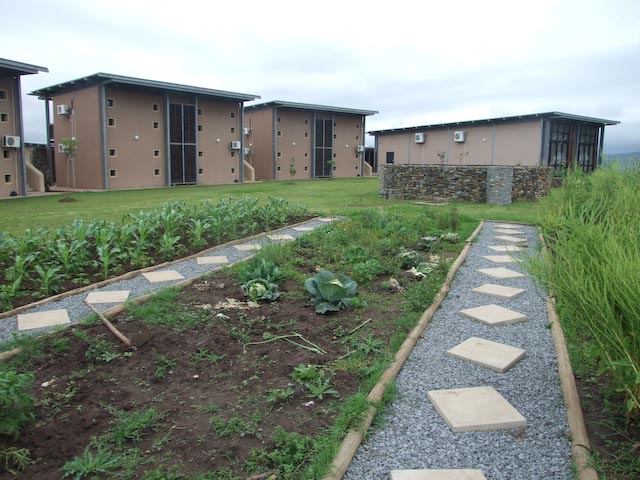
The first stop was just outside Kokstad, Kwa-Zulu Natal in the small settlement of Shayamoya to visit  the 7 Fountains Primary School.
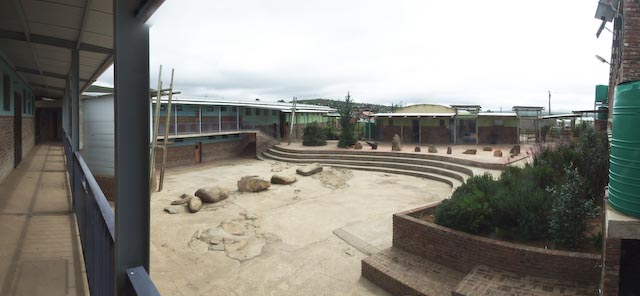
 
The primary school was designed by East Coast Architects  and commissioned by Oprah’s Angel Network as part of their community involvement in South Africa.


An East Coast Architect scheme would not be complete a Jojo Tank or an indigenous garden
 
The Nelson Mandela Heritage Trail

While searching for Architectural Tourist sites online, I came across several links to a Nelson Mandela Historical Route.

The articles described a network of famous sites related to Nelson Mandela’s life such as Qunu, the place of Mandela’s birth, Mveso, Mthata and highlighting points such as University of Fort Hare in Alice, where he was educated, and going further into Pretoria and Johannesburg as well as Cape Town. The route also mentions Steve Biko’s grave site in King Williams Town.
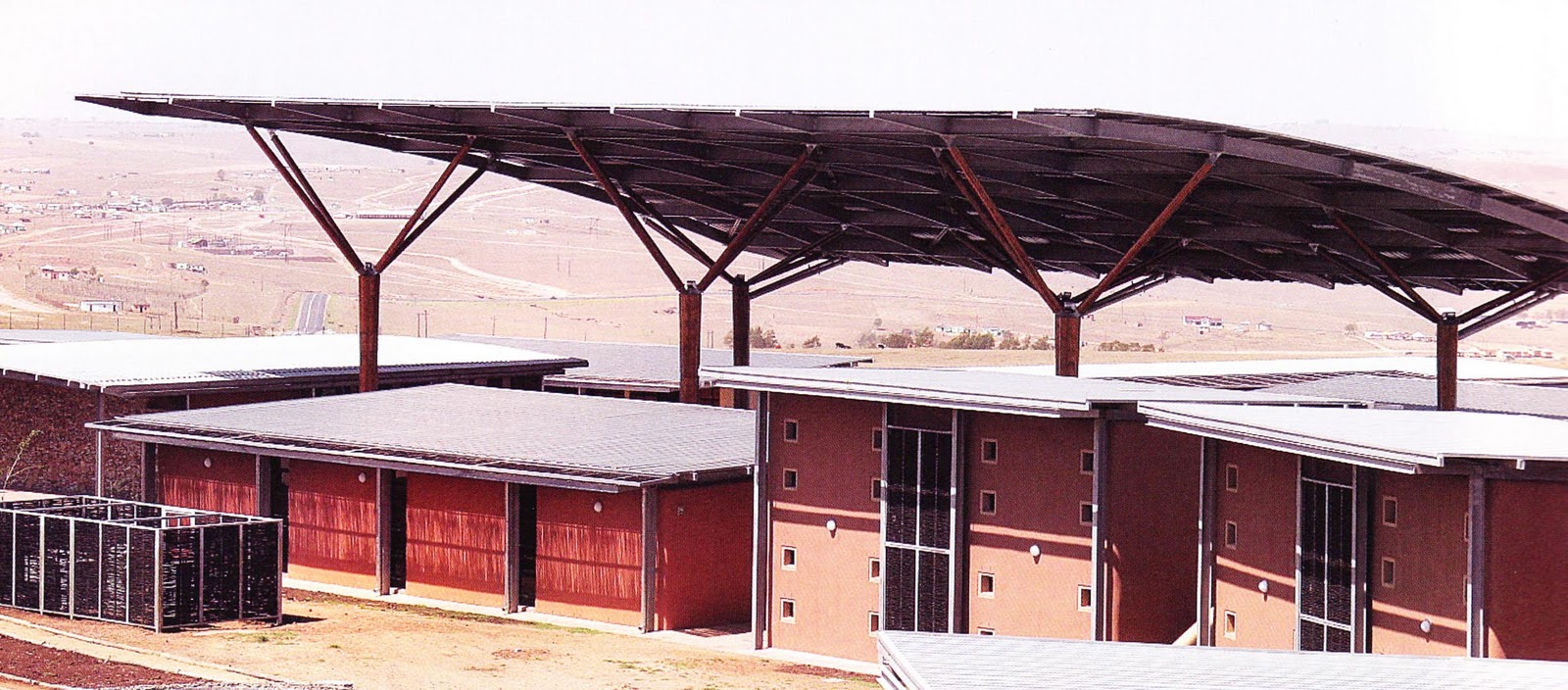
Many of these featured on the N2, with the closest stop being the Youth & Heritage Centre in Qunu. Designed by Stauch Vorster Architects.
At this point in the trip there were some technical issues with the camera, to illustrate the points I have added a one or two referenced images.
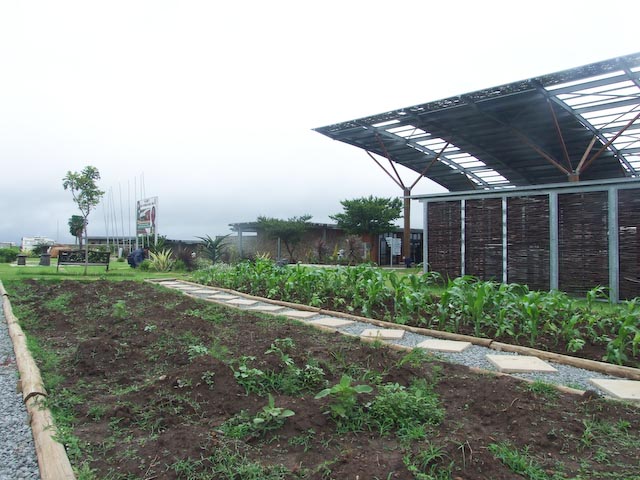
A vegetable garden at the center
IMAGE: Pg 392; 10 Years 100 Buildings, Joubert Et Al


The route included the Nelson Mandela Museum in Mthata, curated by Mashabane Rose Architects. This museum is located in the heart of Mtatha but seemed to only be frequented by European tourists.
IMAGE: http://www.southafrica.info/travel/cultural/mandela-route.htm
IMAGE:http://www.southafrica.info/travel/cultural/mandela-route.htm
The next intended stop was the Mveso Museum Pavilion, designed by Cohen and Judin Architects but the bad condition of the road leading to the heritage site and quickly fading daylight forced us to move on.
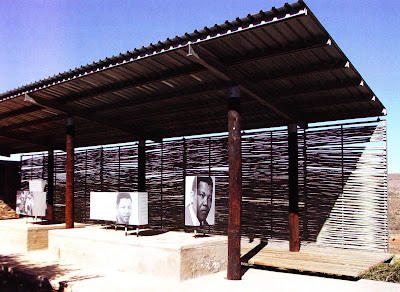
IMAGE: Pg 389; 10 Years 100 Buildings, Joubert Et Al
IMAGE: Pg 388; 10 Years 100 Buildings, Joubert Et Al
PORT ELIZABETH

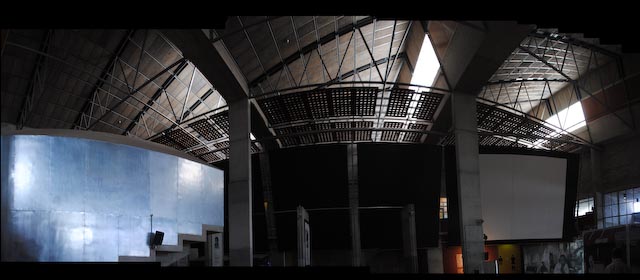
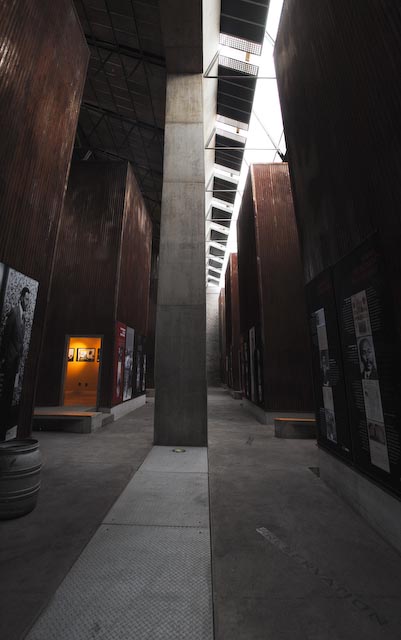
After a restless night on a University digs couch in Grahamstown and a in situ camera repair stint, we headed towards Port Elizabeth to visit the Red Location Museum of Struggle by by the Cape Town firm of Noero & Wolff Architects.
Memory Boxes, intended to symbolise the twilight of memory
The Museum sits in the heart of New Brighton

The Ubuntu Center

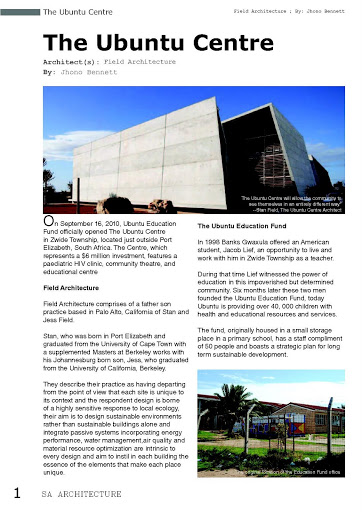
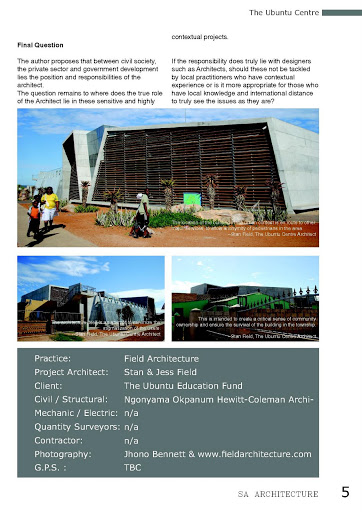
While in Red Location I we came across a recently completed building, the Ubuntu Center by South African born and now California based firm, Field Architecture .

SOMEWHERE ON THE N2…

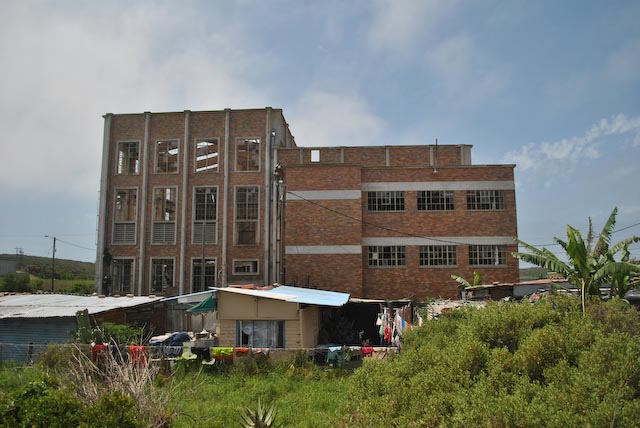
I’ve come across this building many times before and every time I see it I feel this would make quite an interesting project to work on. Unfortunately I can’t remember exactly where it is but its somewhere between Knysna and Mossel Baai on the N2.

There appears to be a whole community that has settled around this former Industrial building. I didn’t get close enough to see the extent of their interaction with the structure itself , but a large tree is growing inside.

CAPE TOWN

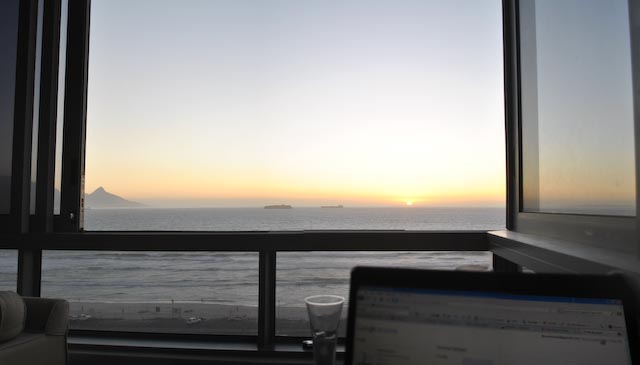
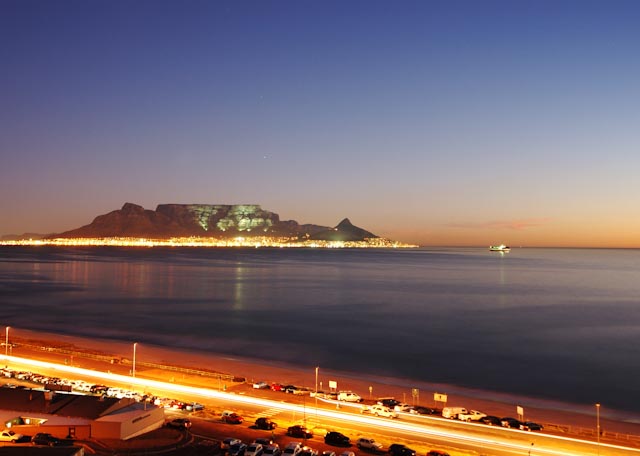
Arriving in the mother city I found accommodation with a former classmate from the University of Kwa-Zulu Natal, who happened to have a spectacular view from his beautiful home in Blouberg. Courtesy of my host I had a breathtaking view from my ‘Cape Office’ while preparing for the year ahead.
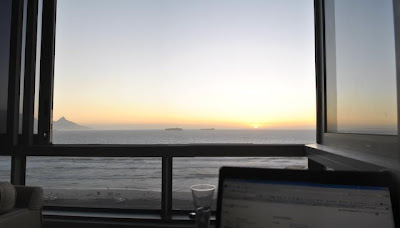
Cape Office View. Average.
IMAGE: BY JOSHUA PUTZ

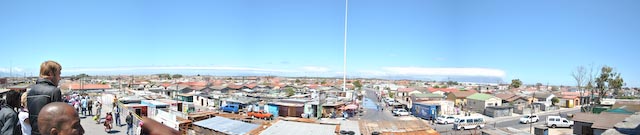
The Cape stop was a twofold affair. In one regard I had much administrative issues to resolve from my former life in the Mountain City, on the other hand I had met many people during my time with Architecture for Humanity who were involved in projects in Kayalitsha and other developing areas in the Cape that I felt would be of interest towards my pre-masters resarch.

Kirstenbosch Gardens

  
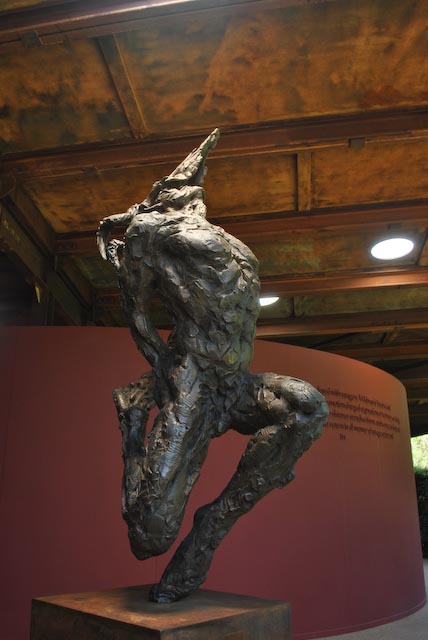
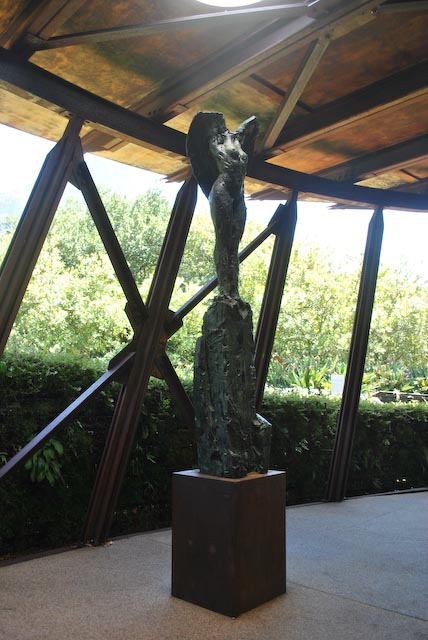
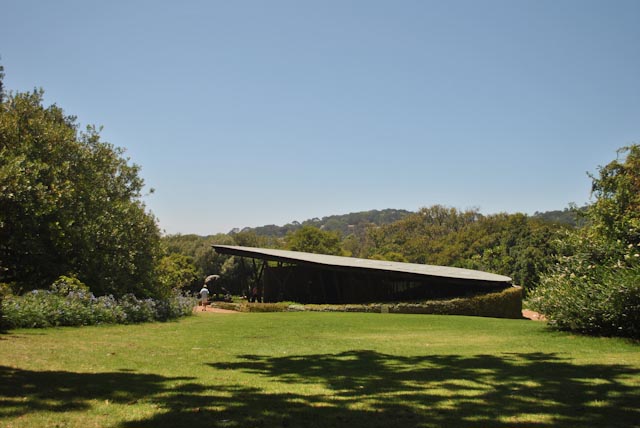
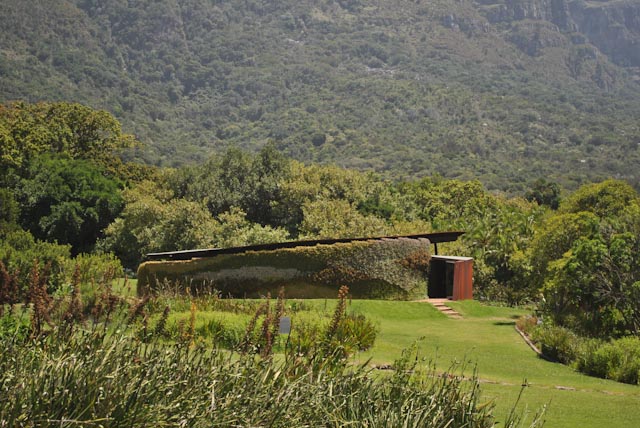
Between my administrative obligations I found time to visit Kirstenbosch for some mountain time and came across this very interesting exhibition building in the gardens.  Dylan Lewis‘s sculptures have always fascinated me and this building together with his work was well worth the surprise.
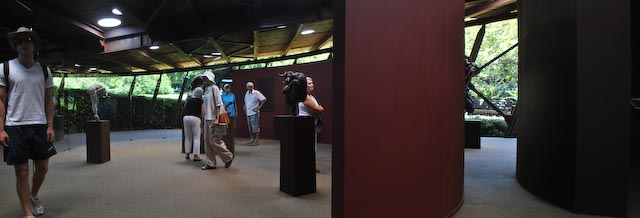
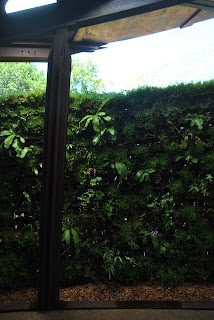
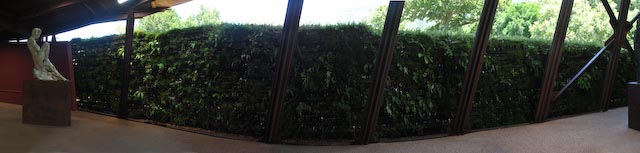
A planted wall wraps around the exhibition centre
The UNTAMED exhibition is a collaboration between sculptor  Dylan Lewis, Architect Enrico Daffonchio and Poet Ian Mcullum

Kayalitsha

I was fortunate enough to attend a trip in Kayalitsha planned by one such contact, Verena Grips, whose involvement with an NGO called MatchBox was of great interest towards my now narrowing focus on developing areas of South Africa.

MatchBox aims towards improving the quality of life and learning of children in townships. Verena had arranged a trip with another student who was looking into Township Tourism in South Africa.

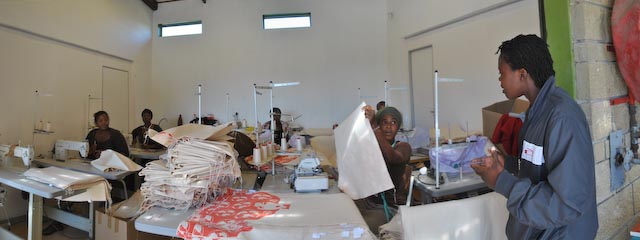
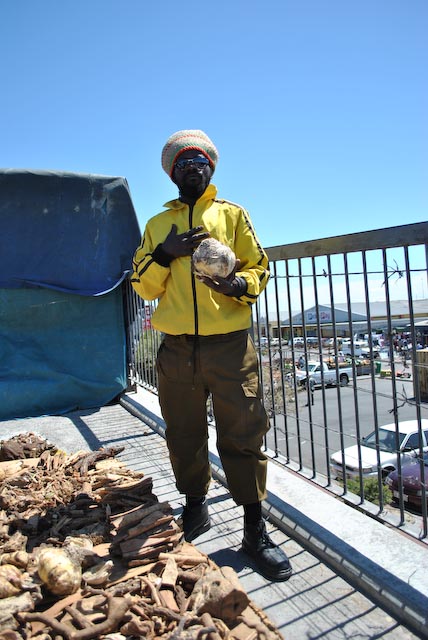
The first stop in that trip was the Look Out Hill Visitor Information Centre, here we met a local tour guide  from Coffee Bean Routes tours.

Our tour guide took us through the centre, where we met some of local ladies who work with another group to produce hand bags to sell in market.
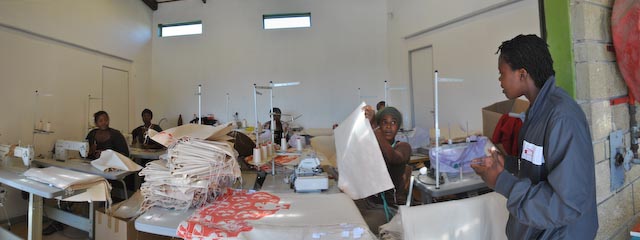
As the name implies the centre is overlooked by one of the higher points in Kayalitsha and offers a panoramic view of the settlement.
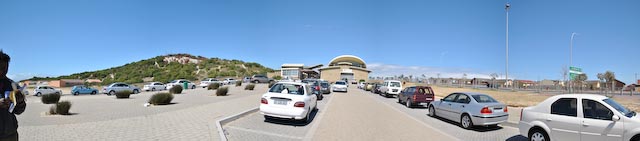


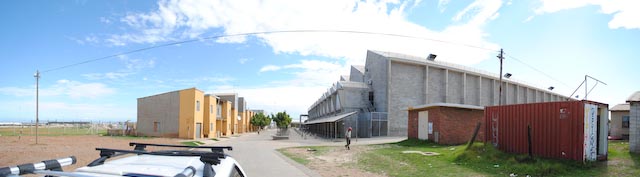
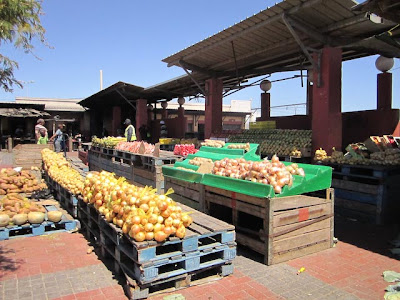
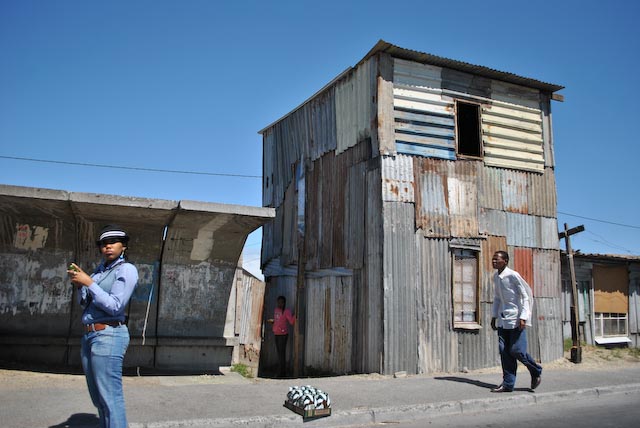
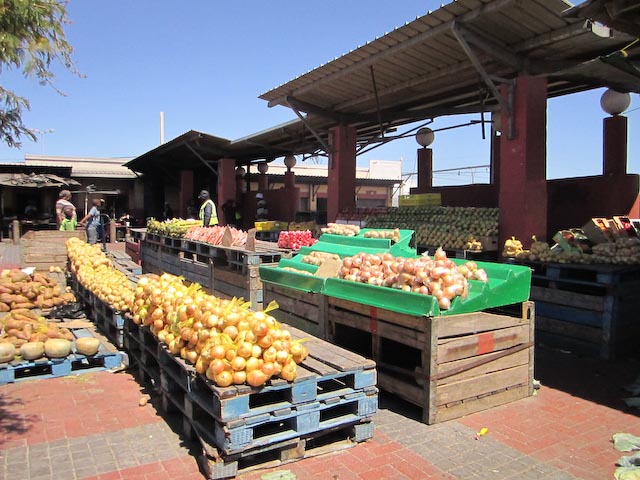
From here we visited the largest shopping mall in the area, the Nonqubela Link Mall , this mall sits adjacent to a train stop and between is serviced by a local market. What we found interesting was that an informal market could exist with a formal mall and still function.

The ‘formal’
The ‘informal’
View from the station platform

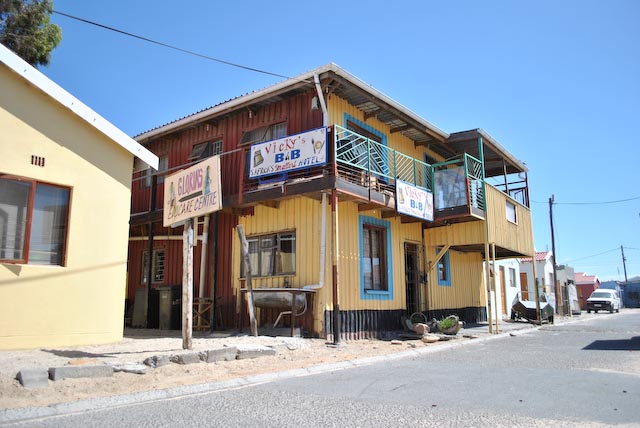
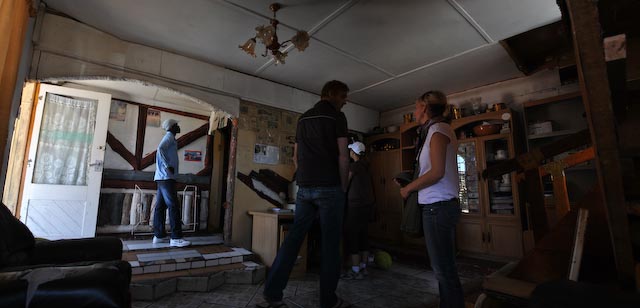
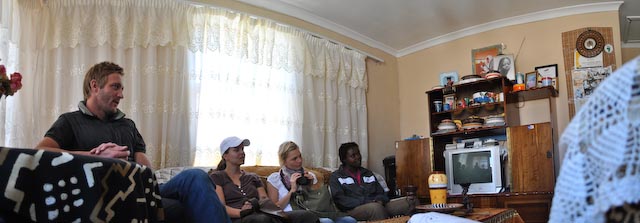
As part of the township tourism our guide had planned the next few stops at woman run local B&B’s. These ladies were running successfull lodging facilities and invited us in for a cup of tea and some interesting stories of foreign visitors, radio talks shows and how they share their skill base with others in the same business field.

Vicki’s Bed and Breakfast


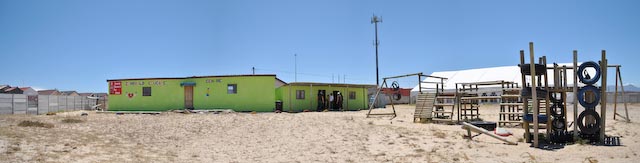
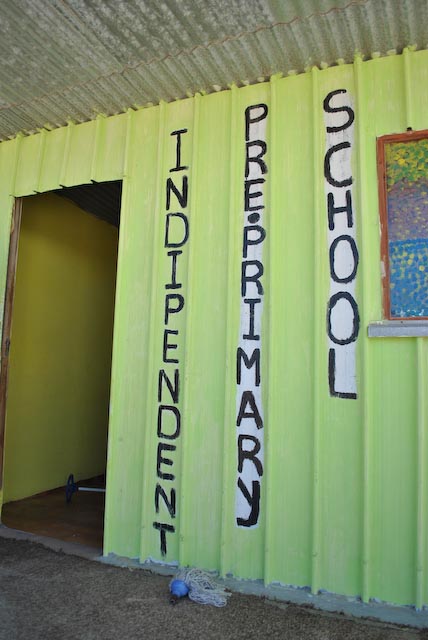
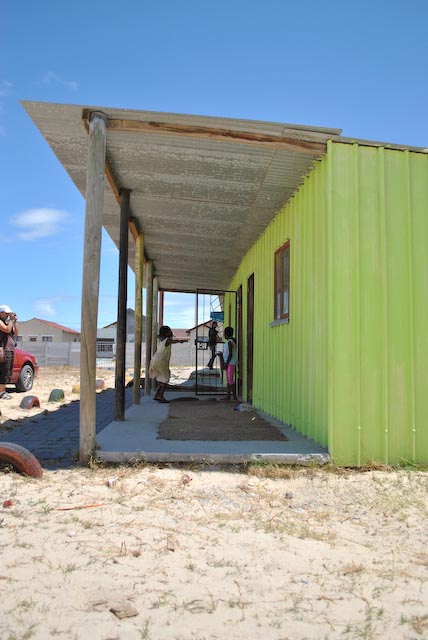
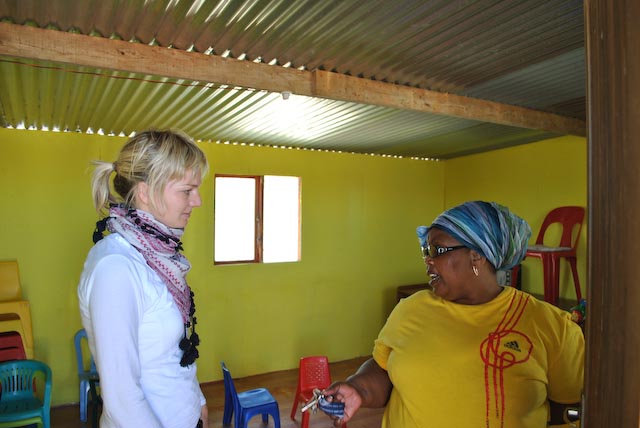
Verena’s personal focus on creche’s and day care facilities that have been adapted from donated containers such as the Zanoxolo Educare Creche took us to some of these spots in Kayalitsha.
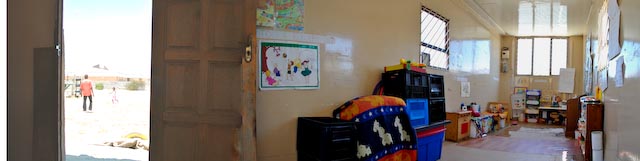

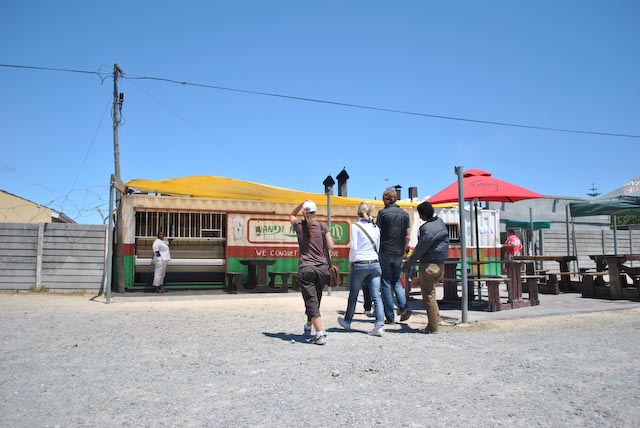
In true township tourism fashion we finished the day off with a visit to a local shebeen. While Mzoli’s in Gugelthu is probably the most well known of Cape Town’s township hotspots, it was Kayalitsha’s less known counterpart Ace’s that we chose as our lunchtime destination.


STELLENBOSCH

Transdiciplinary Workshop

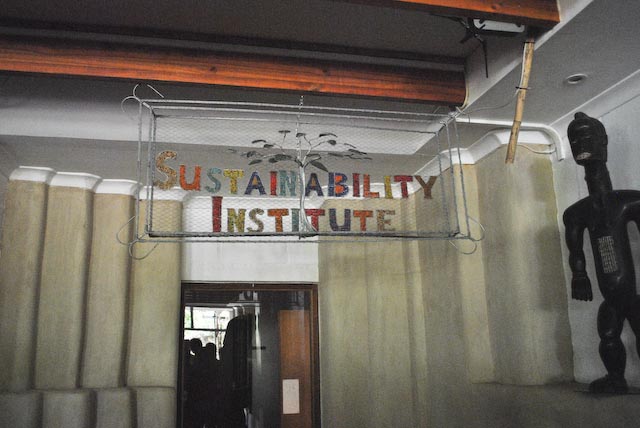
The final stop in the trip was planned for Stellenbosch’s Lynedoche Village. Here, I was registered for a week long workshop seminar on Interdisciplinary Sustainability at the Sustainability Institute.

The workshop itself was intended for PHD candidates, but the organisers were happy to accommodate me at a pre-masters level.

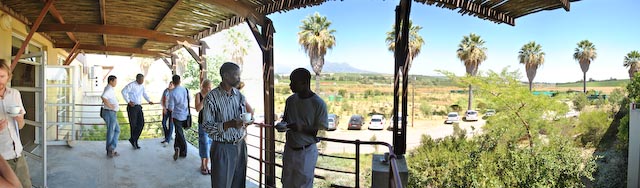
The balcony of the institute became the place of dissemination of the course’s content

The workshop was attended by a diverse cross section of professionals who, like me, were interested in learning of cross-disciplinary approaches towards sustainability.

The disciplinary spectrum included; a physchologist, a graphic designer, microbiologist, nutritionists, industrial designer, IT economists, social scientists, geological and environmental scientist and even a hydrologist to name a few.


The course was run by two representatives from the Stockholm Resilience Centre and overseen by John Van Breda from the Sustainability Institute.

The week included definitions and discussions around Transdisciplinary Work with local and foreign case studies and exercises in defining roles and outcomes of the various parties in Transdisciplinary Work. 

Part of the exercises involved defining the research questions and role playing processes on ascertaining how to set up a research project around a Transdisciplinary team. This exercise proved to undo much of how I had planned on tackling my thesis topic and gave me a clear insight of where to go in my masters year.

While the exercises and explanations of what Transdisciplinary Work  appeared to be much in the scope of how Architects and other designers work through problems the center itself held an interest for me.

The Sustainability Institute

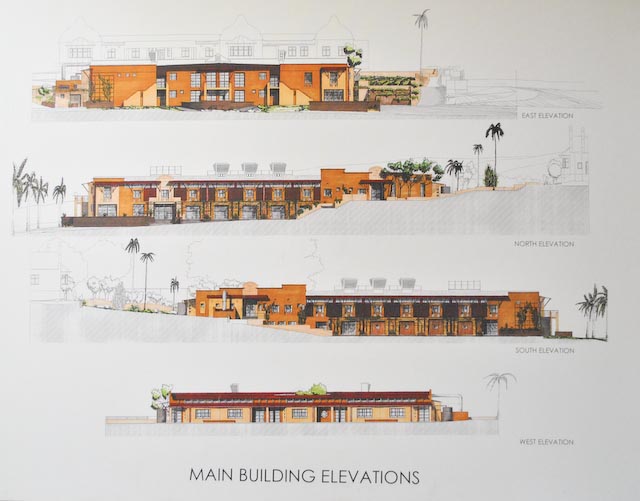
A render of the built structure as presented on the walls of the center on canvas

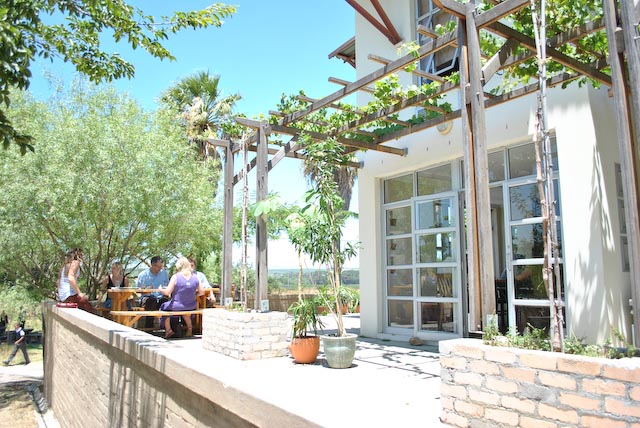
The building is located in the area of Lynedoch, adjacent the train station and according to the staff, the site was historical a weekend hotel for the upper echelon of Cape Society to ‘escape’ the city and enjoy a game of croquet in the Boland.

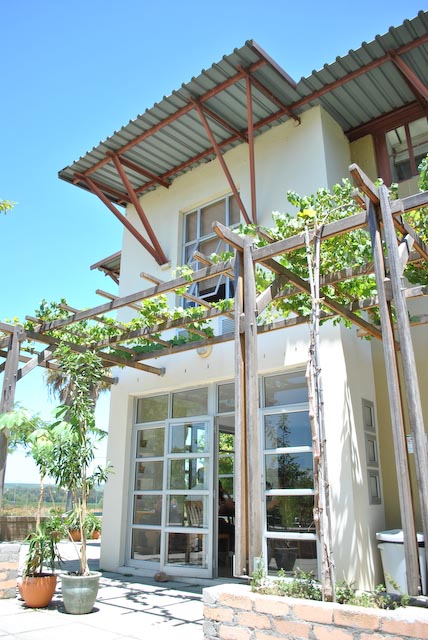
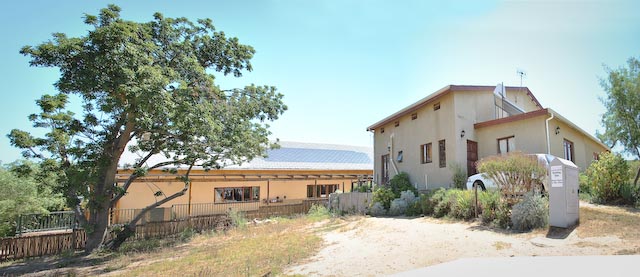
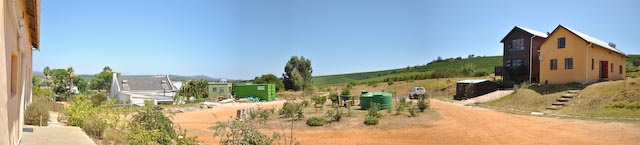
The center and the surrounding gardens
The existing hotel and new centre in contrast

The center now is a research hub for Sustainability in South Africa and is globally recognised as a leader in the field headed by Mark Swilling. For the detailed story of the Sustainability Institute click here.


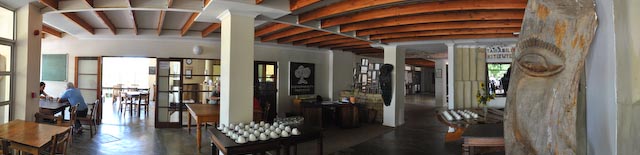
Over meals provided on site by the institute gardens the informal meeting and sitting areas inside and outside proved to be the most interesting part of the week as this is where the real interdisciplinary discussion took place. 

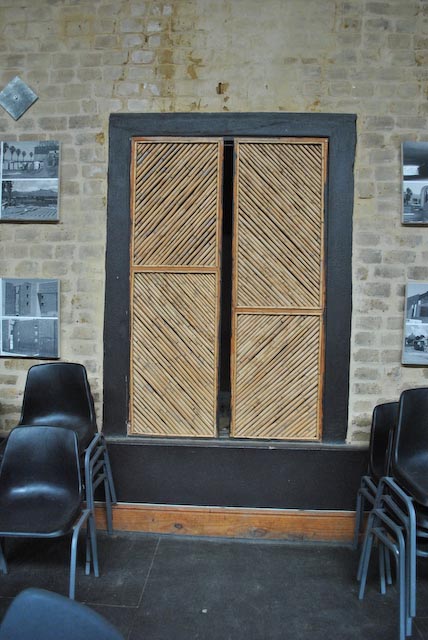
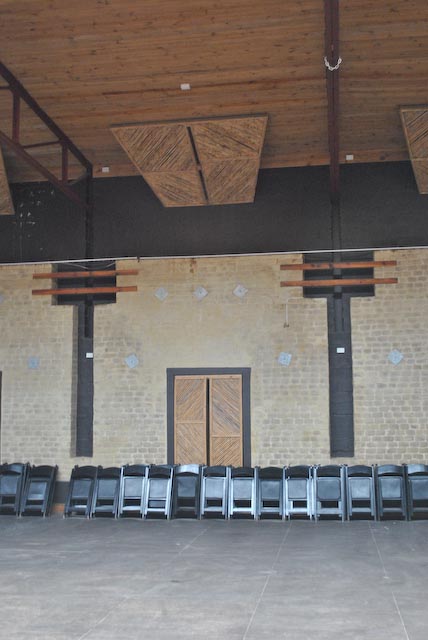
The centre was designed by Cape Town’s ARC Architects and wraps around what appears to be a cement block barn structure on site that was adapted to become a community hall for the historically disadvantaged community of Lynedoche.


 The adapted barn houses a rock store in its basement that works as a thermal change mass to cool the class rooms of the primary school. The relationship between the primary school, the community came across as the strongest intangibly sustainable aspect of the entire centre. All day school children and local residents animate the and enrich the atmosphere of the institute facility.

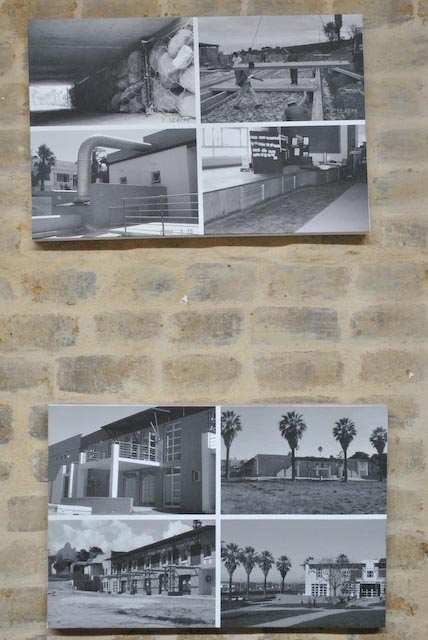
Historic photo of construction and thermal rock store

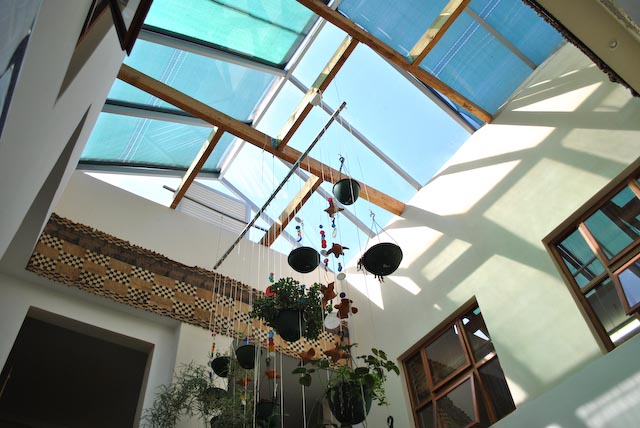
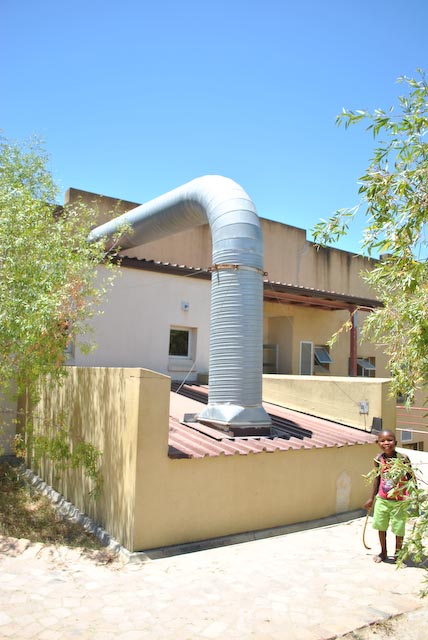
The community hall uses a system of wind funnels and louvres to cool the space itself, while the thermal rock store serves the primary school facilities.

Wind scoops work with wind chimneys on the roof in a similar fashion to malqaf  found in Islamic Architecture


The converted barn is clad with adobe bricks that serve an undefined role, perhaps only ornamental?

The center interacts closely with this community and facilitates a primary school on site as well as subsided housing on the estate as well and harvesting programs in the area along with local farmers and residents.

The thermal rock store ventilation link to cool the primary school.


Day care facility with solar roof tiles

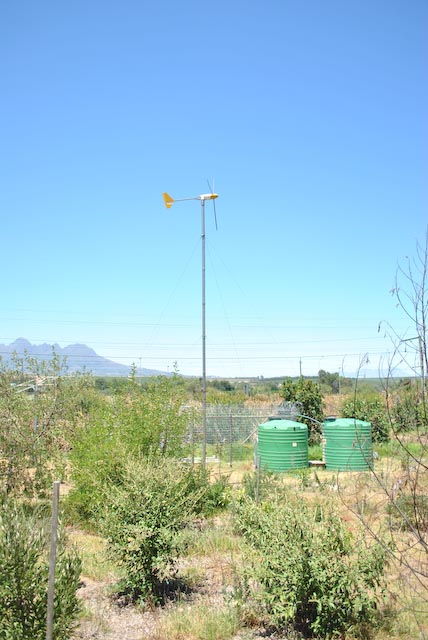
The estate boasts an array of off grid systems that deal with waste treatment, energy & food production. These systems as well a daycare facility on site aim to provide the local residents of Lyndoche with jobs while acting as a model for socially as well as environmentally responsible facility.

Vertically Integrated Constructed Wetland
The Biolytix System

A large portion of the job creation as well as the training for students comes from the garden systems on site. At the moment they grow there own vegetables on site

Recycling post and agriculture on site


An age old meeting venue, under the shade of an old tree

Indigenous tree plantation

The facility is housed by its own eco-estate. These houses work within the framework of the institute and provide research data as well as accommodation. They employ various techniques and processes to lower their respective carbon footprints.

Part of the eco estate with the black water collection pionts
*

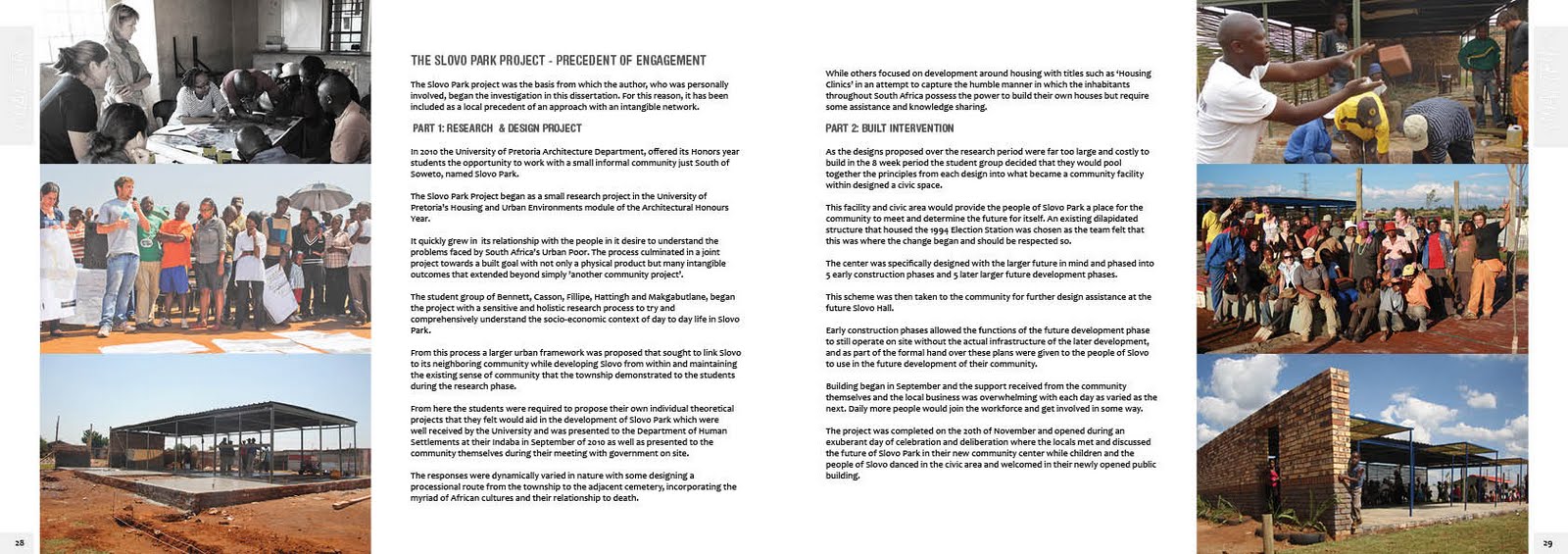
When asked in December what would be an appropriate focus for a thesis topic, it seemed to continue in Slovo Park was the obvious option: strong connections with the community had been made, the context was mapped and an insight into the needs and dreams of the people had been established.

Slovo Park Group Framework (Bennett, Casson, Fillipe, Hattingh, Makgabutlane)
The first draft of the proposal I outlined the development and research of the spruit area between the two communities and an architectural investigation into how that could be done through a built intervention possibly exploring urban agriculture.
*
My time cross-country gave me space to reflect on my time in Slovo Park and Pretoria,bringing a more clear understanding of my role as an architect and designer in developing South Africa
The workshop at the Sustainability Institute provided me with a sharper focus on my thesis year and liberated me from my pre-conceptions of the role of architects in social upliftment and research and a result forced my decision not to work in Slovo Park in 2011.
The trip left me with more questions than answers, a disposition that I’m starting to feel is likely to be more commonplace in my year ahead while in pursuit of my Masters Degree.
2010 END.