The Housing Clinic

The Housing Clinic
From the standpoint that the issues around housing in South Africa are too complex and vast for anyone to easily get a grasp on the concept, the design seeks to give a tangible face to the solutions.

The Approach

The housing SA brand is meant to be the face for Housing South Africa, a joint initiative with local government, NGO’s and the homeowner themselves.


Through this coalition of energies will housing the nation begin to work.


Nodal Development
The master development plan, in order to structure the growth of Slovo in a sustainable manner within Nodal development the key site at the juncture of the existing, with the industrial (the future) and the green field site to establish the new town center.
 
Incremental Growth
The growth and and placement of the initial building is intended to feed off the energies of the new bus stop, creating a dialogue with the community and establishing itself initially in its context.  As it grows it will do so along a grid determined off the existing housing and start to affect the existing housing through its interaction with the people who it serves.
           
Housing Doctor
The concept of housing as a service is carried through to the design in that a housing ‘Doctor’ CSA (Community Service Architect) is posted to the site and through interaction with the community in dealing with their initial housing problems, ie leaking roofs, bad insulation, over heating, access to housing subsidies etc, the CSA then learns from the people and shares his knowledge and the knowledge of the people in order to help them.   
The CSA also provides the link to government and disburses information on available subsidies. RDP waiting lists and other housing options. More so, the Housing Clinic is intended to be a showcase of good building principles and new and effective technologies, the building itself will be a demonstration to the community it serves.


The Housing Clinic is intended to be key element in any community becoming a part of their day to day life. The Tower structure is the first step in introducing the notions of good development on a large scale by showing the people that they are part of a larger community and not just marginalised individuals.
The Housing Clinic itself is a showcase of good building principles and exemplifies the practices of what the people in the community build and others. The Housing Clinic is just one part of a larger network of such offices, spreading these principles and ideas through out the country, becoming the living manifestation of the Red Book.  

Housing & Urban Environments (H-UE)

Quarter 3 

The final project for our 3 quarter session was that of Urban and Urban Environments, we were given a choice of 2 sites and expected to undertake the necessary research to and try gain an understanding of the urban condition of the area. From this we were expected to derive a building  that dealt with housing in its context. All within 6 weeks.

*


Slovo Park
The site chosen was located in Slovo Park, which is roughly 5km South of Kliptown in Gauteng (10km South of Soweto).


The settlement is considered ‘informal’ by government standards and has no formal services short of Standard Bank sponsored pit latrines on the street front of each house. Electricity was provided in the form of invasive floodlighting, as this was not integrated with the community’s consent the floodlight were disconnected and the electricity found uses elsewhere in the settlement through a process we came to know as ‘inyoka-ing’.


The community differs from others in their collective approach to take the first initial steps in being aided by government in their community organisational structures and their use of the grid structure from their neighboring ‘formal’ settlement (El Derado Park) to lay out their houses.

By doing so, they havemade their settlement more easily serviceable without disturbing the existing nature and fabric of the inhabitant lives.

Urban Analysis

Our study culminated in the framework analysis  presented below.


University of Pretoria H-UE Group (Bennett, Casson, Fillipe, Hattingh, Makabutlane), 2010


Our recommendations were basically outlined in the treatment of the edges delicately to release identified energies within the community that would catalytic ally enhance the growth of the community from within in.

These edge treatments were identified along routes that linked the settlement to other developed settlements in the area.
These links were described to manifest in various ways, the most significant being a proposed system of community farms that would occupy the now vacant Harrington Spruit. 

These connections and edge treatments would in effect link the site through nodal development to the greater JHB network.


University of Pretoria H-UE Group (Bennett, Casson, Fillipe, Hattingh, Makgabutlane), 2010

Built Intervention
Recently the entire project was presented to the Department of Human Settlements meeting in Pretoria.

The Slovo Park Group has now taken the combined principles of their work over the last 3 months and designed a small key intervention at the existing community center. The group hopes to complete the project by November this year and is busy arranging the necessary funding to complete the task.

 
The Slovo Park Project can be viewed on its own website  
www.slovo-park.blogspot.com

Heritage & Cultural Landscapes- Pretoria Art Museum

Quarter 1
 

My first project at the University of Pretoria was the adaptive re-use of the existing Pretoria Art Museum within the context of Arcadia Park.


This was a particularly difficult project due to the unfathomably subjective possibilities of design approaches based on the notions of ‘Cultural Significance’. Anyone who has attempted a heritage project will understand the complexities involved in working through this process.


My first attempt at this project led me down quite a revealing path as this was my first project after working in an office for two years. I guess my initial need to prove myself as a designer and work using ‘office design logic’ could only produce what was originally presented.


But the re-worked presentation was quite a cathartic process to practice and implement what I’ve learnt at UP.

*

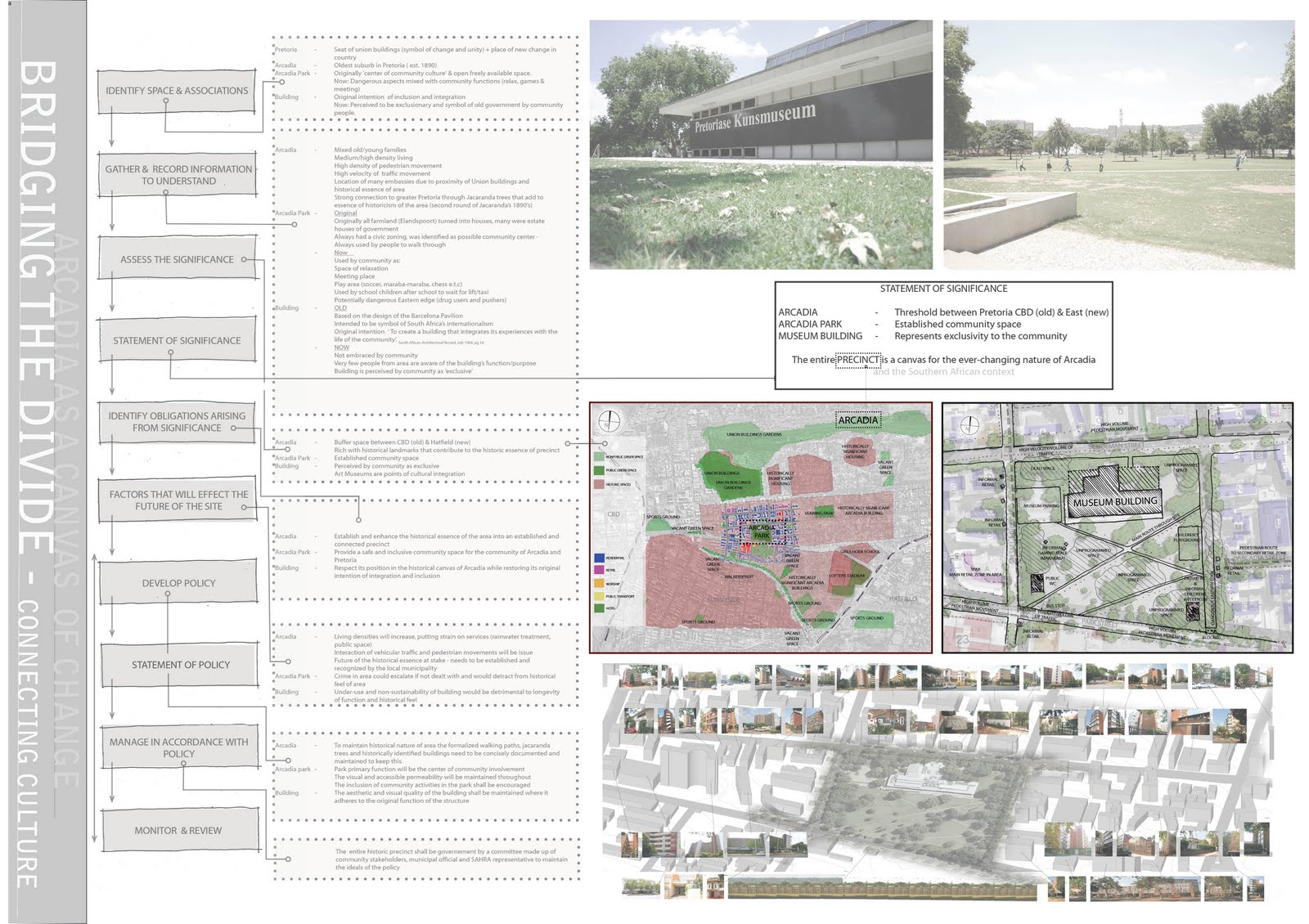
Statement of Significance:
Arcadia (the oldest suburb in Pretoria) is a cultural canvas of the change Pretoria experienced as a city
Arcadia Park is the community space that belongs to the people of Arcadia and South Africa
The Pretoria Art Museum is understated civic building needing to re-instated
 
Framework
The design calls for a consolidation of the historically significant buildings in the area along the existing public green spaces to establish historical green routes through Arcadia
These spaces would not only protect the pedestrian from the high traffic movements of the area but provide an environmental function of moving excess rainwater along a system of swales and recharging the ground water at these key green spaces.
Arcadia park being a key point in this movement of water as well as the center for Cultural Information of the greater network.
The Park
Arcadia park at the moment is functioning as a community space with locals using it as a space of relaxing, playing games and sports and a social meeting space. All these activities happen independently of the Art Museum and many locals when questioned didn’t know what the building was for.
The museum is so disconnected from the park that after further research a street children’s art center was discovered working entirely independent from the museum.


Intervention

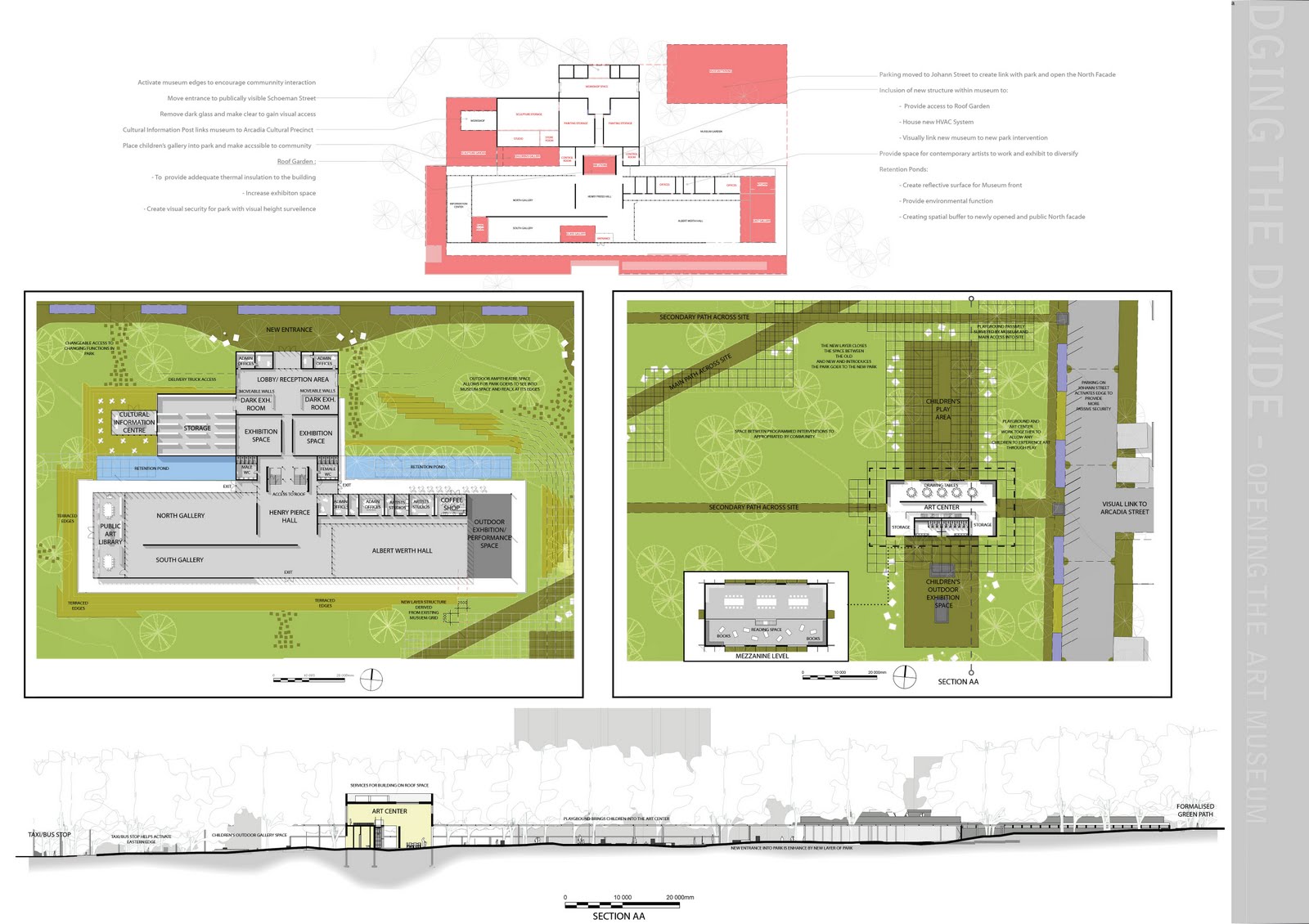
The new design establishes the existing activities while providing a formal center for the children’s art to take place.
The energies of the movement of people through the site is intended to work with the inclusion of a new layer to signify the coming together of the new and the old.


This layer is intended to provide the platform for the newest layer of the park to place, by providing a literal framework for local artists and community member to use to their own needs.
The idea of treating the edges of the park to facilitate these activities is applied to the museum itself with a removal of the podium it now sits on and construction of terraced seating around the structure.
This would hopefully encouraging a discourse between the new structure and the old playground that is placed between.


The Museum
The museum itself is intended to be left structurally sound with only the removal of the podium and the children’s art center. The art center will be replaced with the publicly accessible art center to the parks eastern edge.
The programming of space is adapted to facilitate the new entrance to north, providing a more visual facade to the public and encouraging movement through the museum to the park
This is intended to alleviate the criminal nature of this edge with passive surveillance and supplemented with the placement of the parking adjacent


Environmental Potential: Final Submission

Quarter 2
 

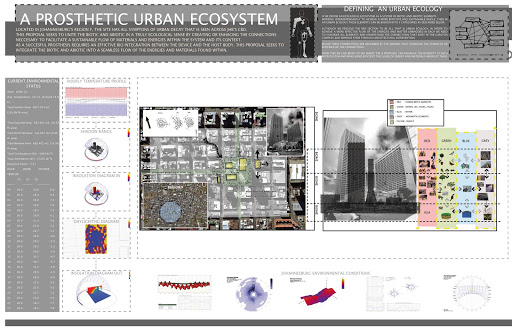
The refined proposal attempts to streamline the previous ideas and explain how the intervention makes the Carlton Center and the surrounding complex more ecologically responsive.

 
*


Deep Ecology
Working from the previous post’s critique; the design works around the idea of Deep Urban Ecology and how each building is simply an ecosystem within a the complex’s ecosystem which again lies in Johannesburg e.t.c. The design attempts to re-program the systems to create more sustainable flows of energy and materials between the ecosystems and to promote diversity in regards to the environmentalism, finance, sociology and biology.


Urban Ecosystem
The role’s of the buildings have only slightly been altered with the Skyrink building now using the upper floors to take advantage of the better light and ventilation to provide facility for urban farming. The key point for the social intervention is the introduction of the Skillz Development Program (SDP) which provides the manpower to run the in exchange for services such as social function of educating, food and the important cultural interactions and spirit that make any inner city fabric alive.

Urban Green Iconic
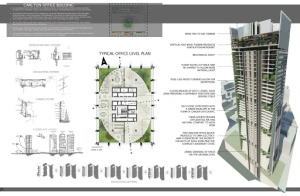
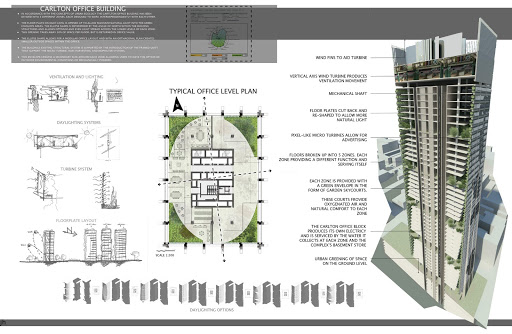
The presentation tries to explain the functions of the Carlton Office building, which in the scheme acts as the global and financial icon for the complex. Retaining its title as the tallest building in Africa while keeping inline with it historical role as a commercial catalyst.


Urban Cells
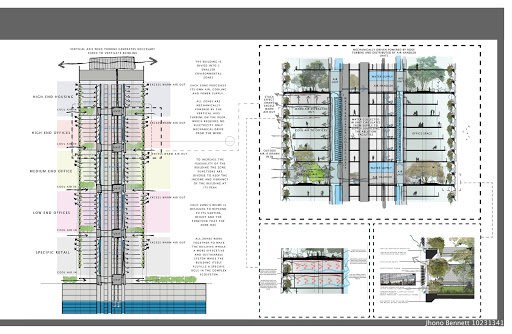
The intervention of the office building begins with the reshaping of the floor plates to allow for natural light into the deep plan building. The building is then  broken up in to 5 zones, each given a new zoning category to increase the commercial diversity of the building and make it more sustainable financially in the long term. 

  • Each of these zones serve each other in tandem, with the water harvested off the facade being stored and re-used for cooling and servicing of the ablution blocks. 
  • The entire building’s ventilation is powered by an industrial size vertical axis wind turbine which generates the necessary pull that is controlled at each level. 
  • The air is drawn from the oxygenated green spaces at each level, cooled by the water stored and serves the office/retail/apartment space within.

These systems work together to make the whole more effective; by programming the flows of the energies and materials between these smaller systems the whole is more effective and natural environment.


This principle is the core of the design proposal and is used in attempt to unify the complex into a more synergistic whole.

Environmental Potential: Part 2

Critique 2

After assessing the nature of JHB inner city more closely, a need for a stronger social approach became clear. The modified proposal approached the problem on a much more human scale.


An Approach
Although the buildings, the people, the flora and fauna all seem to occupy the same spaces and interact on a daily basis, those interactions don’t speak of any inter-connectivity. The site requires a inter-connectedness, similar to the symbiosis that exists in natural ecosystems.
Ecological Design at its core speaks of harnessing the flows of energies and matter in an ecosystem and allowing those flows to create a more efficient and sustainable system.
Ken Yeang describes ecological design as a well integrated prosthesis. This notion of any ecological intervention attempting to mimic nature as being prosthetic seemed to exemplify what was needed in this proposal.


The Brief
The brief was set by the Saint Gobain Design Competition www.saint-gobaindesignhub.co.za and required the format to be in four A1 sheets.


The proposal calls for the buildings to be interdependently linked to create an urban ecosystem that re-assimilates the fabric of JHB’s decaying urban center.

The presentation is intended to critique the existing urban ecology and re-inter grate the existing elements into an interdependant and sustainable ecosystem.


The Carleton Center
The Carlton Center retains its Commercial function, drawing income and global stature as the tallest building in Africa.
The Carlton Hotel provides housing for those society has forgotten and discarded. Under a social re-integration program, those living here are housed at minimal cost while providing the services to maintain the facility.
Those under the social program benefit from being taught valuable skills within the Learning Center provided by the building adjacent the hotel. 

Skyrink Building
The Skyrink Building acts as a sorting and storage point for all recyclable matter. This recyclable material is re-manufactured within the existing shopping complex and sold back to the community by the people working under the program. This is part of the skills development program and provides those under it practical experience.
The street plaza is to be greened and provide space within and around it for the previous shopping complex’s tenants, creating a more outdoor market and activating the space around the complex.
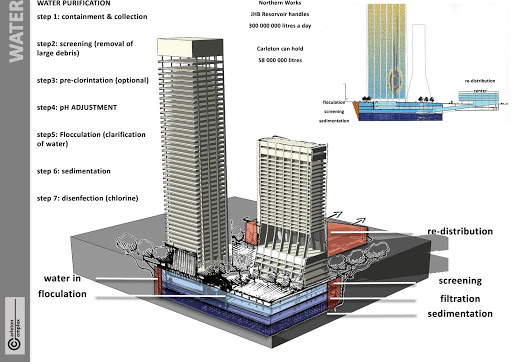
The basement parking levels are to be used to store and treat water from rainwater harvesting and grey water systems which would serve the complex.


A more detailed analysis of the Carlton Center, and its re-adaptive plan.


Post Crit
Post Crit: Although the idea of re-assimilating all aspects of society is sound, the placement of a recycling sortment facility in an urban CBD was not received well.
The removal of an existing, viable shopping complex was also criticised while more emphasis on the Carlton Center itself was recommended.


The phrase ‘Back to the drawing board’ as well ‘You’re trying to con us with your wordsmithery and emotive imagery’ were also used. The designer is still not sure what either of these mean in the context of the presentation and has chosen to interpret these in his own manner…

Environmental Potential: Part 1

Critique 1
 

Our new assignment is a adaptive re-use of the Carlton Center in Johanessburg CBD.

Initial
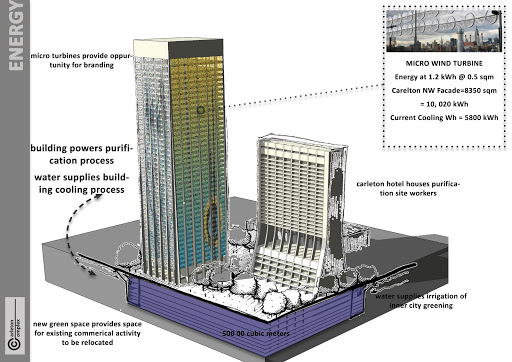
My initial idea was to flood the entire basement section (as the BRT system would provide future transport for all visitors and workers to the complex)and by harvesting all the rain water in the area, purifying it and selling it back to the commercial sector as industrial water create a viable and sustainable way to re-integrate the complex back into to the grid.


The basement could hold roughly 58 million litres of water, and the existing Carlton Hotel would provide housing for all those working at the treatment facility.


The Carlton center itself would house the office for JHB water, and the adjacent building would provide additional services for the facility such as collection and re-distribution points for the supply and distribution of the water.


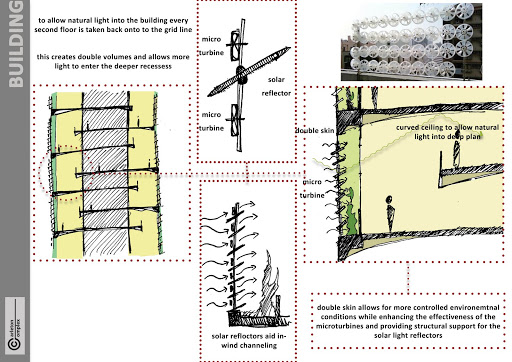
The Carlton center itself would be re-adapted to be more energy efficient. This is demonstrated by the inclusion of a double skin modular unit that fits within each segment of the existing structure.


The Carleton Center
The unit also employs light shelves to help natural light further into the deep planned building which together with a modified floor slab and curved reflective ceiling allow this to happen, while also creating a thermal barrier from the sun.


The unit also employs a system of microturbines from a local supplier http://www.haikoenergy.com would provide enough energy for the building itself surplus energy would aid in powering the treatment of water below.
Due to grid-placement of the microturbine an oppurtunity for branding is presented by colouring each turbine indiviudalling to create a pixelated but clearly graphic image on each buildings facade.


Post Crit
To house the necessary infrastructure to create the water treatment plant would be unfeasible as well as amount to more material on site that would occupy precious water space.
Although this is true, this idea could have been made possible, but due to lack of time I modified my approach accordingly.