Participatory Design Won’t Fix Unequal Southern African Cities: But We Should Still Do It, Just Better

This chapter draws from over a decade of South African urban field-based spatial development practice. This includes a series of practice-oriented reflections carefully documented alongside project collaborators, organizational peers, and project stakeholders in Johannesburg during this period. This knowledge base has been supplemented by a set of focused interviews for a Leverhulme-funded grant project – a partnership of universities, local and abroad, community-based organizations (CBOs), civic entities, and grassroots partners (GDI, 2018) – conducted remotely during the COVID-19 pandemic lockdown. The chapter seeks to engage with these datasets through a discursive analysis of the contemporary understanding of participative practices in spatial development. It includes interviews with actors involved in informal settlement upgrading (ISU) in one of the most unequal cities in the world, Johannesburg, South Africa.

This chapter argues that there is a nuanced and interpersonal gap between the perceived nature of participatory spatial development processes and the realities of implementing and managing such concepts alongside the complex socio-political dynamics evident in a systemically unequal society such as South Africa. To structure this, the chapter begins with a broad theoretical starting point from which to locate the concepts of inclusion, participation, and community via the Sustainable Development Goals (SDGs) and the South African literature around spatial development in cities. This literary base is then used to introduce a suite of methods and datasets drawn from a series of nuanced, grounded, and reflective observations of socio-technical practice across South Africa. The chapter culminates in a set of summative thoughts and reflections on these experiences and the reviewed literature, leading towards suggestions and critical questions for the reader in support of their own re-imaginative and reflective processes around urban planning practices in Southern Africa and beyond. This practice-oriented study aims to articulate and share important on-the-ground knowledge for those working in the ISU sector, as well as scholars who work around this topic. It seeks to bring the realities of working in the field to contemporary academia while supporting those who refer to such literature and work in the field as they reimagine urban practice around planning in Africa and beyond. It asks readers to consider a more self-critical set of interpersonal and inter-scalar practices through a nuanced reading of these processes and their value in ISU.

A key message lies in an observation that inclusive approaches are important in making an inclusive city across multiple scales. However, they are not simple processes, will not guarantee a successful project outcome, and require complex interpersonal readings of the contextual process to be conducted effectively – but it should still be done, just better than currently.

See Full Text here

Venting Practices: Navigating Interpersonal Dynamics of Socio-Technical Spatial Design Work in Neo-Apartheid Cities

This chapter will focus on the built environment dynamics of spatial design practitioners and the related discipline’s involvement in addressing spatial inequality. It draws from a series of recorded conversations between three South African socio-technical spatial design practitioners during the 2020 Covid19 Lockdown. These conversations were titled ‘Gripe Sessions’ and were held every 2 weeks between three socio-technical practitioners as a means of support, reflection, and knowledge sharing through a peer-led ‘venting’ model. The co-author’s intent lies in making tangible a series of interpersonal dynamics that are present within working from the grass-roots neighbourhood scale of socially engaged built environment work in the contemporary neo-apartheid city condition. The chapter draws from Feminist scholarly principles on concepts of positionality and offers an additional ‘partial perspective’ to this topic, in doing so it does not offer to empirical findings, rather it uses qualitive social studies technique to introduce and ground the concerns identified by the co-authors to the larger discourse around city-making practice towards spatial justice in South Africa’s built environment.

Bennett, Jhono, Olwethu Jack, and Jacqueline Cuyler. ‘Venting Practices: Navigating Interpersonal Dynamics of Socio-Technical Spatial Design Work in Neo-Apartheid Cities’. In The Urban Ecologies of Divided Cities, edited by Amira Osman, John Nagle, and Sabyasachi Tripathi, 169–73. Cham: Springer Nature Switzerland, 2023. https://link.springer.com/chapter/10.1007/978-3-031-27308-7_31#citeas.

Navigating the What-What

This piece of work was a reflection of the challenges I faced in navigating the positional dynamics of working between different locations, considering my own demographic realities as a White South African. Through my research, I developed a proposed methodology of reflective animation, which was grounded in the theories of Jane Rendell’s Site Writing modality.

The publication process was an incredibly co-productive experience, and I was lucky to have the support of Meike Schalk, Torsten Lange, Elena Markus, Andreas Putz, and Tijana Stevanovic (eds.) throughout the process. The doctoral course “Approaching research practice in architecture” provided a wonderful environment for me to develop and refine my work, and I am grateful for their guidance and support.

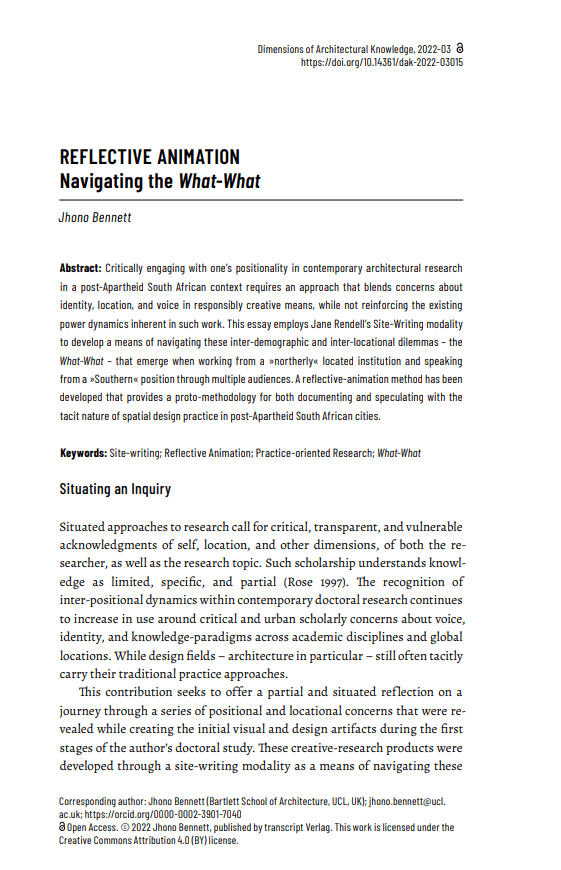
Abstract:

Critically engaging with one’s positionality in contemporary architectural research in a post-Apartheid South African context requires an approach that blends concerns about identity, location, and voice in responsibly creative means, while not reinforcing the existing power dynamics inherent in such work. This essay employs Jane Rendell’s Site-Writing modality to develop a means of navigating these inter-demographic and inter-locational dilemmas – the What-What – that emerge when working from a »northerly« located institution and speaking from a »Southern« position through multiple audiences. A reflective-animation method has been developed that provides a proto-methodology for both documenting and speculating with the tacit nature of spatial design practice in post-Apartheid South African cities.

The publication is available for free access (along with the full Journal) here:

»Dimensions. Journal of Architectural Knowledge« is an academic journal in, on, and from the discipline of architecture, addressing the creation, constitution, and transmission of architectural knowledge. It explores methods genuine to the discipline and architectural modes of interdisciplinary methodological adaptions. Processes, procedures, and results of knowledge creation and practice are esteemed coequally, with particular attention to the architectural design and epistemologies of aesthetic practice and research.

Issue 3, »Species of Theses an Other Pieces«, is concerned with the form of the doctoral thesis in practice-oriented research. In reference to George Perec’s »Species of Spaces and Other Pieces«, this issue takes the love for playing with forms, genres, and arrangements as its program.

Principles at Work: Community Caution

In the context of South Africa’s complex socio-cultural fabric, the notion of ‘community’ holds significant importance. The country’s history of colonialism, apartheid, and struggles for social justice have shaped how we understand and operationalize ‘community’ in various contexts, especially within the realm of spatial design. This article, drawn from a longer piece contributed to the Just Spatial Design ZA platform, delves into the multifaceted ways in which the concept of ‘community’ is operationalized in South Africa.

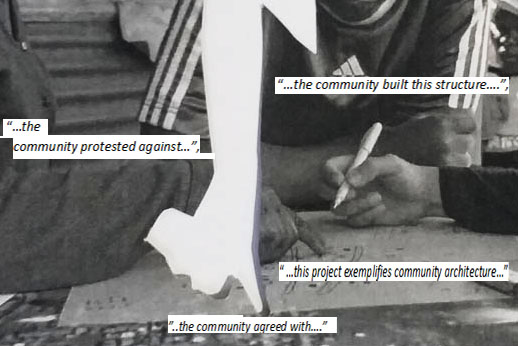
…this project exemplifies community architecture…”,

…the community built this structure….”,

…the community protested against…”,

”..the community agreed with….”

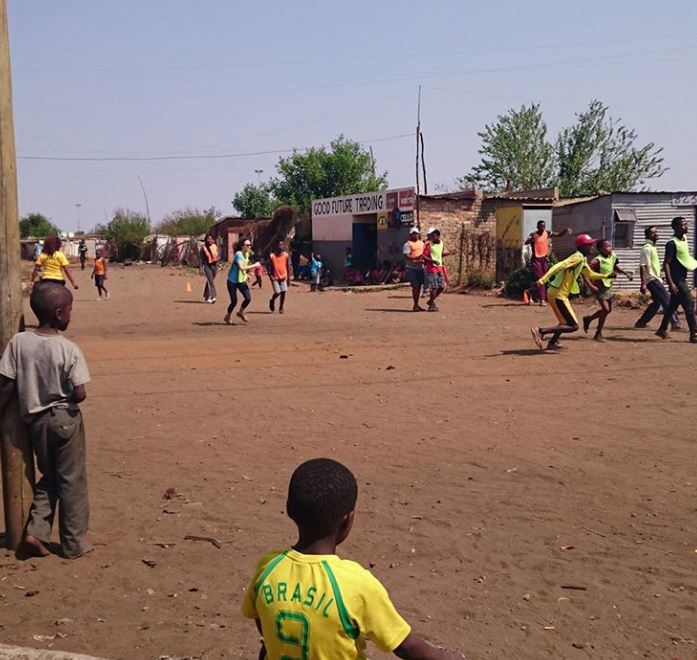
When one read these sentences captured in the above picture, hears these When one reads these sentences captured in the above picture, hears these phrases, or even shares these words in your practice or institutional spaces, a particular set of images, ideas, and actions are brought to mind. Perhaps a smiling, but determined woman carrying a heavy load; a group of laughing children playing in a desolate street; maybe a modest – but proud – homeowner standing against a ‘humble’ dwelling as the sun sets in the distance…(see more on this type of spatial-romanticism here: [0]) No? What imagery appears in your mind’s eye?’

Excerpt from Article ‘Community Caution’

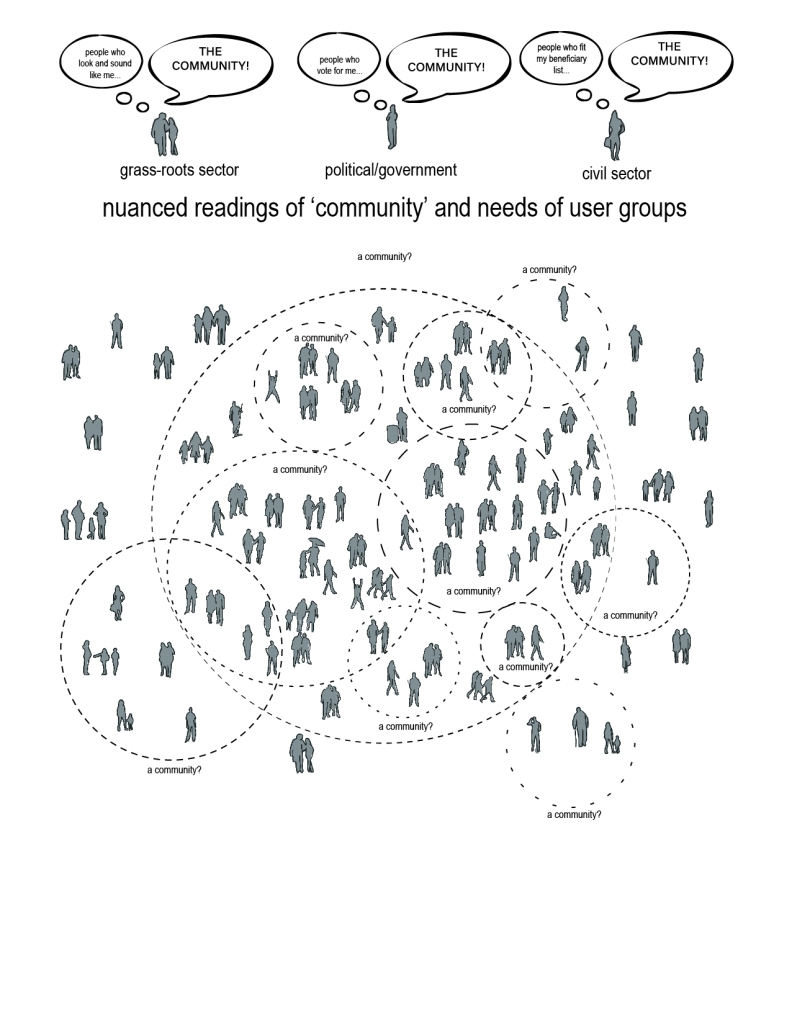
A short article drawn from a longer piece I contributed to the Just Spatial Design ZA platform on how concepts of ‘community’ are operationalised in South Africa. Below area some diagrams I developed to assist in explaining some of the complexity: https://justspatialdesignza.com/2020/10/19/caution-with-community/

Community versus Communities – Image: Bennett

Teaching Design in a Post-rainbow Nation: A South African Reflection on the Limits and Opportunities of Design Praxis

My first solo book chapter has been published. This was my first attempt at reflecting on my experience as both a teacher as well as a practitioner in Johannesburg and attempting to frame this through theory as both research and resource for others working in similar conditions.

Abstract

There has been an intense discourse on the relationship between inter-stakeholder university engagements, or service learning, and the broader society that South African universities claim to serve over the past decade in both local and international academia. The inherent problem within these power structures, the challenges to achieving mutually beneficial project outcomes and the growing concern of vulnerable, unheard institutional and individual voices are critical factors. The recognition of these dynamics within the emerging field of design research and design-led teaching is less nuanced in these debates. Training institutions of architecture have a rich history of undertaking service-learning initiatives to create value and learning for both the students and the stakeholders of such projects. Still, in South Africa, they are only now seen through a post-rainbow nation lens. The FeesMustFall movement is primarily driving this change. Larger institutions are recognising previously marginalised voices that now find traction in learning and practice across South Africa. This chapter reflects the author’s experience with emergent views and concerns as a researcher, lecturer and spatial design practitioner in Johannesburg. This section centres on learning regarding city-making in Southern Africa, and it presents two case studies followed by a discussion of growth opportunities.

Bennett, J. (2021). Teaching Design in a Post-Rainbow Nation A South African Reflection on the Limits and Opportunities of Design Praxis. In F. Giuseppe, A. Fisher, & L. Moretto (Eds.), African Cities Through Local Eyes. Experiments in Place-Based Planning and Design (1st ed., pp. 151–172). Springer: The Urban Book Series. https://doi.org/10.1007/978-3-030-84906-1_8

Community Caution

In the early stage of my doctoral research, I reflected on my practice work with 1to1 and developed my thoughts on the problematic operationalization of the term “community” in South Africa’s informal settlement upgrading.

This was an attempt at a form of satire with grounded reference, aiming at a practitioner/academic audience in my own sector.

The actionable questions from the process being:

  • Can we adopt and normalise a more complex idea of ‘community’ being multiple communities and individuals who share space?
  • When we say or think ‘community’, can we allow for people to question what we mean by that towards a better understanding of a context?
  • Can we be more specific to describe what we mean: a neighborhood, a group of men/women/children, the church goers, the football players e.t.c – this will allow your designs more variables to draw from?
  • Can we allow for dissent, non-agreement and conflict – these are as crucial for good participation that agreement, cohesion and consent are often based on reductive and simplistic ideas of people who are as a rule complex and nuanced and not perfect?
  • How can we meaningfully recognise and value the project beneficiaries and adjacent grass-roots actors in projects in ways that support financially, experientially and creatively?

Inclusive Cities: Scaling Up Participation in Urban Planning

Through 1to1 I have been very fortuante to be a part of this global network project. The Initaitve was held over 3 years and supported research, learning and engagements across South Africa, Zimbabwe, Kenya and Manchester, United Kingdom.

See: https://www.gdi.manchester.ac.uk/research/groups/global-urban-futures/scaling-up-participation-in-urban-planning/ for all details. Summary below:
Goal: 

In recent decades the world has experienced unprecedented urban growth. According to the United Nations 4 billion people, or 54% of the world’s population, lived in towns and cities in 2015. That number is expected to increase to 5 billion by 2030.

Urban growth has outpaced the ability of many governments to build infrastructure and, in many towns and cities in the global South, provision for housing is inadequate. Consequently one in three urban dwellers live in informal settlements. Issues of insecure tenure, poor access to basic services, and insecure livelihoods are all prevalent. Although local government may have the desire to improve the situation they are, in many cases, under-capitalised and under-capacitated. Existing planning legislation and practices remain incapable of resolving such issues therefore local residents try and resolve these themselves. Their efforts are, however, fragmented and localised.

The 2030 Agenda for Sustainable Development and the resulting Sustainable Development Goals vow to end poverty, to achieve gender equality and ensure liveable cities. Multi-disciplinary approaches that build on local action and create strong partnerships are needed in order to advance initiatives and to address the UN Sustainable Development Goals to ensure the availability and sustainable management of water and sanitation for all and to make cities and human settlements inclusive, safe, resilient and sustainable.

This commitment to ‘leave no-one behind’ highlights the importance and strengthens the significance of citizen involvement in urban development. Academics seek to contribute to new solutions and approaches to problems faced by the residents in informal settlements. Universities have an important role in generating, analysing and monitoring data that can be used by policy makers. However this should be done in collaboration with local government, local residents and organisations. Citizen involvement and public participation in policy-making and programming should be nurtured and encouraged.

Aims and objectives:


The network aims to develop the knowledge required to move from participatory community-led neighbourhood planning to city-scale planning processes. The aims and objectives of the project are critical to achieving inclusive urban futures, these include:

-Develop frameworks that build on effective approaches of community-led planning for informal settlement, upgrading at the neighbourhood level, and then scaling these to the city level.
-Locate these frameworks within traditions of alternative planning including participatory co-productive planning, participatory planning and action planning thus strengthening the critical mass of people-centred approaches supporting inclusive urban development. This component will elaborate why grassroots organisations make a substantive contribution to inclusive urban development and the achievement of Sustainable Development Goals.
-Develop a framework that enables the integration of community understandings and innovations with academic and professional knowledge.
-Achieving these objectives requires a combined effort from academics and civil society agencies. While academic researchers encourage civil society agencies to engage meaningfully and substantively, it is difficult to achieve this within academic research programmes. By creating a formal network the opportunity for engagement is created, to deliver on a set of shared objectives and to achieve the strengthening of relations between individuals and agencies.

The network:

Professor Diana Mitlin, Managing Director of the Global Development Institute at The University of Manchester, is the project lead.
Dr Philipp Horn, Honorary Research Fellow at the University of Manchester’s School of Education, Environment and Development and Postdoctoral Research Associate at The Open University, provides research support to the project.
The network is a co-productive knowledge partnership between civil society action research agencies and academic departments. The project combines professionals and academics with a commitment to substantive change and experience at local level.

This network is funded by the Leverhulme Trust.

SDI-affiliated civil society alliances of organised groups of low-income residents are working in partnership with academic institutions. Their participatory efforts at neighbourhoods have been presented as best-practice examples in urban poverty reduction. These alliances are:

Dialogue on Shelter Trust, Zimbabwe
Slum Dwellers International Alliance, Kenya
The network comprises committed partners that have been directly involved in previous participatory planning processes, these include:

The University of Manchester (UK)
The Faculty of Art Design and Architecture at the University of Johannesburg (South Africa)
CURI at The University of Nairobi
Faculty of the Built Environment at the National University of Science and Technology (Zimbabwe)
Design Society Development DESIS Lab based at Faculty of Art, Design and Architecture (FADA), The University of Johannesburg
1to1 – Agency of Engagement


All of these departments have a track record on urban development planning. The selected individuals within these departments have established connections with low-income communities, planners and urban professionals within their respective countries as well as sub-Saharan Africa. They have previously conducted practice relevant research around topics such as informal settlement upgrading, service provisioning and participatory community planning.

See: https://www.gdi.manchester.ac.uk/research/groups/global-urban-futures/scaling-up-participation-in-urban-planning/ for all details.

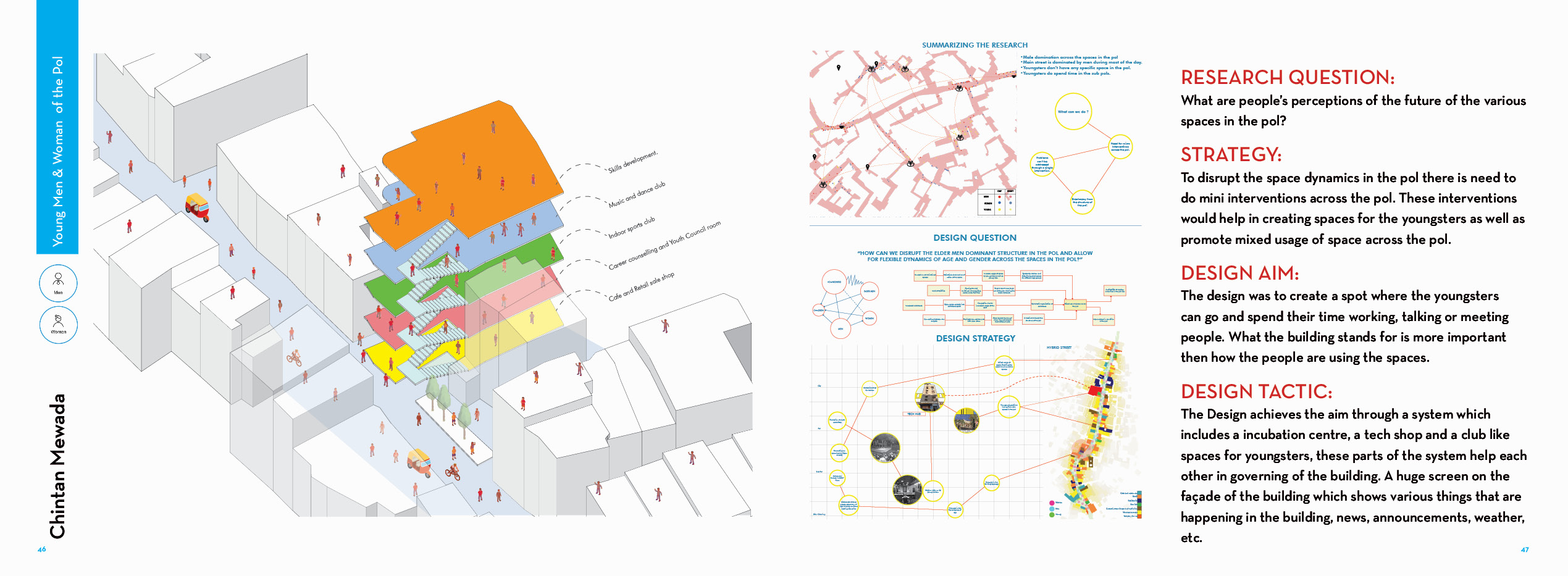
Designing With People – CEPT

In late 2018, Dr. Jigna Desai of CEPT University offered me an opportunity to teach her semester course at the Faculty of Architecture in Ahmedabad. This came about as a spin off of the 3 year professional mobility hosted by Sheffield University, the University of Johannesburg and Nanjing University.

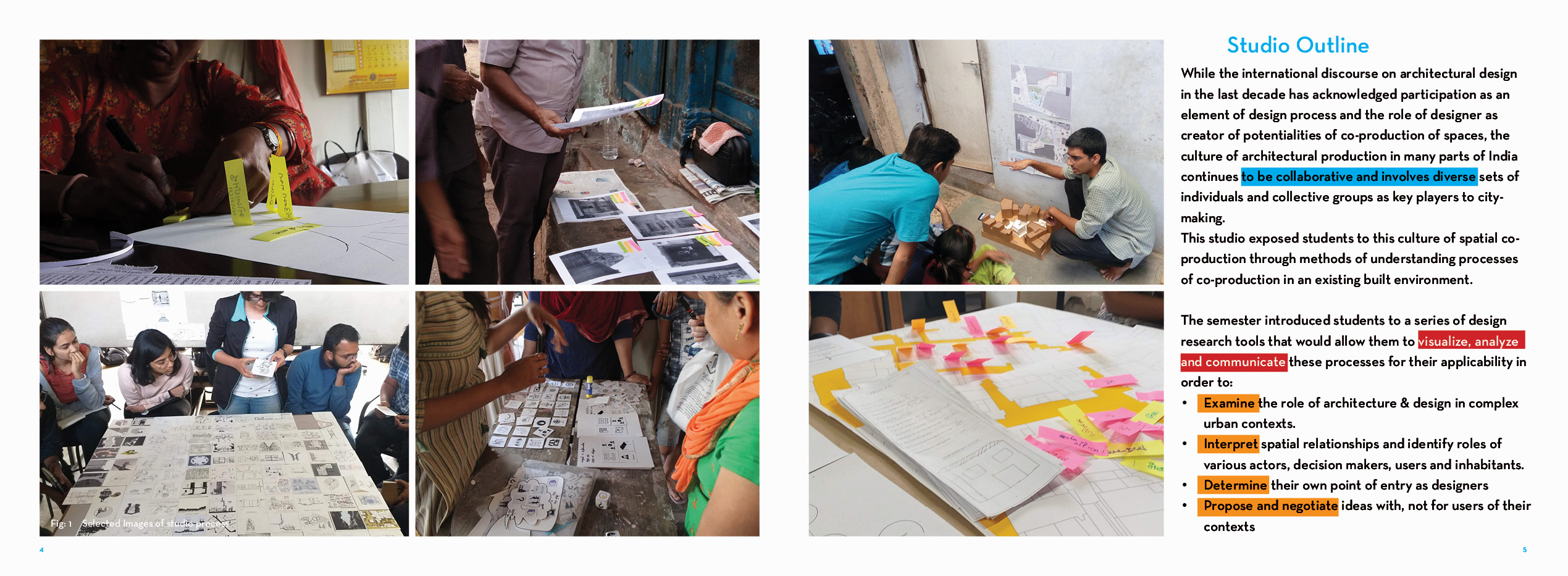
Jigna had been running a design module each year in Mandvi Ni Pol within the old city of Ahmedabad and allowed me to bring my own take  ‘Designing with People’.

DWP_Studio Book2DWP_Studio Book3

The opportunity allowed me to structure a module that was critical, reflective, speculative and grounded in both participatory research as well as design methods.
DWP_Studio Book4DWP_Studio Book5DWP_Studio Book6DWP_Studio Book7

I worked closely with Harshil Parekh, the studio assistant, and we designed the course (with the Mandvi Ni Pol leadership) to be as supportive and mutually beneficial as possible. The limits of such work was crucial to recognize and was done early on in the process. (see below)
DWP_Studio Book8DWP_Studio Book9DWP_Studio Book10

The course actively challenged the idea of participatory work as ‘consensus building’ and sought to build a platform for dialogue of dreaming and discussion with residents. The program equipped students with deep exposure to field work, critical self-reflection techniques and discussions on demographic positionality in such work.

DWP_Studio Book11DWP_Studio Book12

We used action learning, visual thinking and UserX methods of working between ourselves and the resident User Groups we engaged with. DWP_Studio Book13DWP_Studio Book14DWP_Studio Book15DWP_Studio Book16

We co-designed a series of Studio Tools and used them across the semester. This was critical in building a way of working while bridging the difficult gap of participatory research into participatory design(see below). DWP_Studio Book17DWP_Studio Book18DWP_Studio Book19DWP_Studio Book20

The students responded amazingly and put together a comprehensive and challenging body of work that was well received by critics and the residents.

DWP_Studio Book21DWP_Studio Book22DWP_Studio Book23DWP_Studio Book24DWP_Studio Book25DWP_Studio Book26DWP_Studio Book27DWP_Studio Book28DWP_Studio Book29DWP_Studio Book30DWP_Studio Book31DWP_Studio Book32DWP_Studio Book33DWP_Studio Book34

A full Gujarati ‘hand over’ booklet titled Dreaming with Mandvi Ni Pol was put together and given to the leadership in our final engagement with the Pol. The students additionally met with their individual usergroups and underwent a smaller level ‘handover’ DWP_Studio Book35DWP_Studio Book36

Dr Jigna Desai is still working in the Pol and continues this work (see the orange thread) within her larger offering to the old City of Ahmedabad.

1to1 – A Reflective Hand-Over

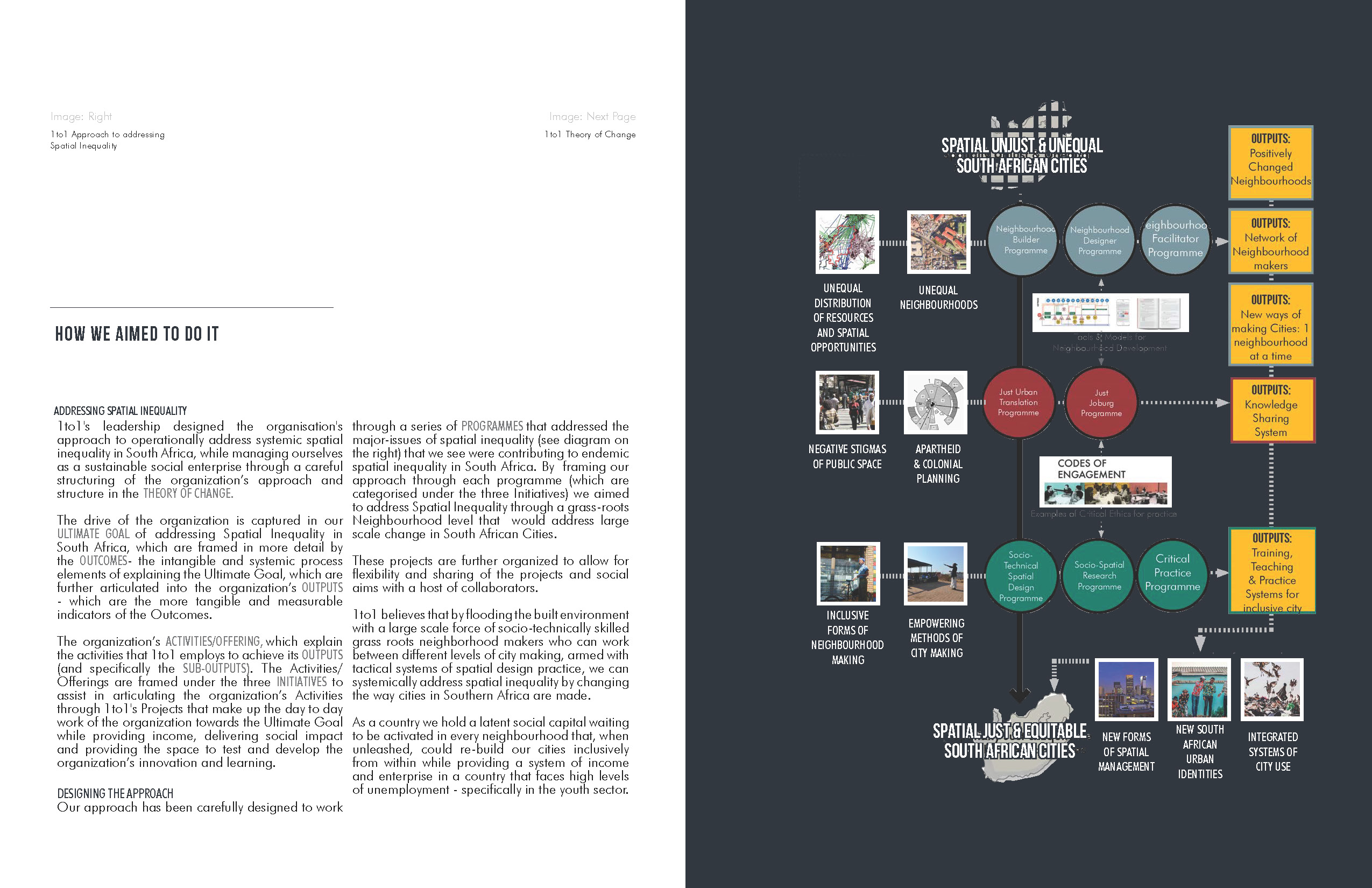
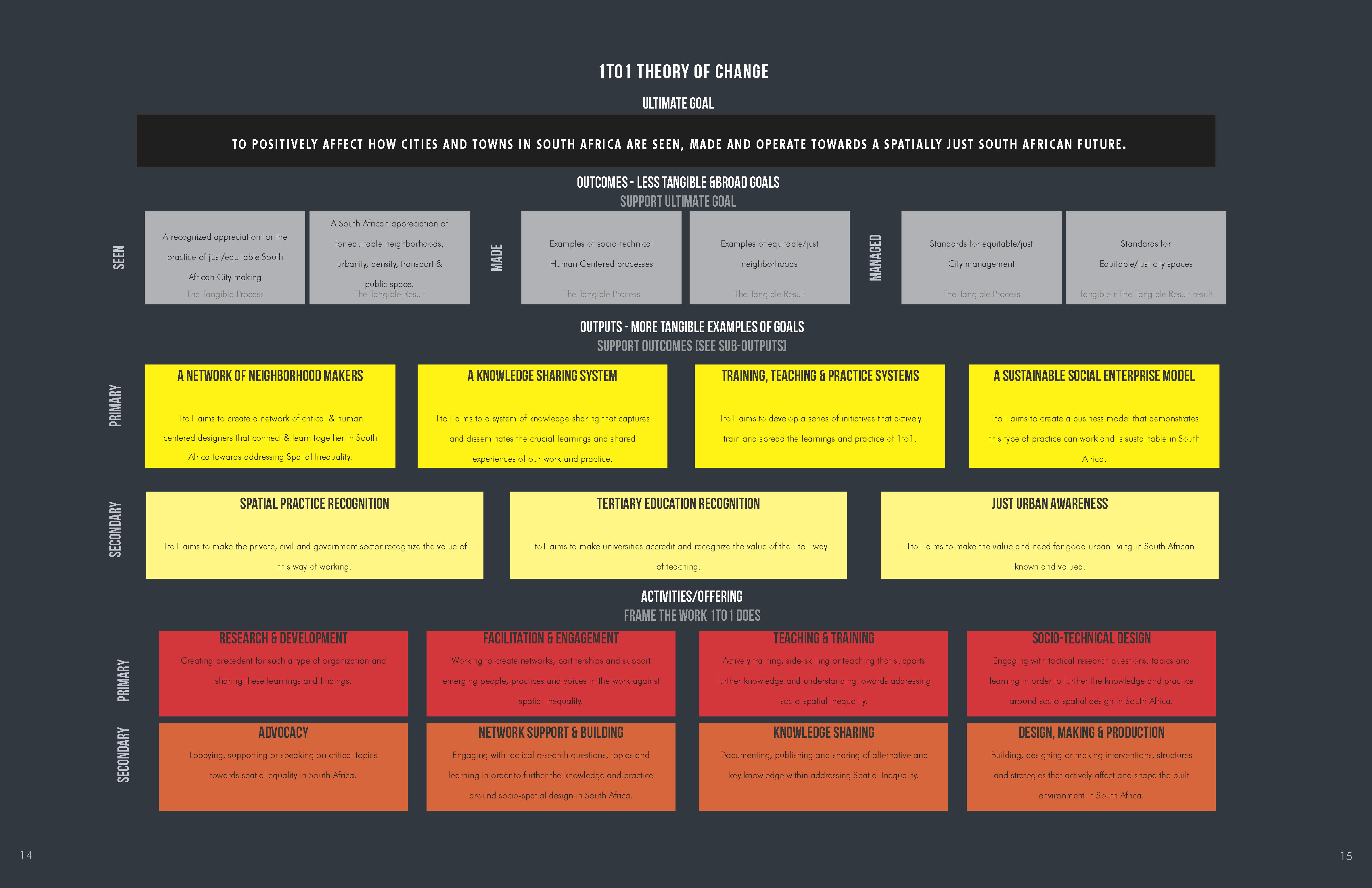
After 8 years of being the leader of 1to1 – Agency of Engagement, I have stepped aside as the executive director of the Non-Profit we started in 2010 and begun a parallel (and supportive) journey to reflect and ground what I’ve experienced and learnt over the years into a PhD.

A Reflective Engagement

1to1_A Reflective Engagement_spreads large_Page_01

As a means of handing over, reflecting and trying to make sense of the last 8 years we have put together a reflective document that we hope will capture and share the experience for other practitioners, our supporters and the people who have joined us so far. (Link here: https://issuu.com/1to1_enyekwenye/docs/1to1_a_reflective_engagement_snglep)

The report is intended to offer a critical take on what we as 1to1 have done since we started, while celebrating the small wins, recognising the various  people who have made this possible and charting a new path towards a more resilient and effective organisation.

1to1_A Reflective Engagement_spreads large_Page_031to1_A Reflective Engagement_spreads large_Page_071to1_A Reflective Engagement_spreads large_Page_08

The report additionally serves as a record of our work and where we began. We tried to frame 1to1 in this moment, as we prepare to shift and change under new leadership and a more focussed view on the future.

1to1_A Reflective Engagement_spreads large_Page_091to1_A Reflective Engagement_spreads large_Page_111to1_A Reflective Engagement_spreads large_Page_181to1_A Reflective Engagement_spreads large_Page_221to1_A Reflective Engagement_spreads large_Page_23

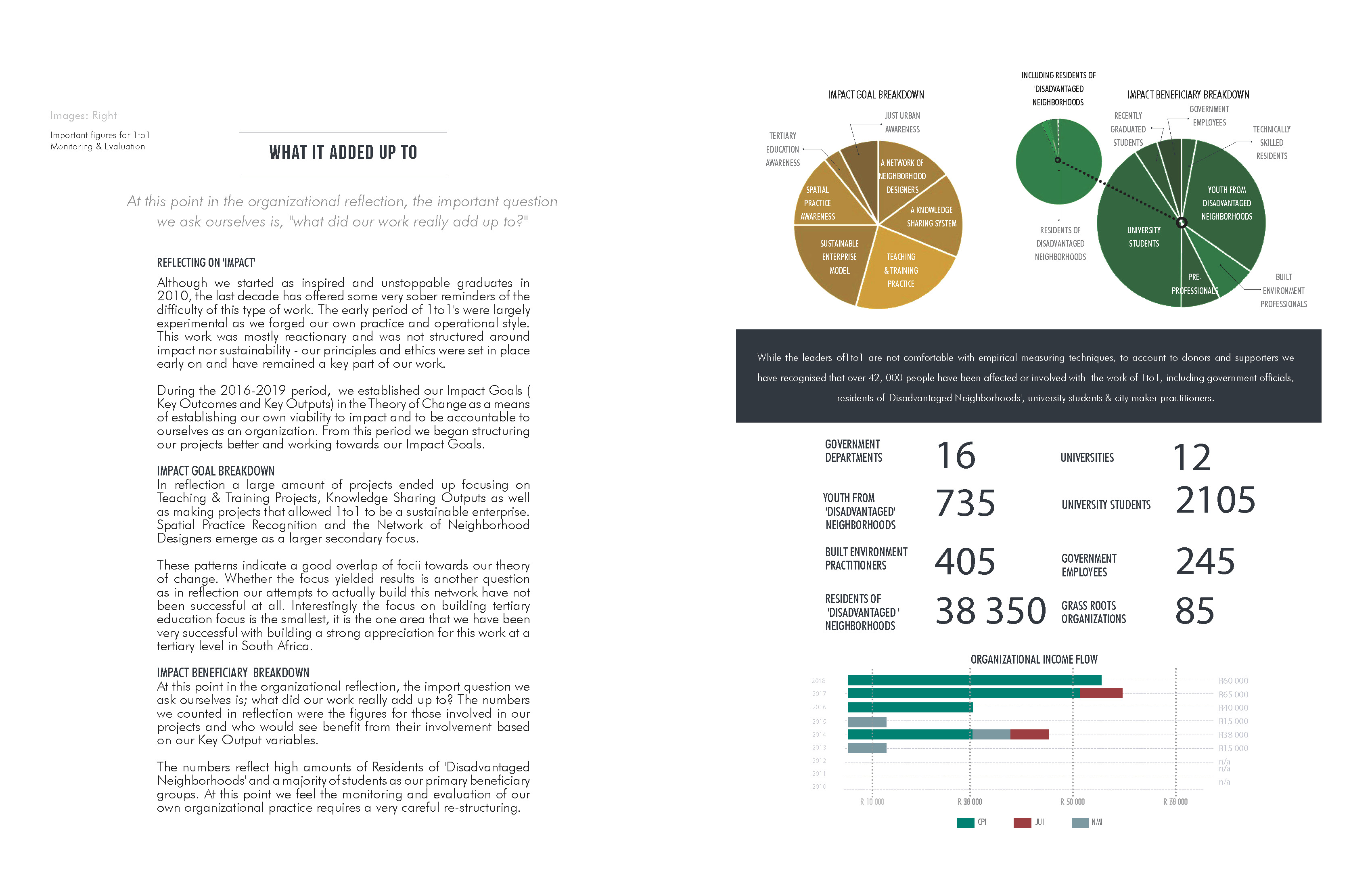
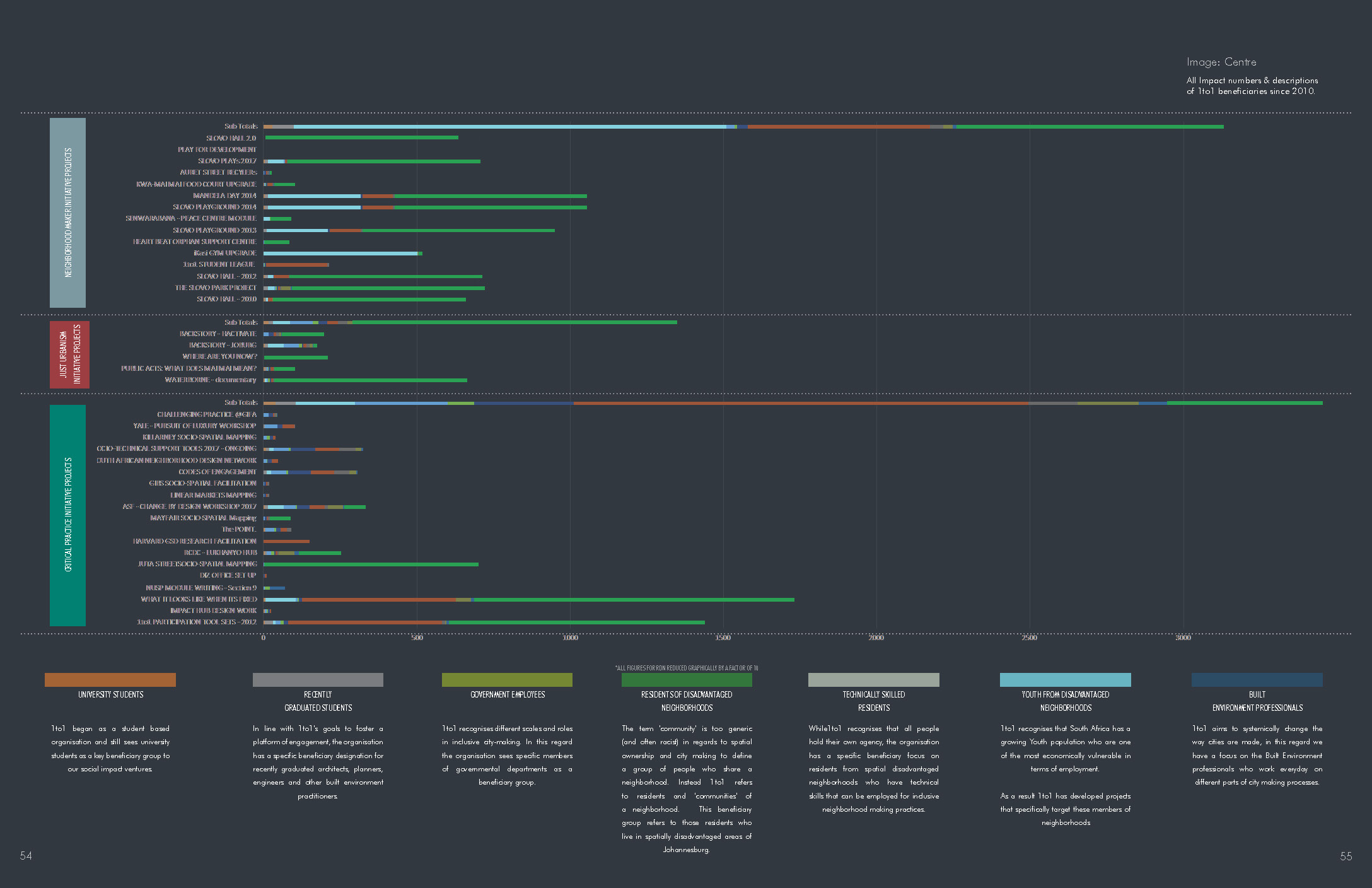
We archived and recorded all our projects, our partners and offered a retrospective view on the ‘impact’ that we felt held merit and should be re-examined in 1to1 2.0.

1to1_A Reflective Engagement_spreads large_Page_261to1_A Reflective Engagement_spreads large_Page_271to1_A Reflective Engagement_spreads large_Page_281to1_A Reflective Engagement_spreads large_Page_29

Finally we looked hard at the pitfalls and successes of the organisation and asked the hard questions within ourselves – should we keep the entity alive?

1to1_A Reflective Engagement_spreads large_Page_31

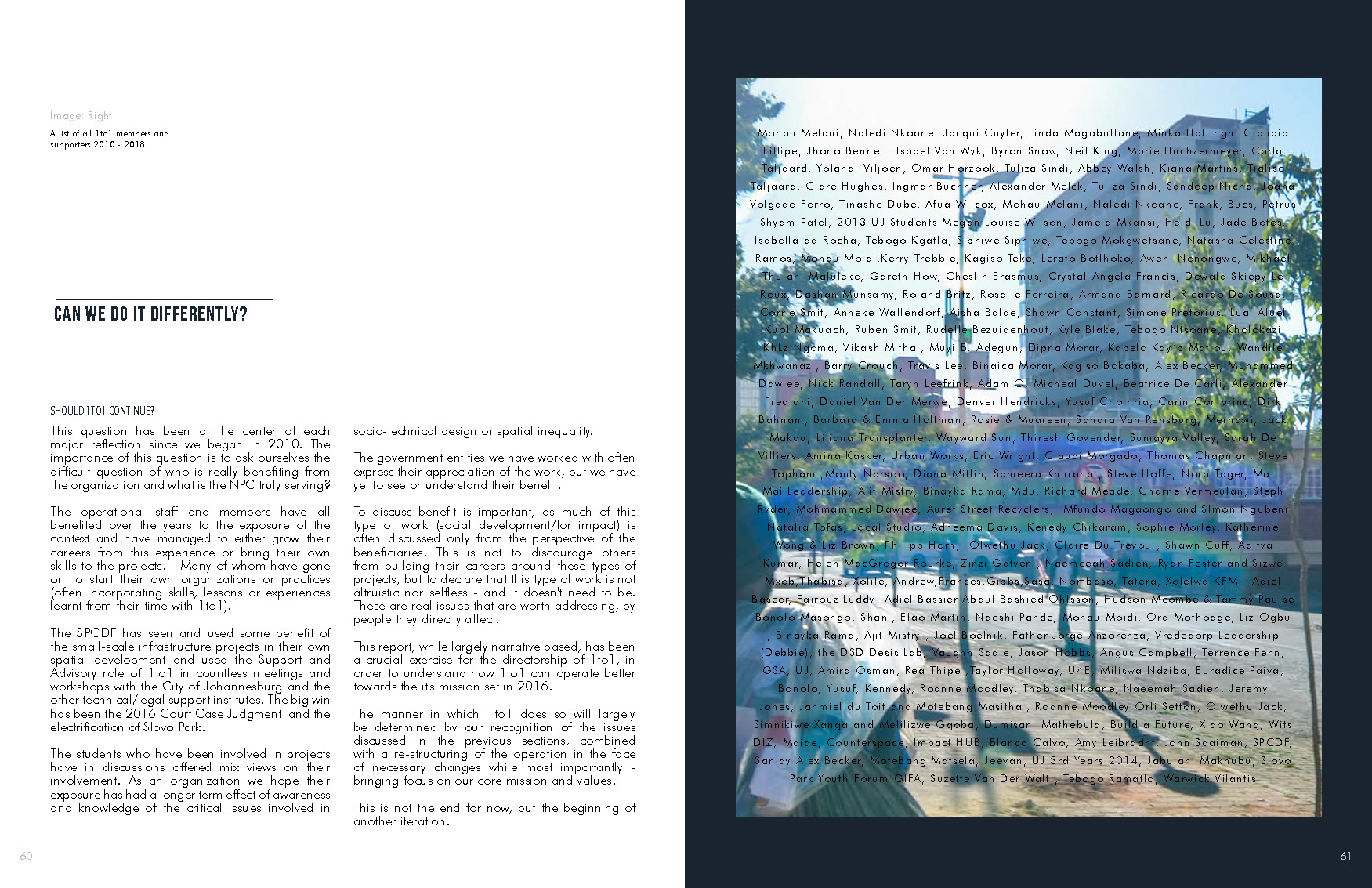
This document bears record of every person who has made an active contribution to 1to1 and hopefully sets down the first step towards a better, more resilient organisation.

I wish my colleagues much luck in their new roles and I will always be close by to support and work within my new capacity as Just Urbanism Initiative Lead.

Un-learning ‘community’: Paper Presentation at CSIR

I recently presented a short reflexive paper as a means to capture the learning from working with Slovo Park Development Forum over the past 8 years. The paper was presented at the CSIR’s Out-of-the-Box Conference in Pretoria. 

The paper was intended to give academic reference for this type of work and address key issues in the wording and practice we use in spatial re-development in South Africa – particularly the word ‘community.

Un-learning ‘community’: reflections on socio-technical spatial design support with Slovo Park

Abstract:

The South African city we experience today did not simply manifest in a vacuum outside of the social injustice of the last 400+ years of colonial and Apartheid ‘development’. The four-hour commute that the average Johannesburg city user experiences, the sense of fractured locality across the metropolitans of Durban and Pretoria and the intact socio-economic segregation of townships to suburbs seen in Cape Town are all the tangible legacies of the Apartheid city design that we complicity accept as our South African city on a daily basis.

The knee-jerk reaction by built environment practitioners to this observation is typically a technocratic response to suggest an addition of infrastructure and implementation and not a reform of the practice of city-making. The fact remains that among the large-scale projects our democratic government has implemented we sit with infrastructure deficits larger today than 1994.

The practice of ‘making city’ in South Africa requires some form of radical change, one that calls on all city makers to re-conceptualise how we see, make and manage our spaces. While technical skills and competencies are vital to this approach, the immediate challenge for built environment practitioners can be seen in the lack of skills or willingness of individuals and institutions to engage with the socio-political complexity of our cities. The misnomer that we are dealing with a homogenous technical challenge for a homogenous social demographic of people (or the ‘community’) that can be solved through a ‘better house/shack/dwelling’, a more efficient toilet system or solar panel array, is damaging and criminally myopic in its lack of imagination, creativity or recognition of the situation.

The paper offers a structured reflection on an eight-year case study conducted by the author and his colleagues. The argument of the paper is centered around a critique on the often-misused terms of ‘informality’, community’, ‘participation’ and ‘development’ in the built environment sector of spatial development. The case study unpacks the approach and methods used within the Socio-Technical Spatial Design practice of ‘Neighbourhood Making’ and offers a reflection on critical skills and lessons gathered from the experience. The intent of this reflexive study is to offer a working reference for private-sector practitioners, government officials and grassroots practitioners who are looking to engage informal neighbourhood upgrading in South Africa.

Urban Conference Visual Summary: South African Cities Network

Through my fellowship as a Mandela Washington Fellow, I was able to secure a practicum appointment with the South African Cities Network. The Network is a non-profit entity that:

The South African Cities Network (SACN) is an established network of South African cities and partners that encourages the exchange of information, experience and best practices on urban development and city management. Since 2002 the SACN’s objectives are to:

  • Promote good governance and management in South African cities
  • Analyse strategic challenges facing South African cities
  • Collect, collate, analyse, assess, disseminate and apply the experience of large city government in a South African context
  • Encourage shared learning partnerships among spheres of government in order to enhance good governance of South African cities.
 

CityFuture_Method Summary_draft 12

I worked as a ‘tactical intern’ where I provided socio-spatial visual support to a current programme under the network’s portfolio.
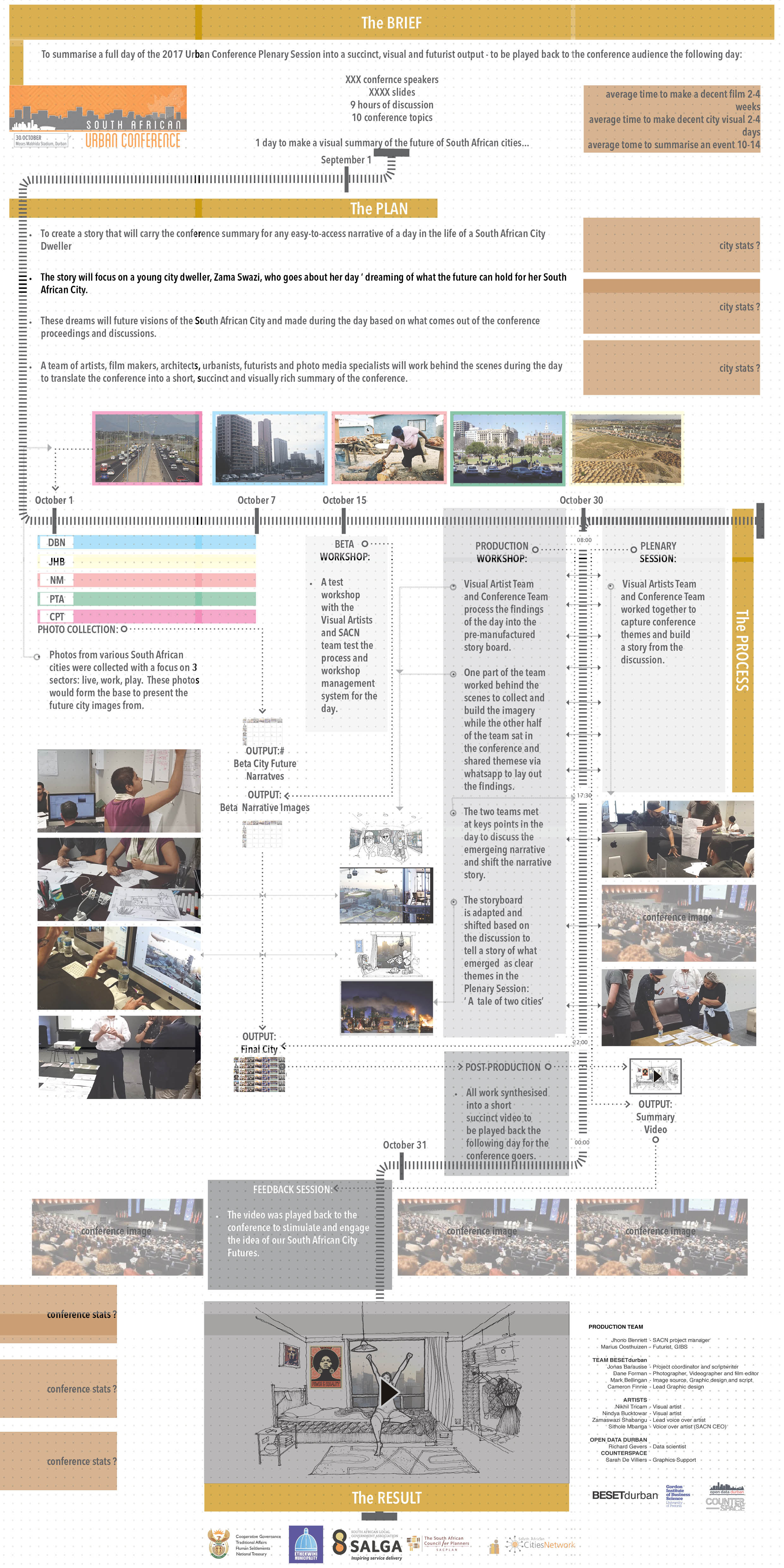
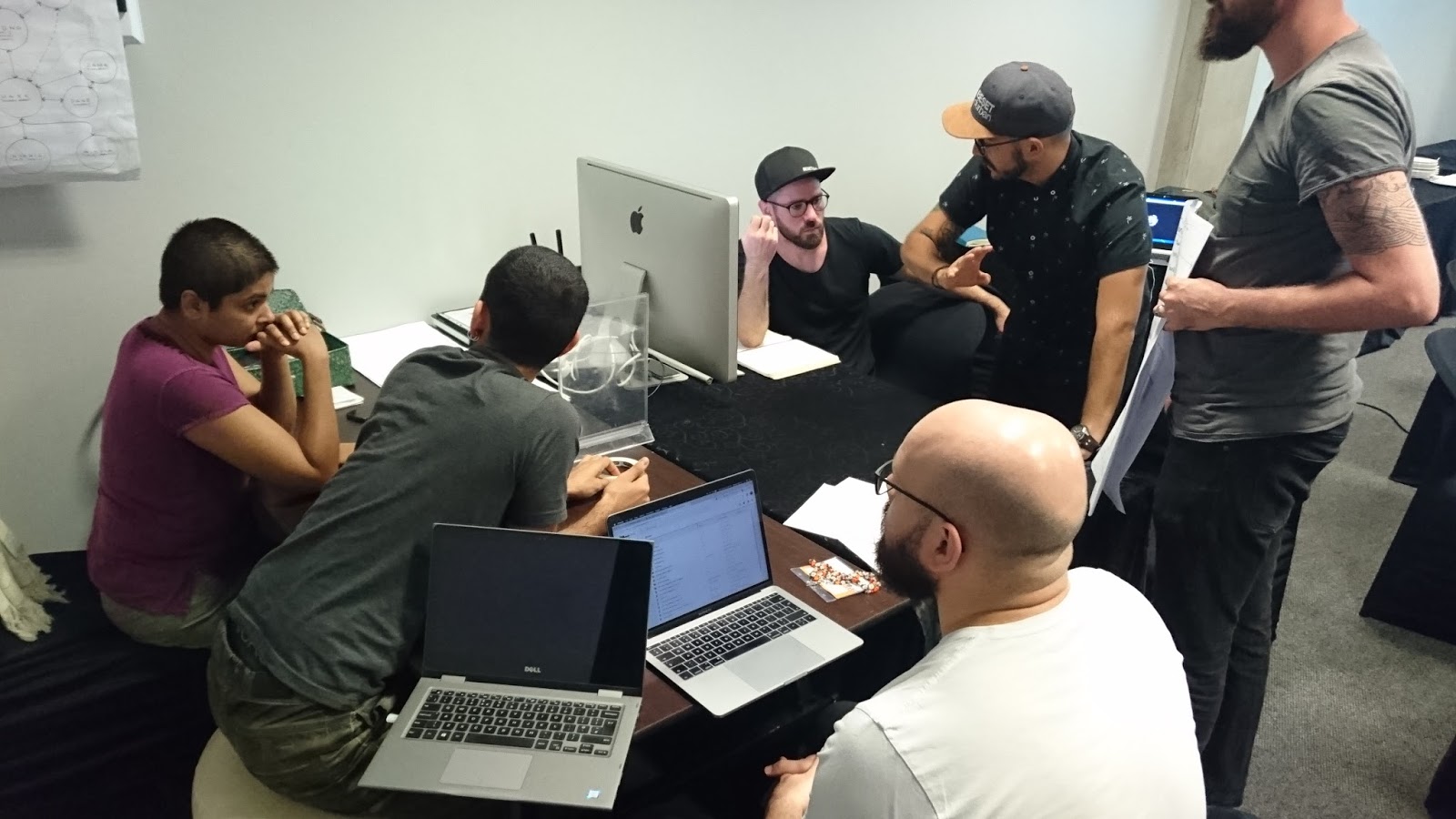
The culmination of this practicum took place while I supported the development, initiation and execution of a brief put together by SACN. The brief was to develop a methodology that would summarise the conference proceedings from the 2017 Urban Conference in Durban.
http://www.sacities.net/events-and-conference/urban-conference-2017
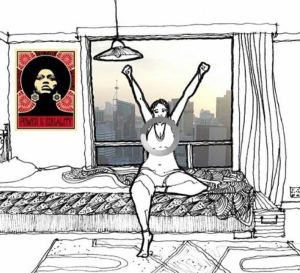
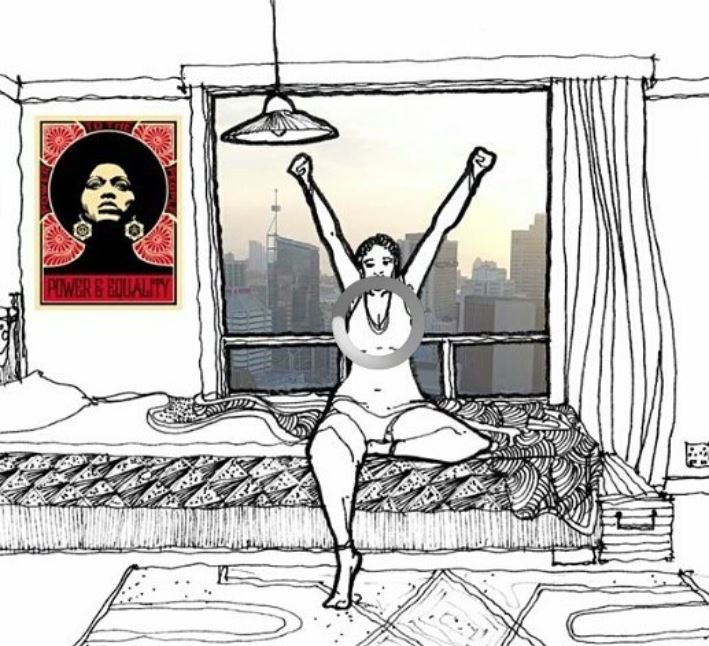
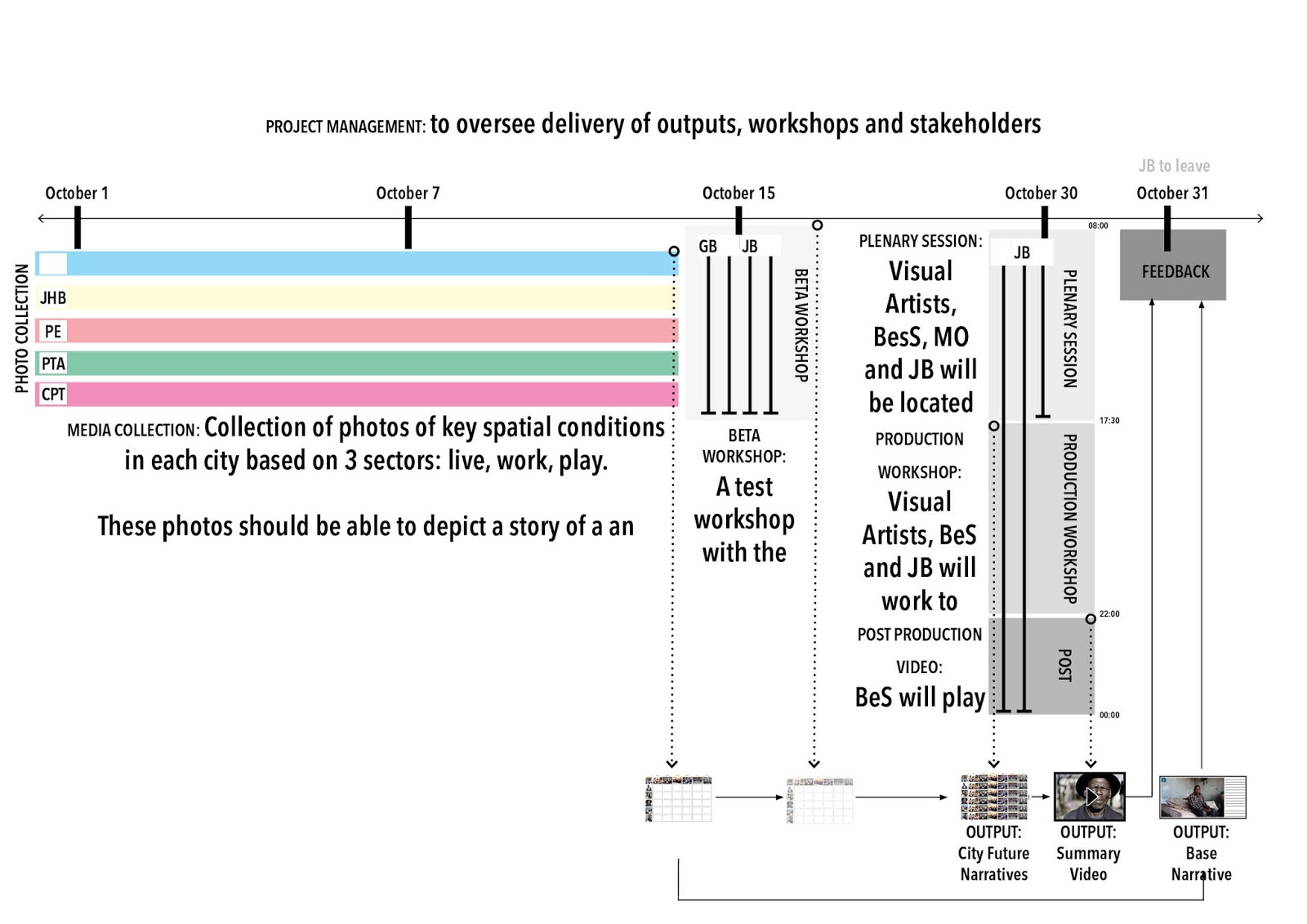
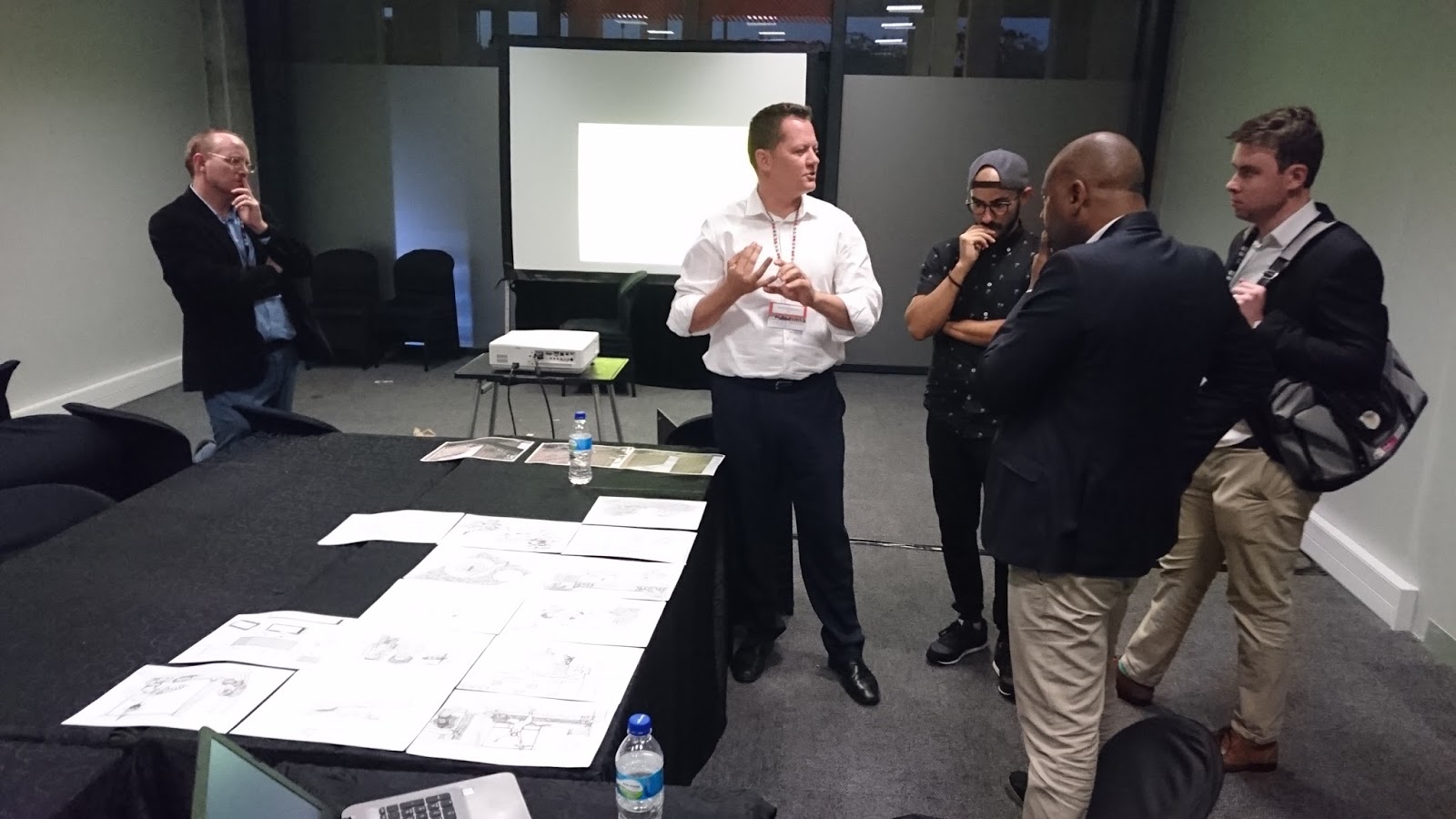
The request was to summarise the proceedings in such a way that they could be played back the next day through a video format that told a visual narrative of a possible future for South African cities. While this may seem simple, the typical process to make a video, let alone visually summarise  a live conference can take anything from a week to a few months. In order to complete this mammoth task the SACN secured the services of Marius Oosthuzien, a registered futurist, who supported in the development of  a pre-fabricated story structure that follow the day-in-a-life of a young city dweller.
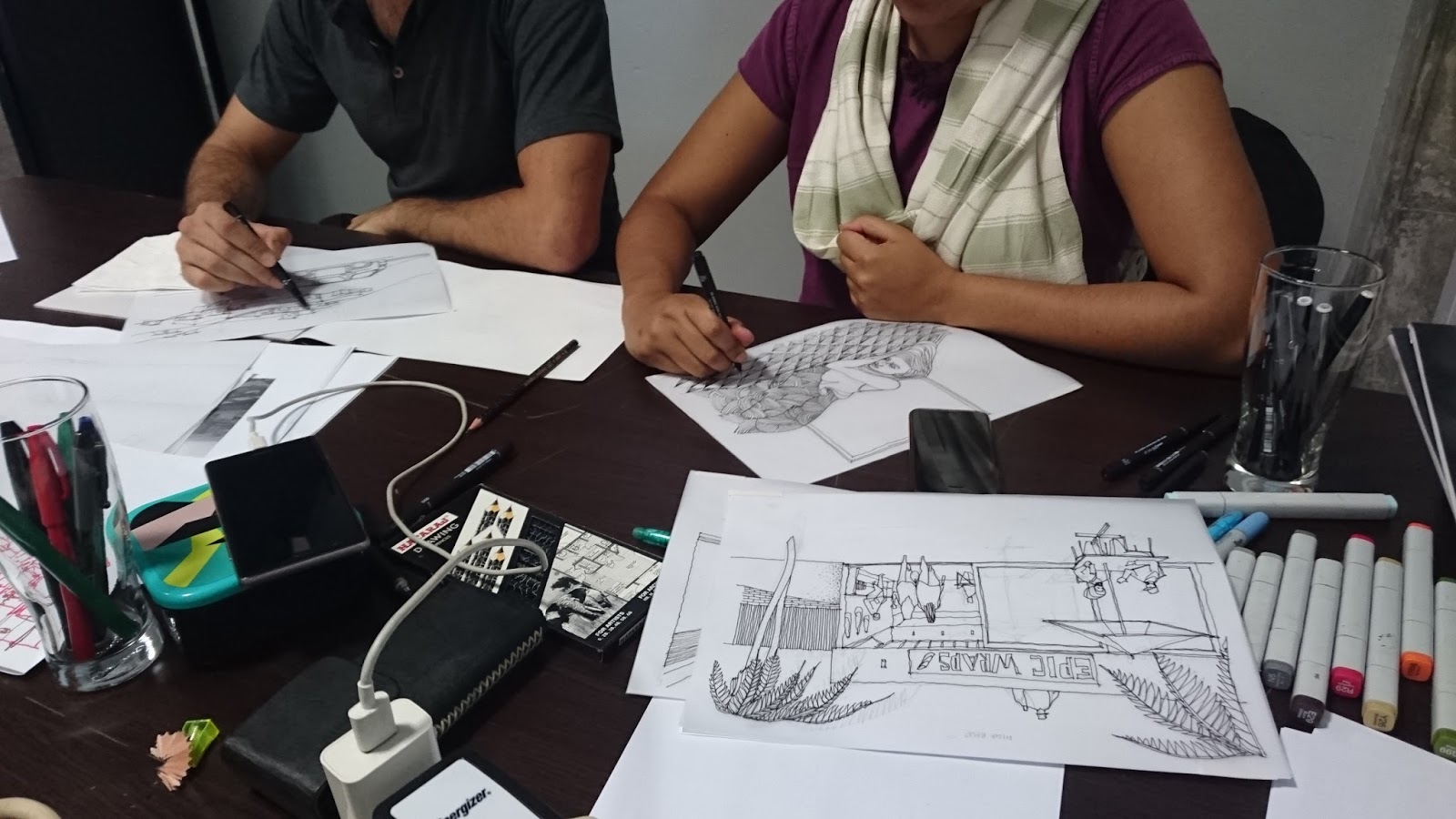
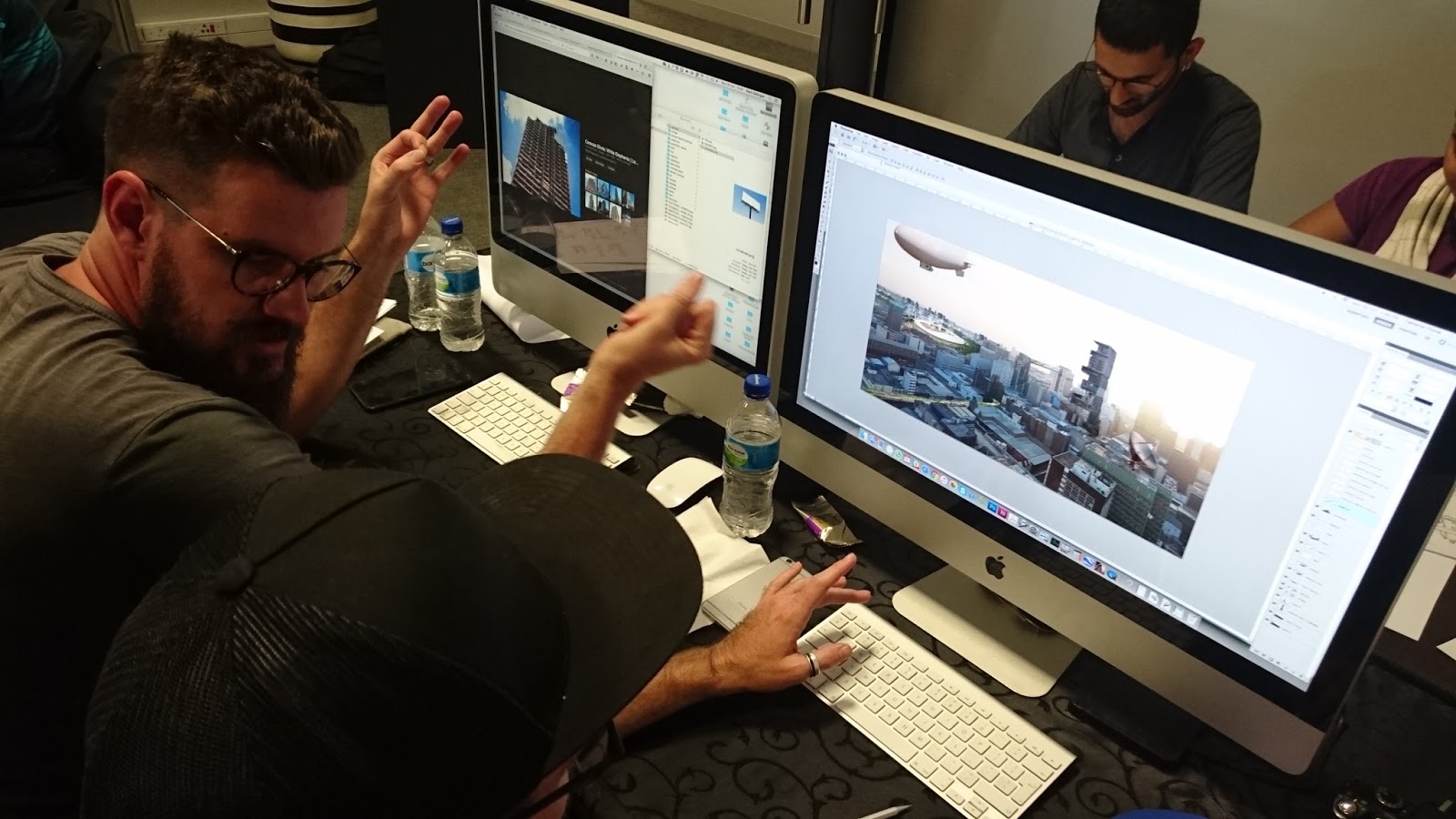
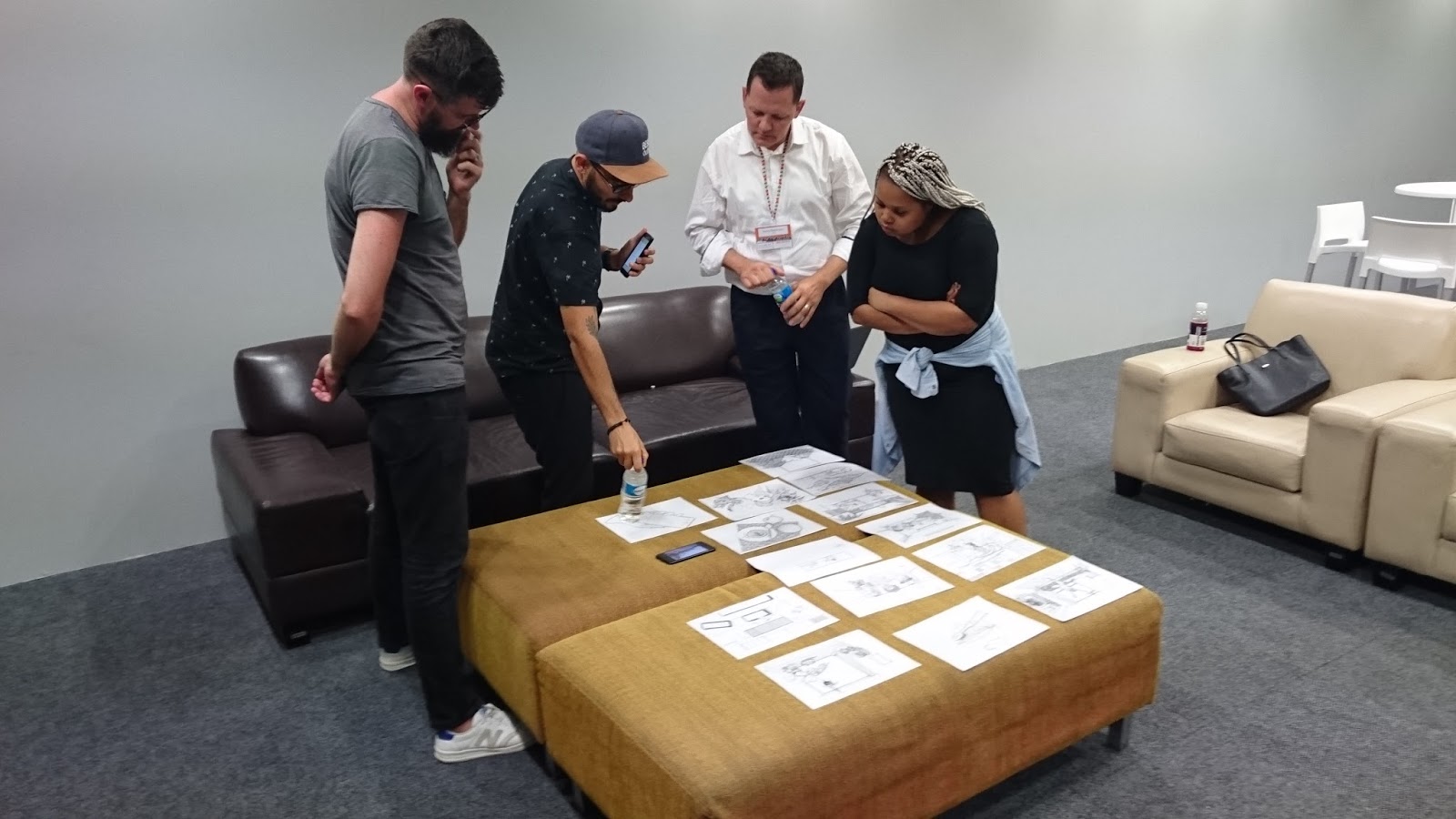
The idea behind the methodology being that a team of artists/visualisers would work through out the conference day to develop a series of visual imagery that would be created from the conference discussion and be used to fill in the dreaming of t his city dweller as she moved through her day.
This summary would then be converted into a short video story and narrated in the evening and made ready for presentation and discussion the next day.
The local artists made up of Durban’s Beset and Nikhil Tricam alongside Nindya Bucktowar performed amazingly with Marius Oosthuizen guiding the summary from the conference.
The video was completed under great stress, but on time and can be seen on Youtube here: