
This piece of work was a reflection of the challenges I faced in navigating the positional dynamics of working between different locations, considering my own demographic realities as a White South African. Through my research, I developed a proposed methodology of reflective animation, which was grounded in the theories of Jane Rendell’s Site Writing modality.
The publication process was an incredibly co-productive experience, and I was lucky to have the support of Meike Schalk, Torsten Lange, Elena Markus, Andreas Putz, and Tijana Stevanovic (eds.) throughout the process. The doctoral course “Approaching research practice in architecture” provided a wonderful environment for me to develop and refine my work, and I am grateful for their guidance and support.
Abstract:
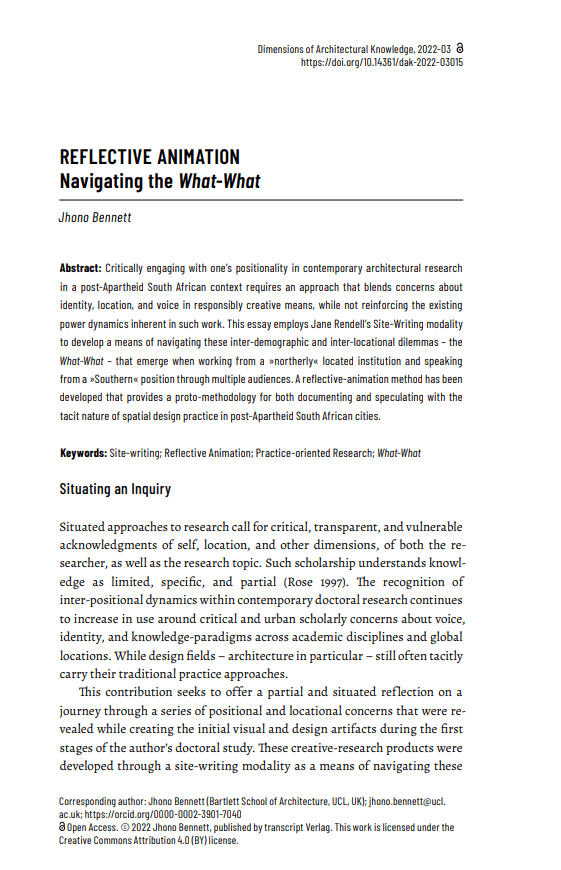
Critically engaging with one’s positionality in contemporary architectural research in a post-Apartheid South African context requires an approach that blends concerns about identity, location, and voice in responsibly creative means, while not reinforcing the existing power dynamics inherent in such work. This essay employs Jane Rendell’s Site-Writing modality to develop a means of navigating these inter-demographic and inter-locational dilemmas – the What-What – that emerge when working from a »northerly« located institution and speaking from a »Southern« position through multiple audiences. A reflective-animation method has been developed that provides a proto-methodology for both documenting and speculating with the tacit nature of spatial design practice in post-Apartheid South African cities.


The publication is available for free access (along with the full Journal) here:
»Dimensions. Journal of Architectural Knowledge« is an academic journal in, on, and from the discipline of architecture, addressing the creation, constitution, and transmission of architectural knowledge. It explores methods genuine to the discipline and architectural modes of interdisciplinary methodological adaptions. Processes, procedures, and results of knowledge creation and practice are esteemed coequally, with particular attention to the architectural design and epistemologies of aesthetic practice and research.
Issue 3, »Species of Theses an Other Pieces«, is concerned with the form of the doctoral thesis in practice-oriented research. In reference to George Perec’s »Species of Spaces and Other Pieces«, this issue takes the love for playing with forms, genres, and arrangements as its program.
 Jhono Bennett