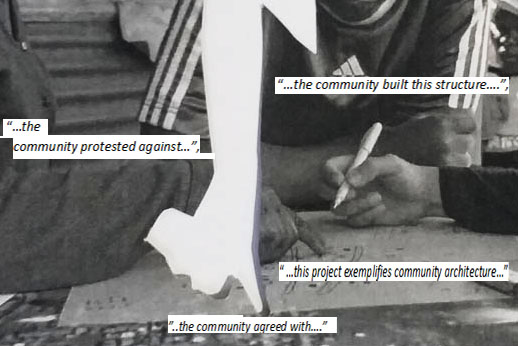
In the early stage of my doctoral research, I reflected on my practice work with 1to1 and developed my thoughts on the problematic operationalization of the term “community” in South Africa’s informal settlement upgrading.
This was an attempt at a form of satire with grounded reference, aiming at a practitioner/academic audience in my own sector.

The actionable questions from the process being:
- Can we adopt and normalise a more complex idea of ‘community’ being multiple communities and individuals who share space?
- When we say or think ‘community’, can we allow for people to question what we mean by that towards a better understanding of a context?
- Can we be more specific to describe what we mean: a neighborhood, a group of men/women/children, the church goers, the football players e.t.c – this will allow your designs more variables to draw from?
- Can we allow for dissent, non-agreement and conflict – these are as crucial for good participation that agreement, cohesion and consent are often based on reductive and simplistic ideas of people who are as a rule complex and nuanced and not perfect?
- How can we meaningfully recognise and value the project beneficiaries and adjacent grass-roots actors in projects in ways that support financially, experientially and creatively?
 Jhono Bennett